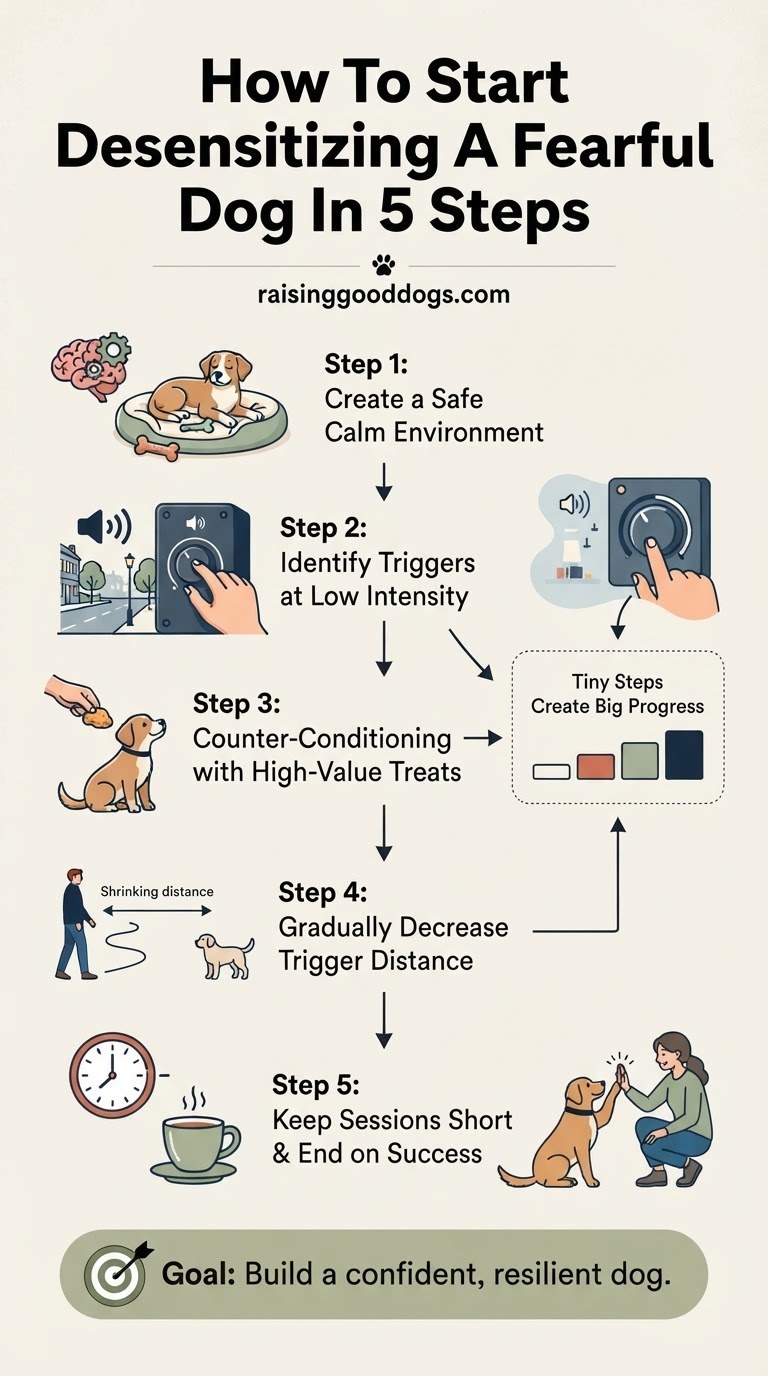
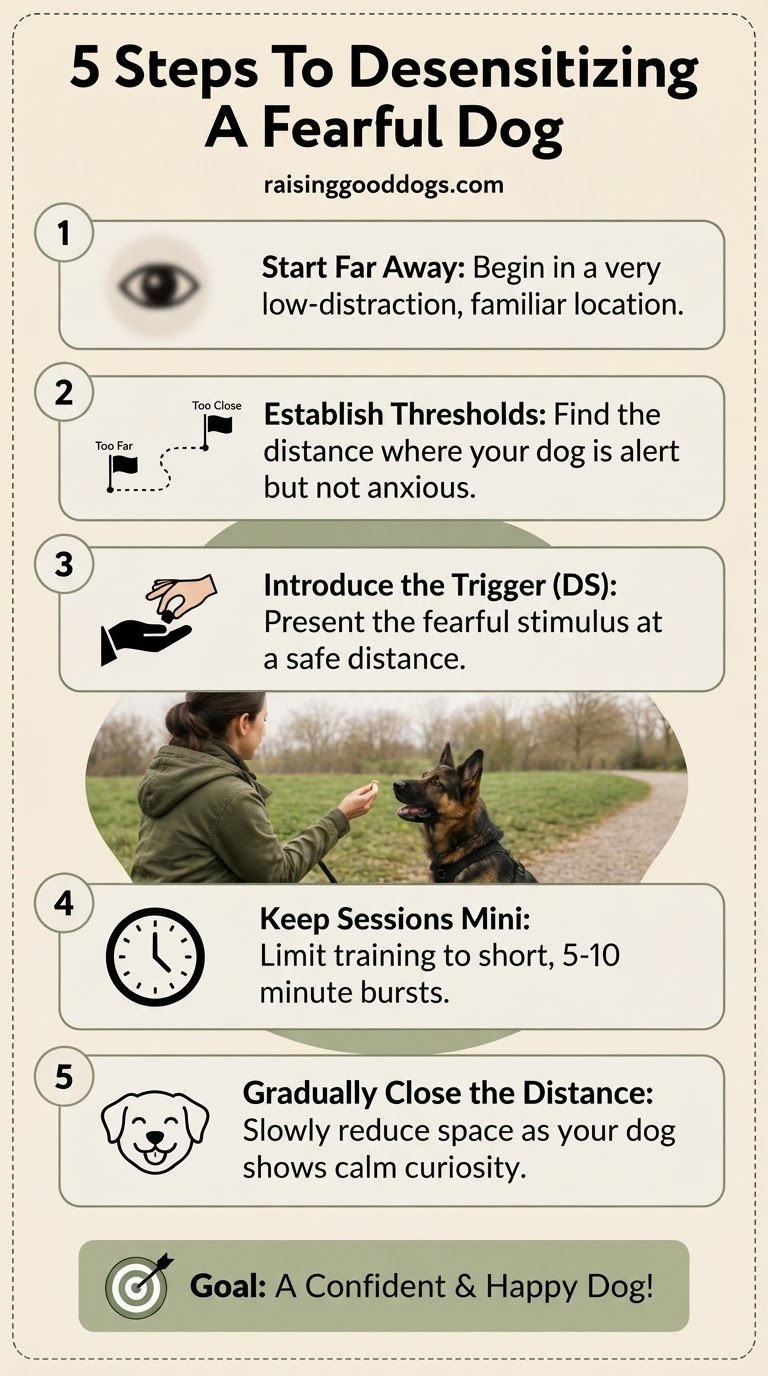
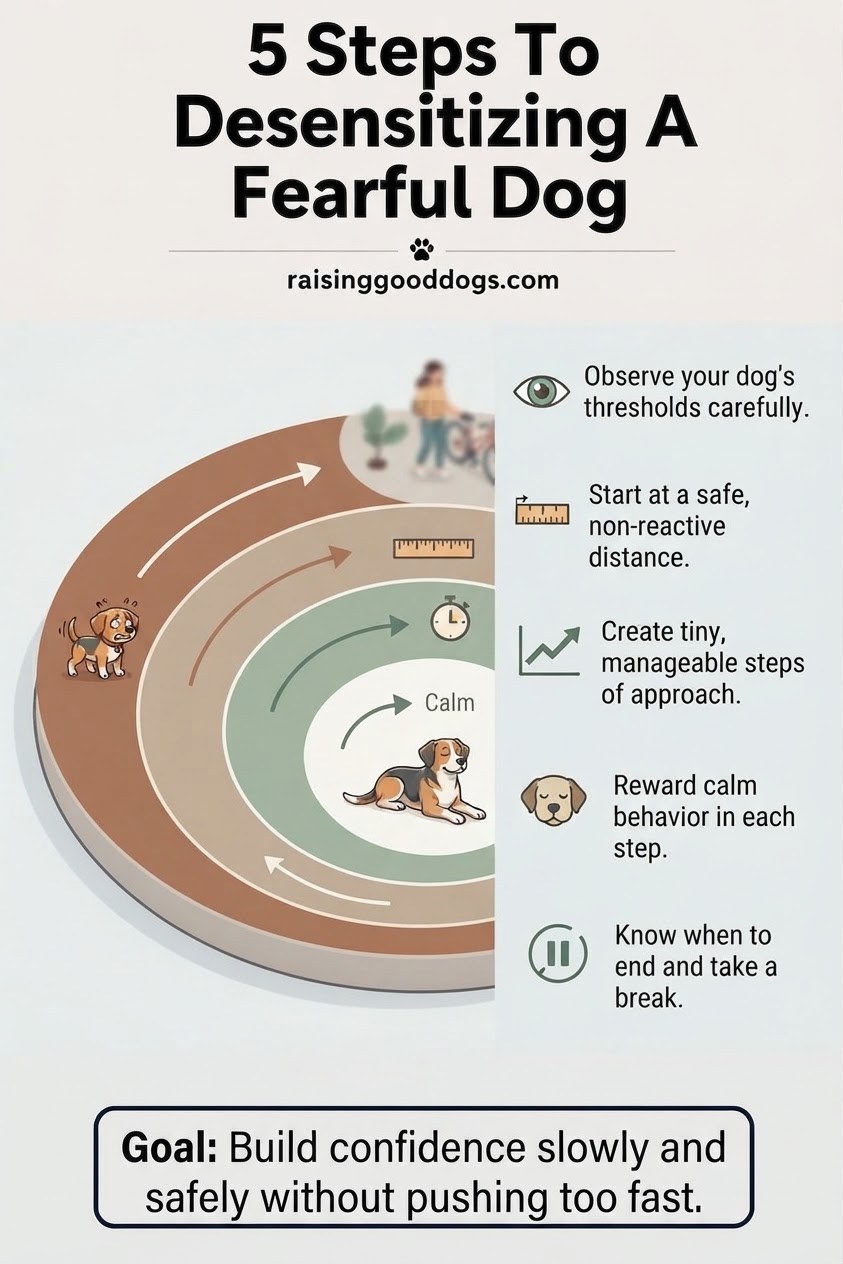
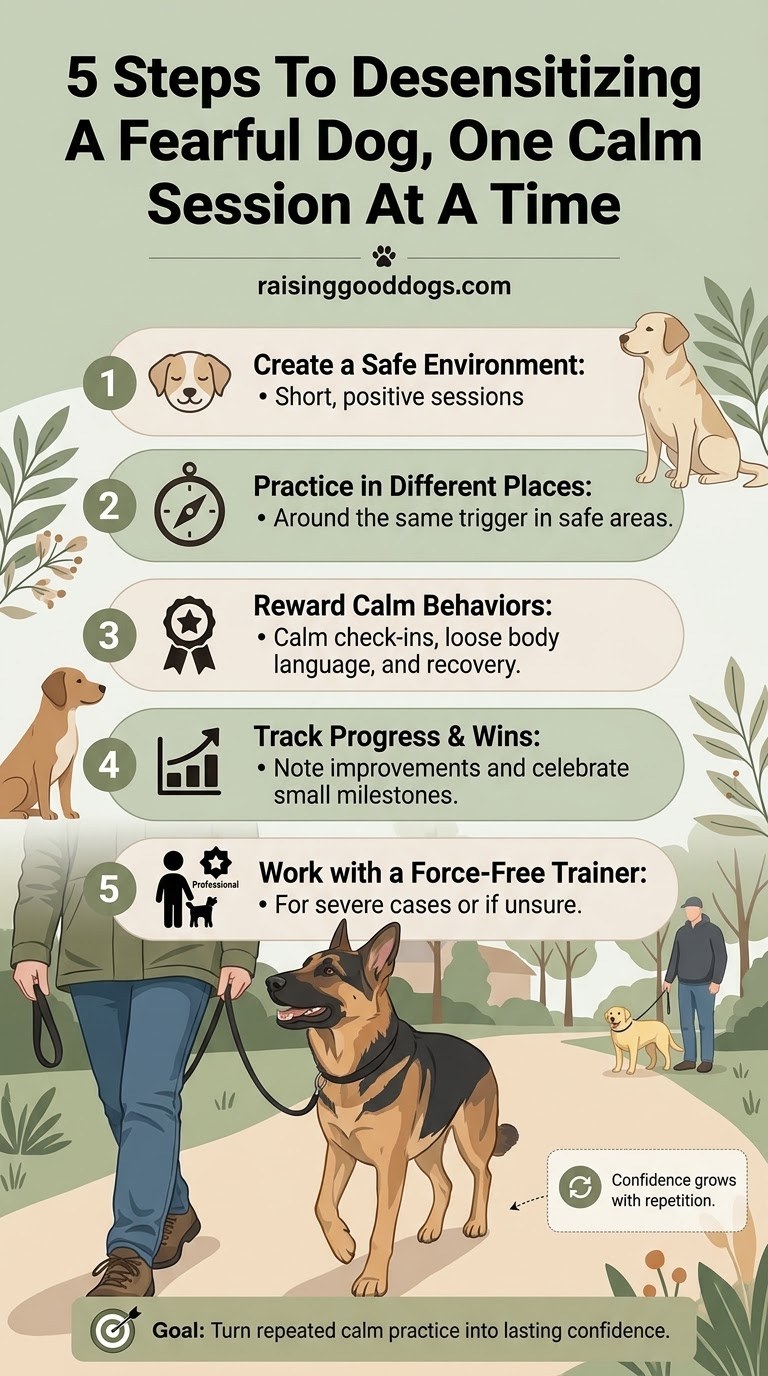
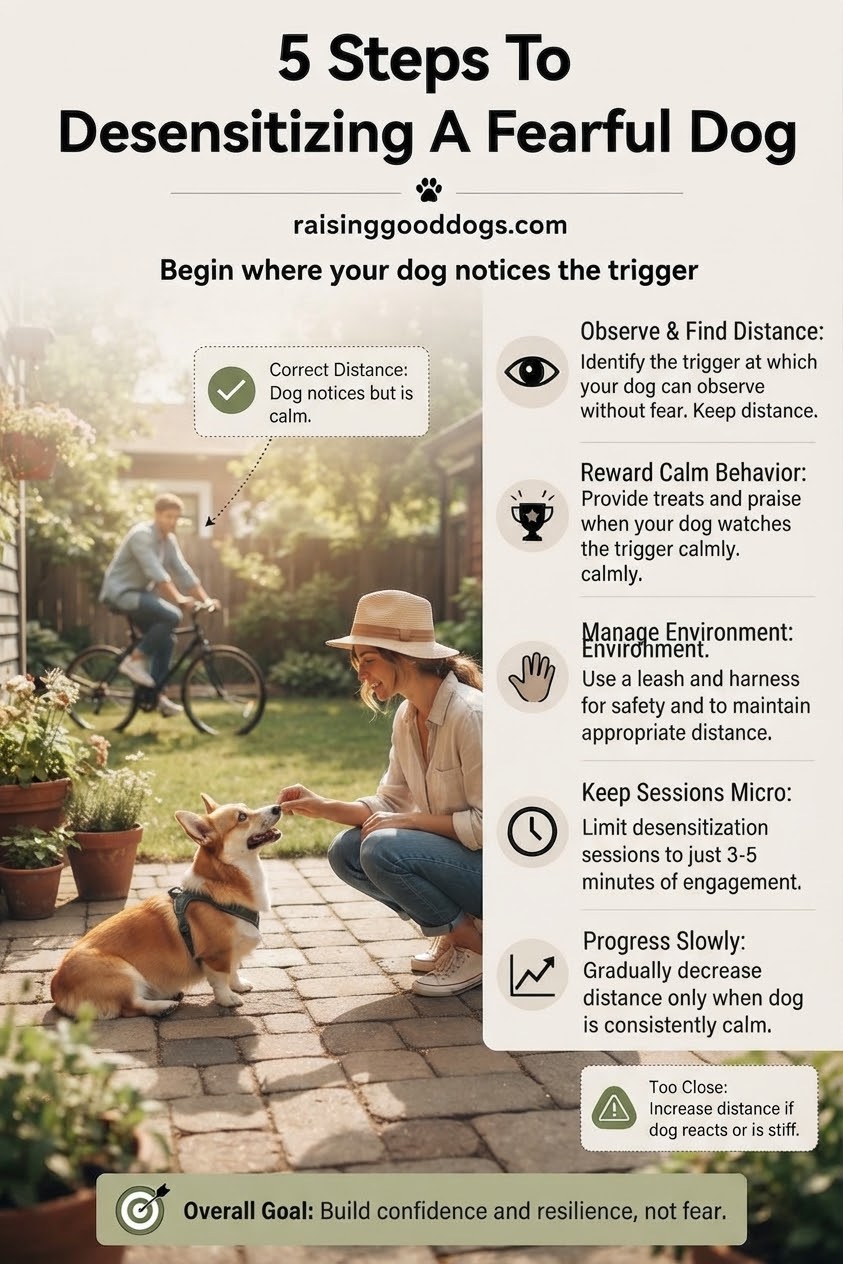
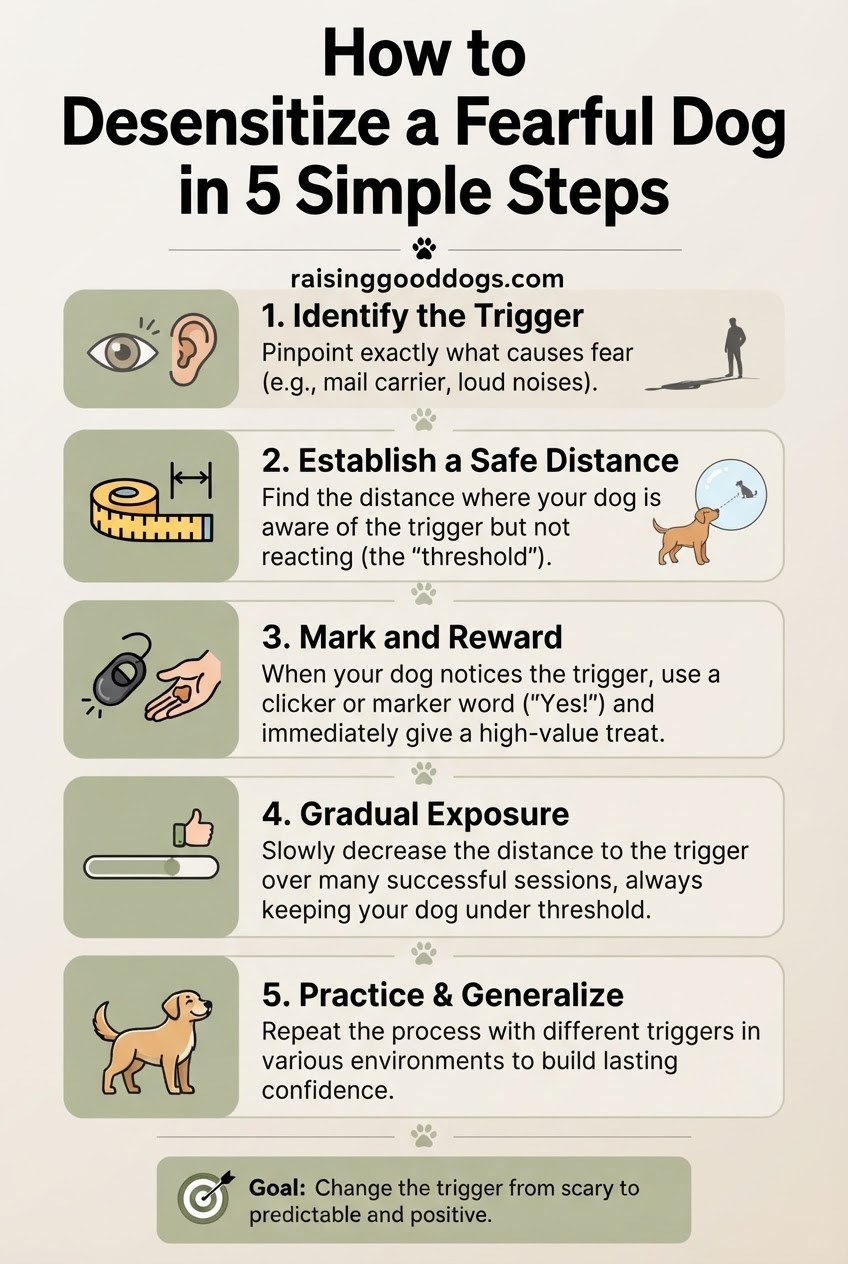
Every fearful dog I've worked with over fourteen years has had an owner who tried the same thing first: hoping enough repetition would wear the fear down on its own. It doesn't — repetition without a plan usually just teaches the dog that the scary thing keeps happening, which is the opposite lesson from the one we want. Desensitization is slow, structured, and boring in the best possible way, and it's the only approach I've seen actually hold up months later, including with my own dog. Here's the five-step version I hand to clients, adaptable to whatever is scary at your house — strangers, other dogs, the vacuum, thunder.
Step 1: Find the Trigger Before You Fix Anything
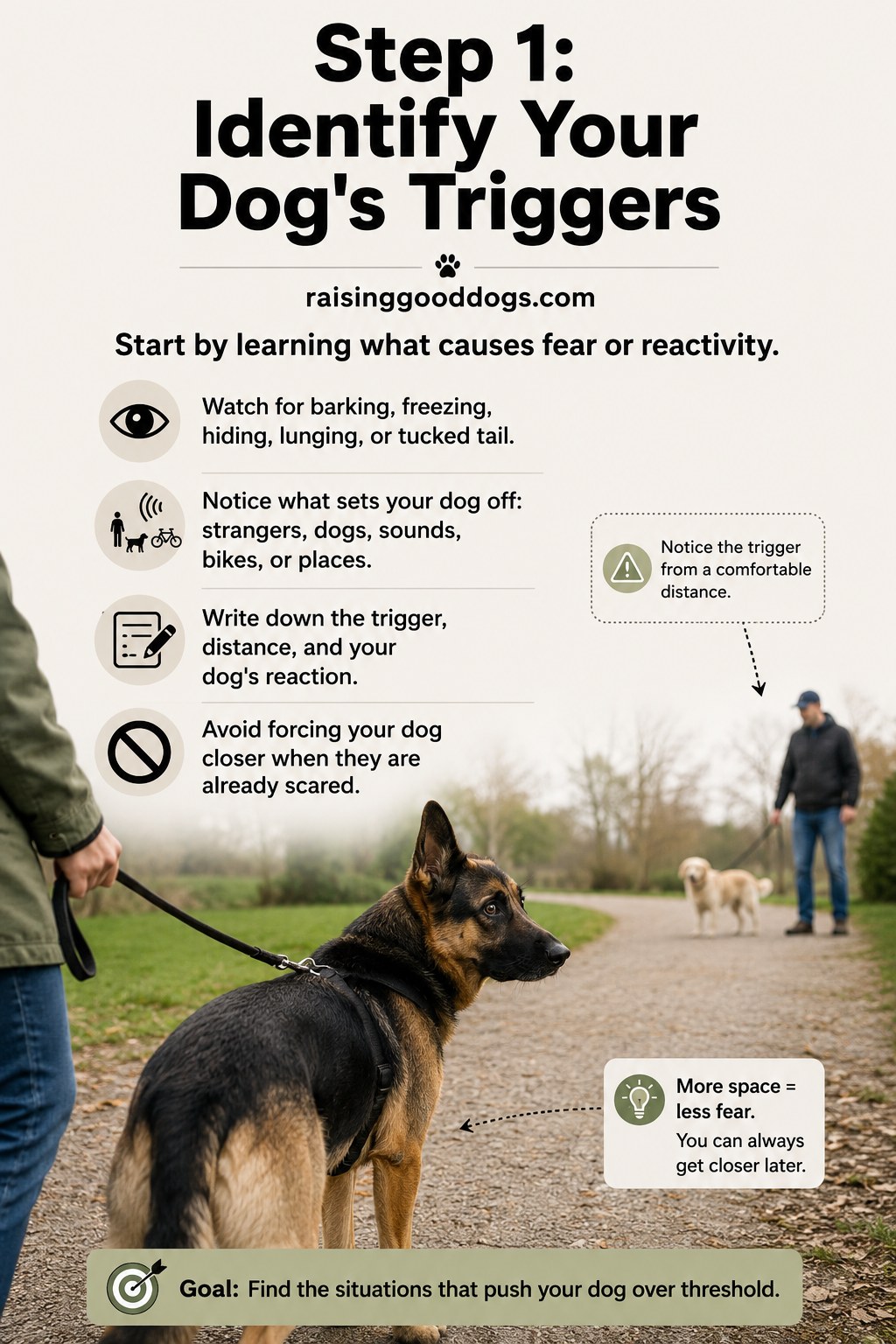
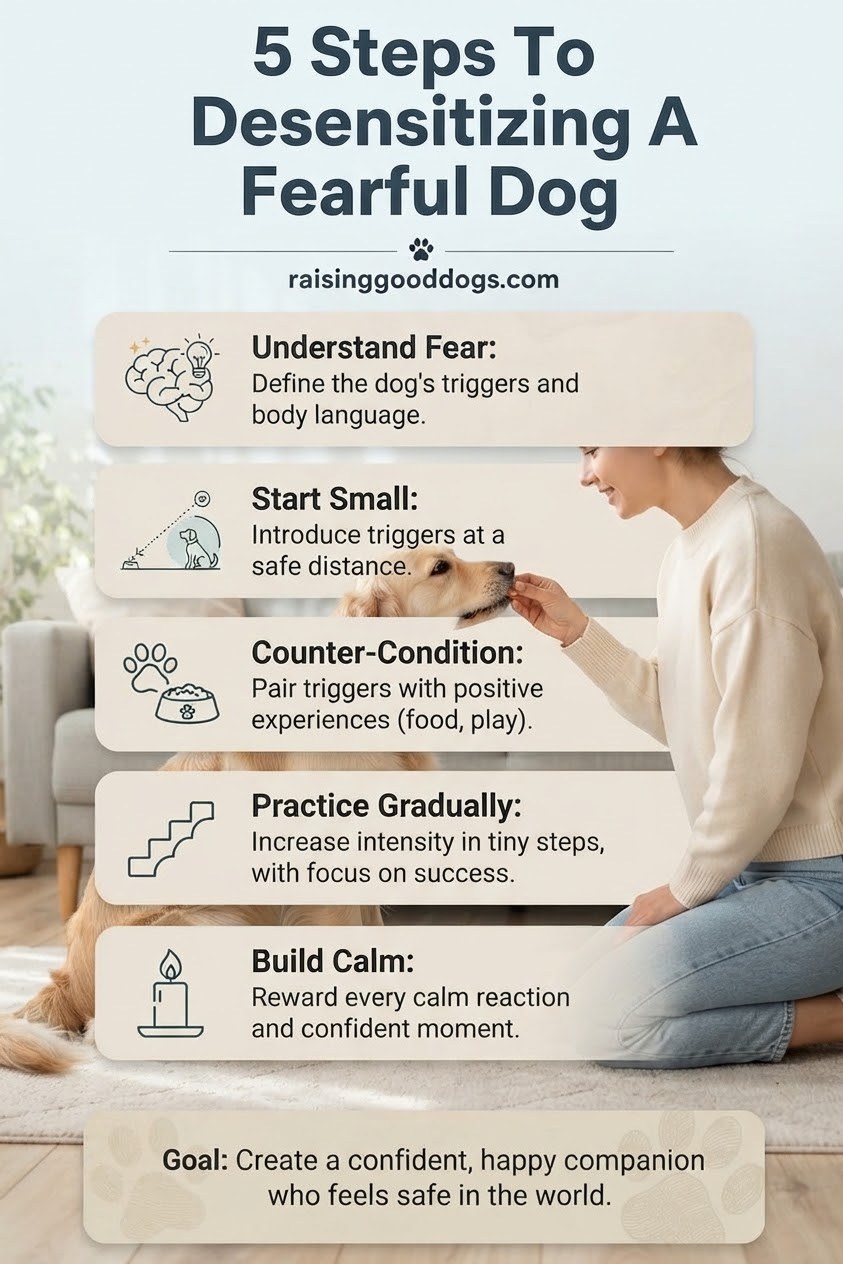
Before any training happens, I ask every client the same question: what exactly does your dog do, and at what distance? Not just 'he's scared of dogs' — I need the specific picture. Freezing at forty feet? Barking and lunging at fifteen? A tucked tail and a hard stare at the mailman from across the street? The fear response tells you where the threshold is, and the threshold is the entire plan.
Watch for the early signals, not just the big ones: a tucked tail, whale eye, a frozen body, weight shifting backward, refusing food that would normally vanish in half a second. Those show up well before the barking does, and they're the ten-second warning I learned to read from years of holding frightened dogs still on an exam table.
- Log it: trigger, distance, and reaction, for at least a week, before you touch a training plan.
- Resist closing the distance to 'get it over with' — that's flooding, not desensitizing, and it usually sets you back further than doing nothing.
- Management starts here: a different route, a wider berth, a car instead of a sidewalk, until you know the numbers.
The goal of week one isn't progress. It's information.
Step 2: Work Under Threshold, Not At the Edge of It
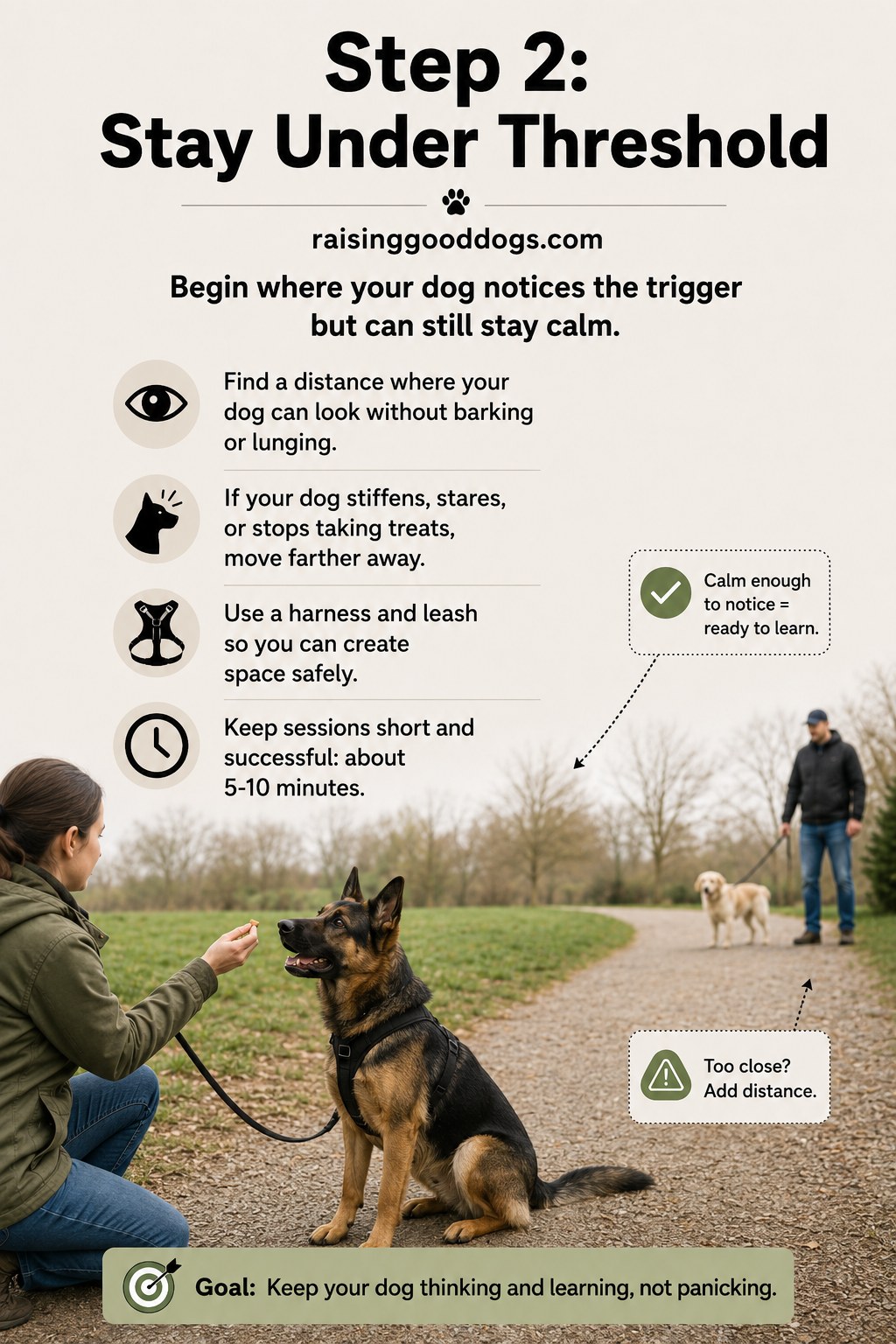
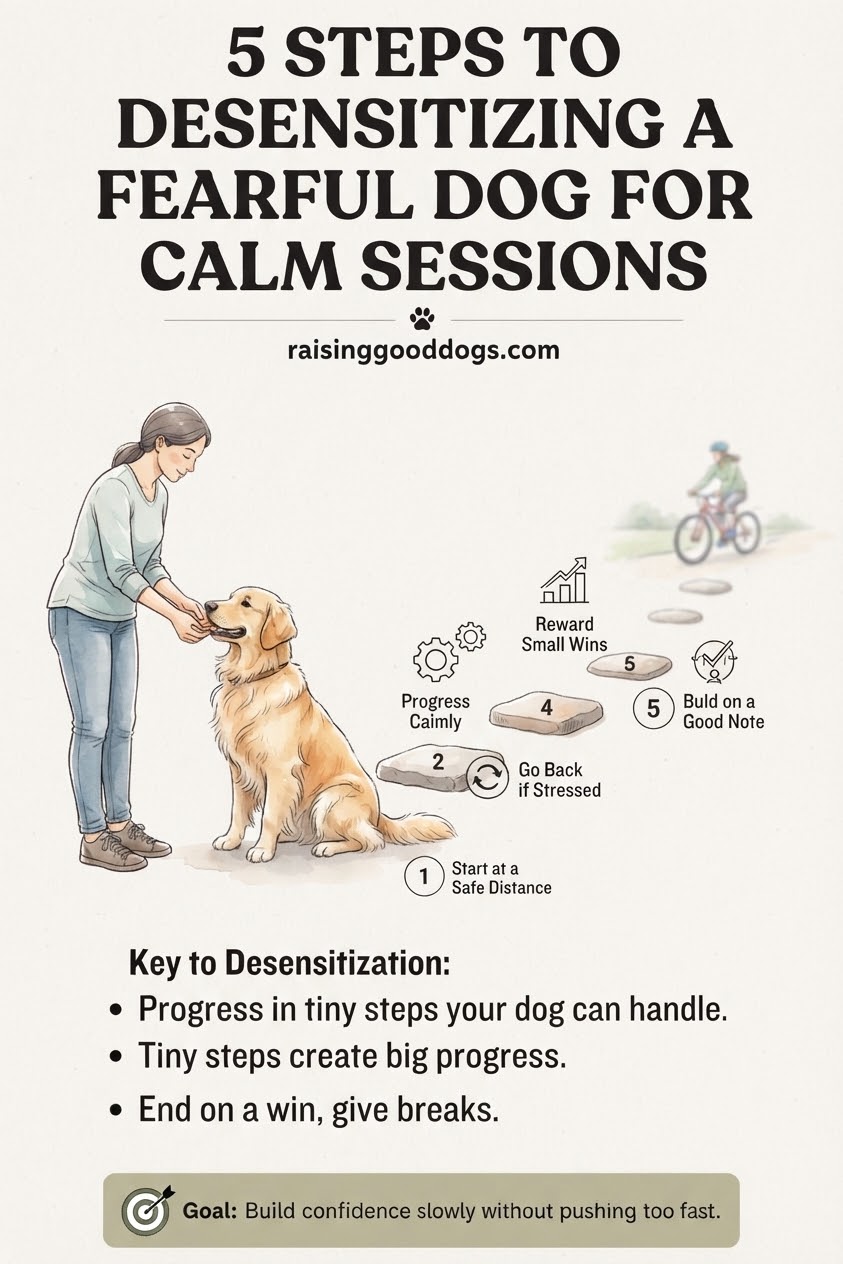
Under threshold just means this: your dog can see or hear the scary thing and still function — still take a treat, still look at you, still breathe normally. If your dog stiffens, stops eating, or starts staring, you're not under threshold anymore; you're just early into a reaction that hasn't finished yet.
This was the piece I got wrong with my own dog for most of a year — I kept thinking he needed to get used to it at a distance that was already too close, and all I was teaching him was that dogs equal panic, over and over, with better treats attached. Once I moved back to a distance that felt almost silly — across a parking lot, along the far treeline — he could finally learn something.
- Use a harness and leash that let you control distance quickly and without pressure on the neck.
- Keep sessions short — five to ten minutes, ending well before fatigue or frustration creeps in.
- When in doubt, add distance. You can always close the gap later; you can't un-teach a panic rep.
Step 3: Pair the Trigger With Something Genuinely Good
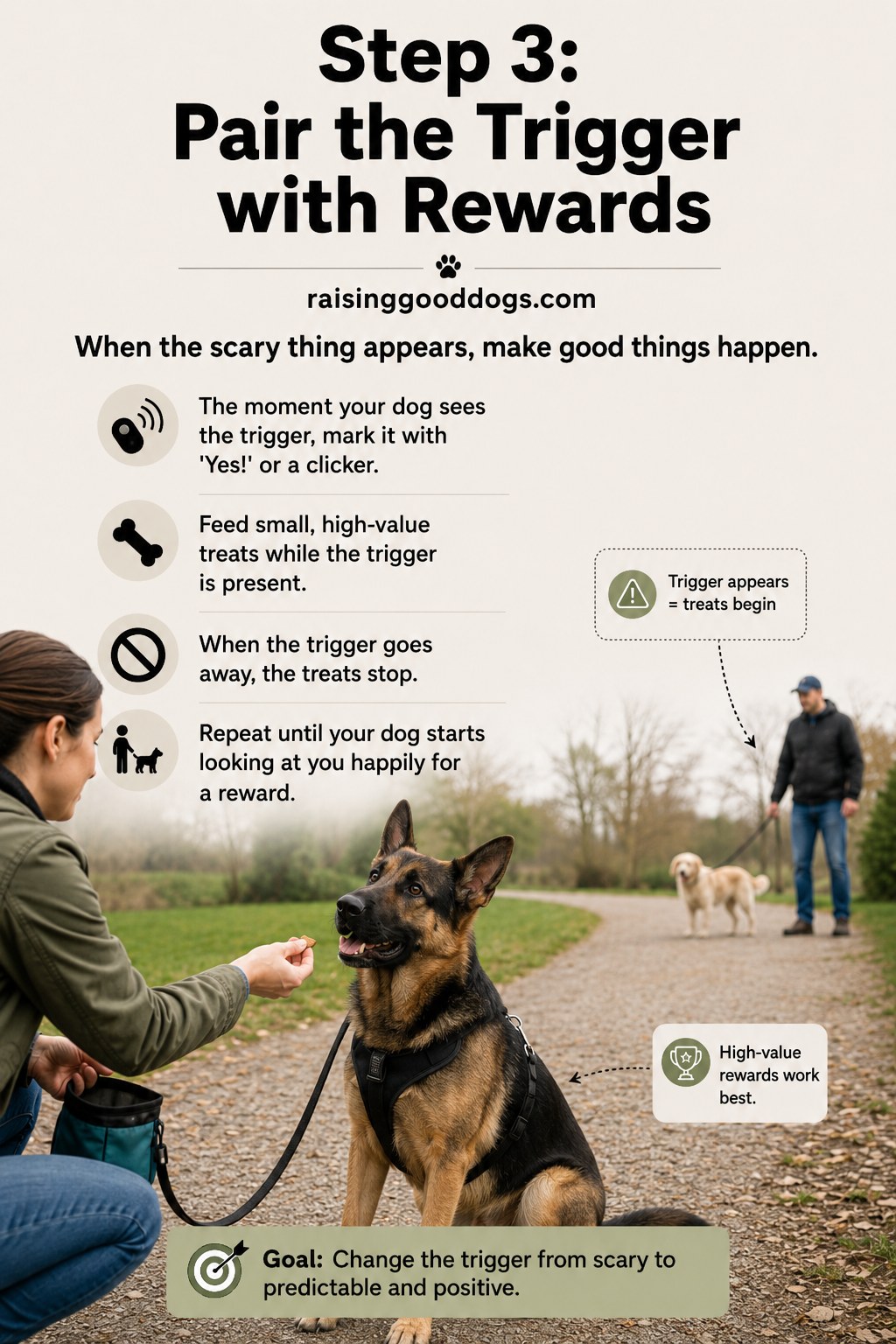
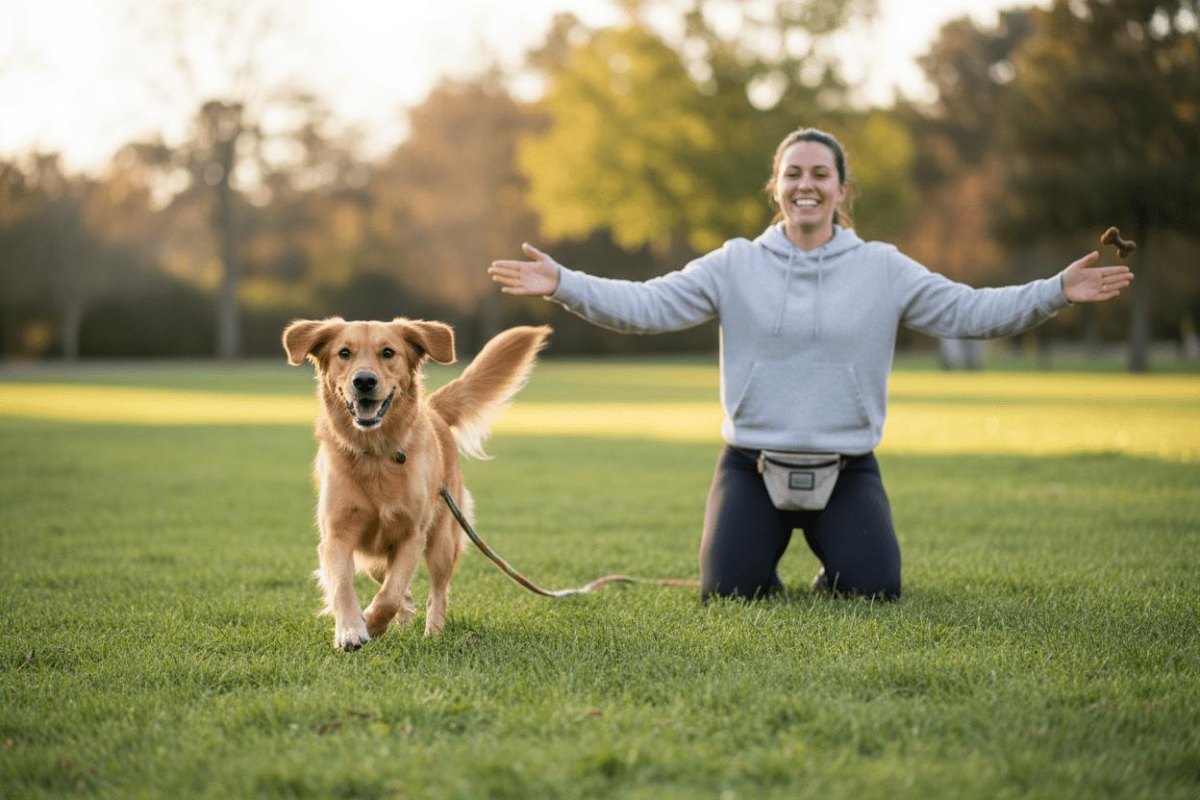
Once you know your dog's threshold, this is the actual desensitization step, and it's simpler than people expect: the instant the trigger appears, good things start happening — small, high-value treats, one after another, no cue required, no 'sit' demanded. The moment the trigger disappears, the treats stop. You're not rewarding calm behaviour so much as building a direct, automatic association: trigger appears, food appears.
Use something your dog would genuinely work for, not the kibble that's always sitting in the bowl. Diced chicken, cheese, the stuff you'd feel slightly guilty about. This is not the moment to economize.
- Mark it fast: a clicker or a cheerful 'yes' the second the trigger appears, treats following immediately.
- Watch for the shift: a dog who starts looking at you, happily, the moment the trigger shows up is telling you it's working.
- Repeat at the same distance until that happy look is reliable before moving an inch closer.
You're not asking your dog to be brave. You're changing what the scary thing predicts.
Step 4: Shrink the Distance in Pieces So Small They're Boring
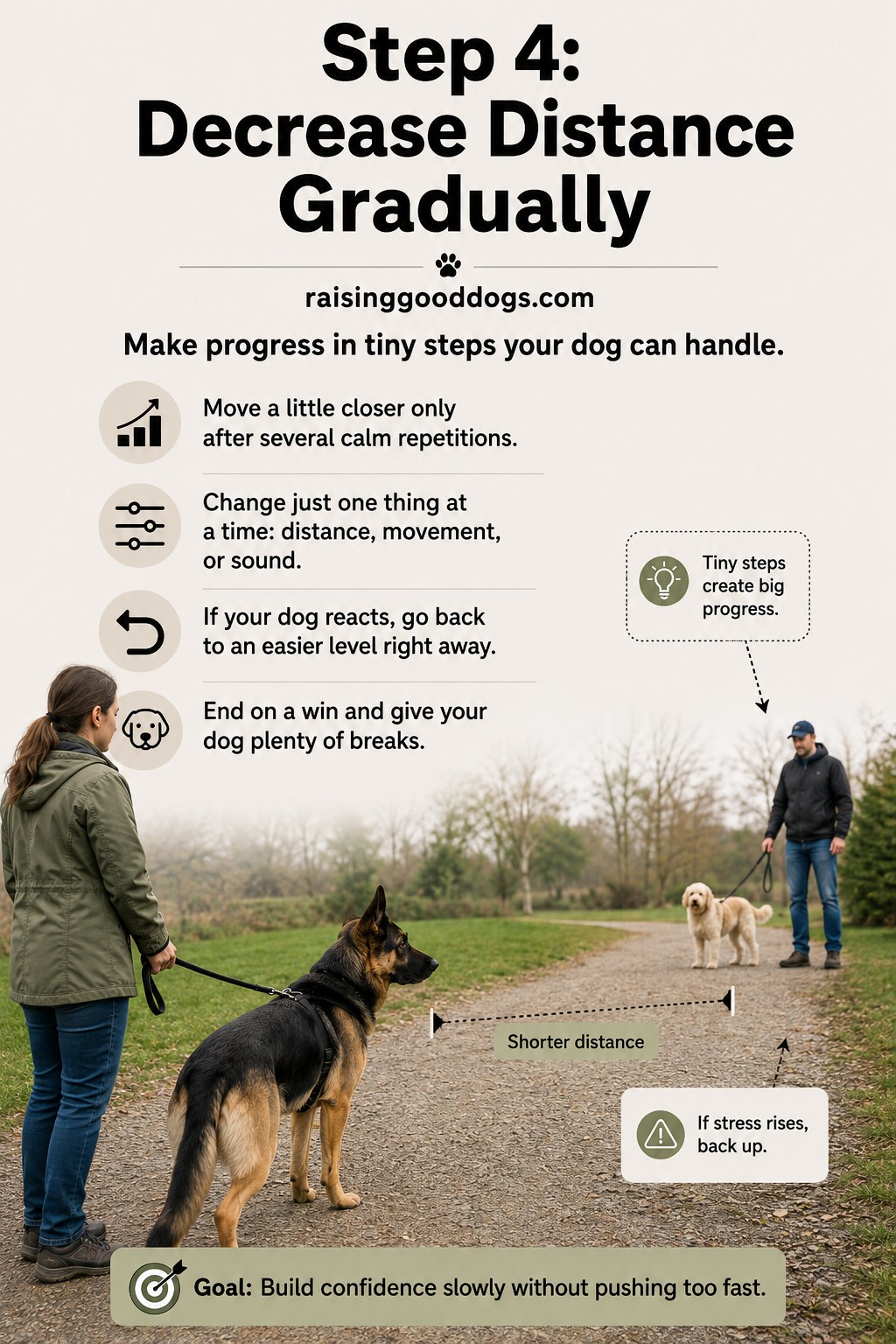
This is where plans fall apart, because progress here should feel almost embarrassingly slow. Move a few feet closer only after several calm, happy repetitions at the current distance — not after one good session, several. Change one variable at a time: distance, or movement, or noise, never all three together, because a dog who's fine with a stationary stranger at thirty feet may fall apart the second that stranger starts walking.
If your dog reacts, that's not a failure of the plan, it's information — you moved faster than this particular dog on this particular day could handle. Go back to the last distance that worked, collect a few easy wins, and stop there for the session.
- One variable at a time: distance first, then movement, then novelty — never stack them.
- End on a win, always, even if that means the session is shorter than planned.
- Expect plateaus: weeks where nothing seems to move. That's normal, not progress reversing.
Step 5: Practice Until Calm Is the Default, Not the Exception
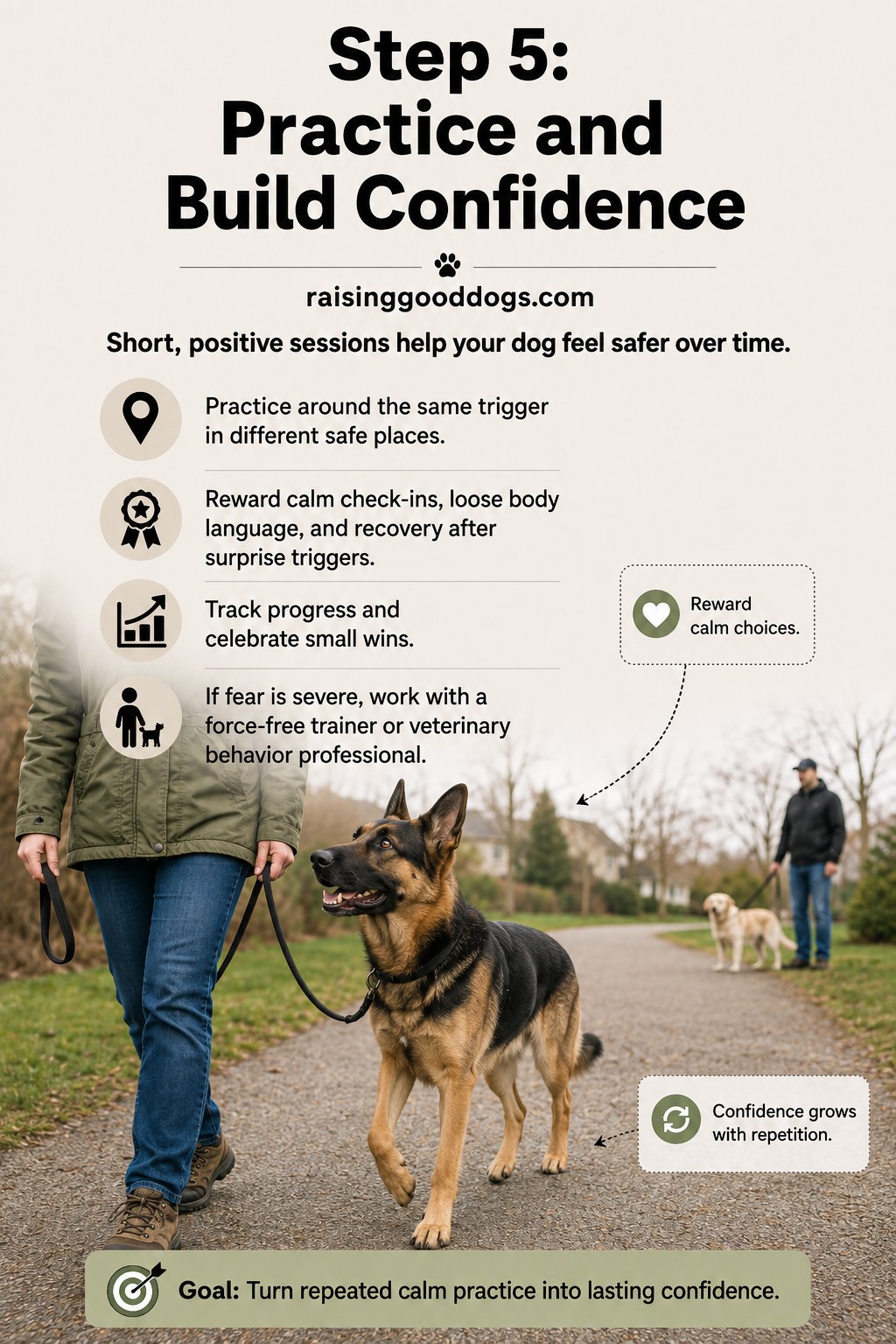
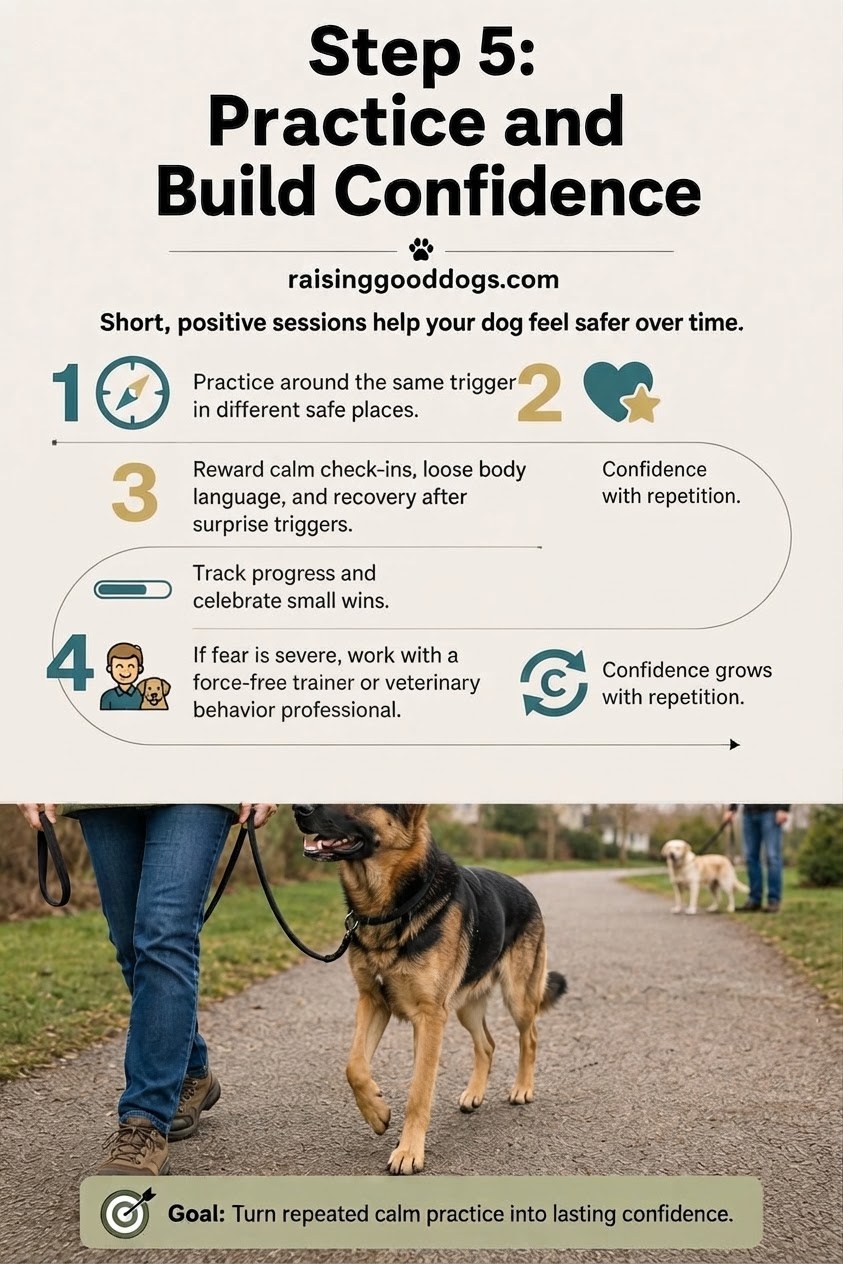
Confidence doesn't arrive in one dramatic session — it arrives from dozens of small, boring, successful ones, in enough different places that your dog generalises the lesson instead of learning only that one field behind your house is safe. Once the first location is solid, practice the same scenario somewhere new, and reward the things you actually want to see more of: a loose body, a calm check-in with you, a fast recovery after something startles your dog that you didn't plan for.
Realistically, this takes months, not weeks — I tell clients to expect real, noticeable change somewhere around eight to twelve weeks of consistent short sessions, with setbacks along the way that don't mean you're back at zero. If the fear is severe — shutting down completely, or escalating to snapping or biting — that's not a blog-post project anymore. That calls for a certified force-free trainer working with you in person, and a conversation with your vet about whether a veterinary behaviourist should be involved, especially if the fear appeared suddenly, which can sometimes point to pain or a medical cause rather than a purely behavioural one.
None of this is glamorous work — it's five feet of distance, a pocket full of chicken, and a lot of sessions that look like nothing is happening. But it's the version that actually holds up months later, which is more than I can say for the shortcuts.





Your Questions, Answered
How long does desensitizing a fearful dog actually take?
It varies by dog, but I tell clients to expect roughly eight to twelve weeks of consistent short sessions before change feels real and noticeable, sometimes longer for more severe fears. Setbacks along the way are normal, not a sign the plan failed.
What if my dog won't take treats during a session?
A dog who refuses food they'd normally take instantly is telling you they're over threshold. Add distance immediately rather than pushing through — that refusal is one of the clearest stress signals there is.
Can a shock or vibration collar speed this up?
No, and I don't recommend or use them. Fear responds to safety and predictability, not startle or pain, and aversive tools tend to suppress the visible signals of fear without resolving it, which often makes things worse later.
My dog's fear appeared suddenly out of nowhere — where do I start?
Start with your vet, not a training plan. Sudden fear or behaviour change can point to pain or an underlying medical issue, and that needs ruling out before any desensitization work begins.