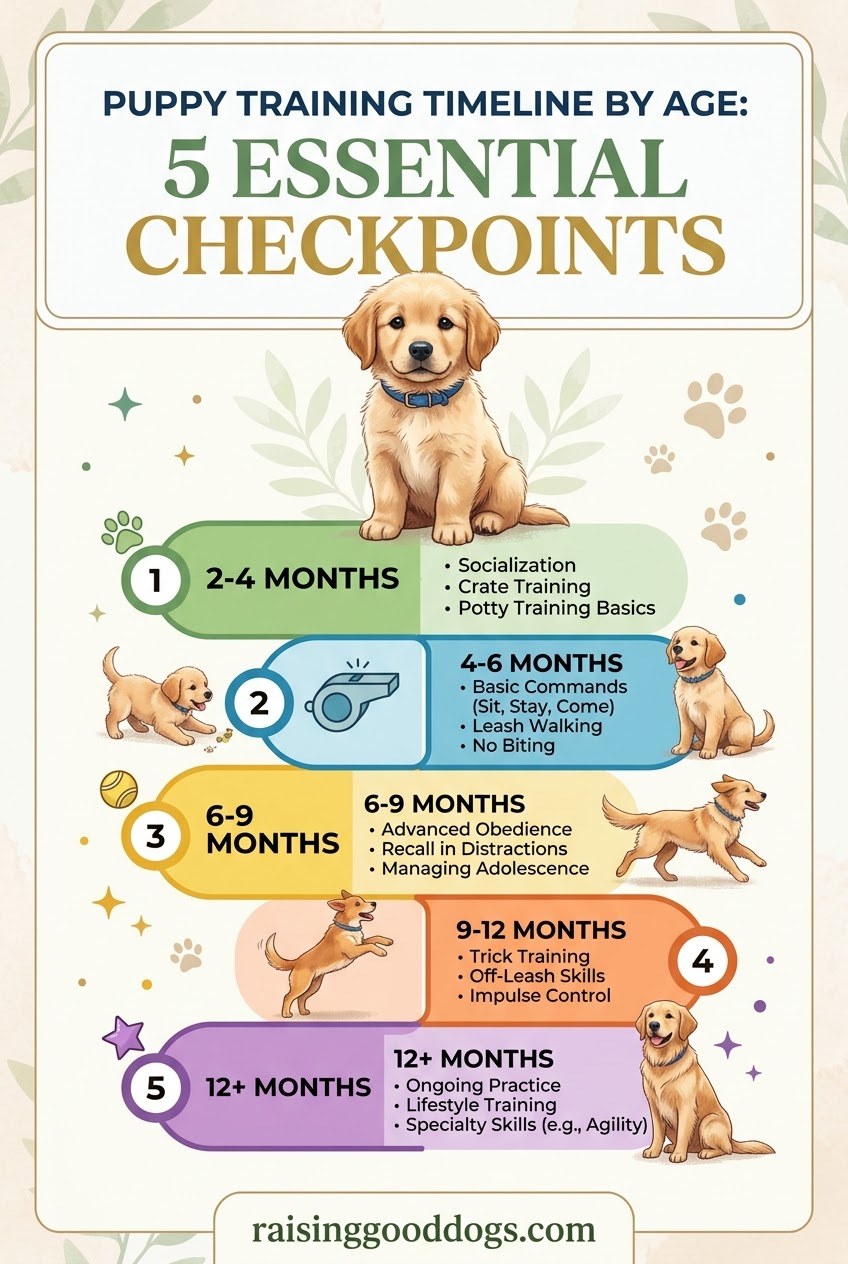
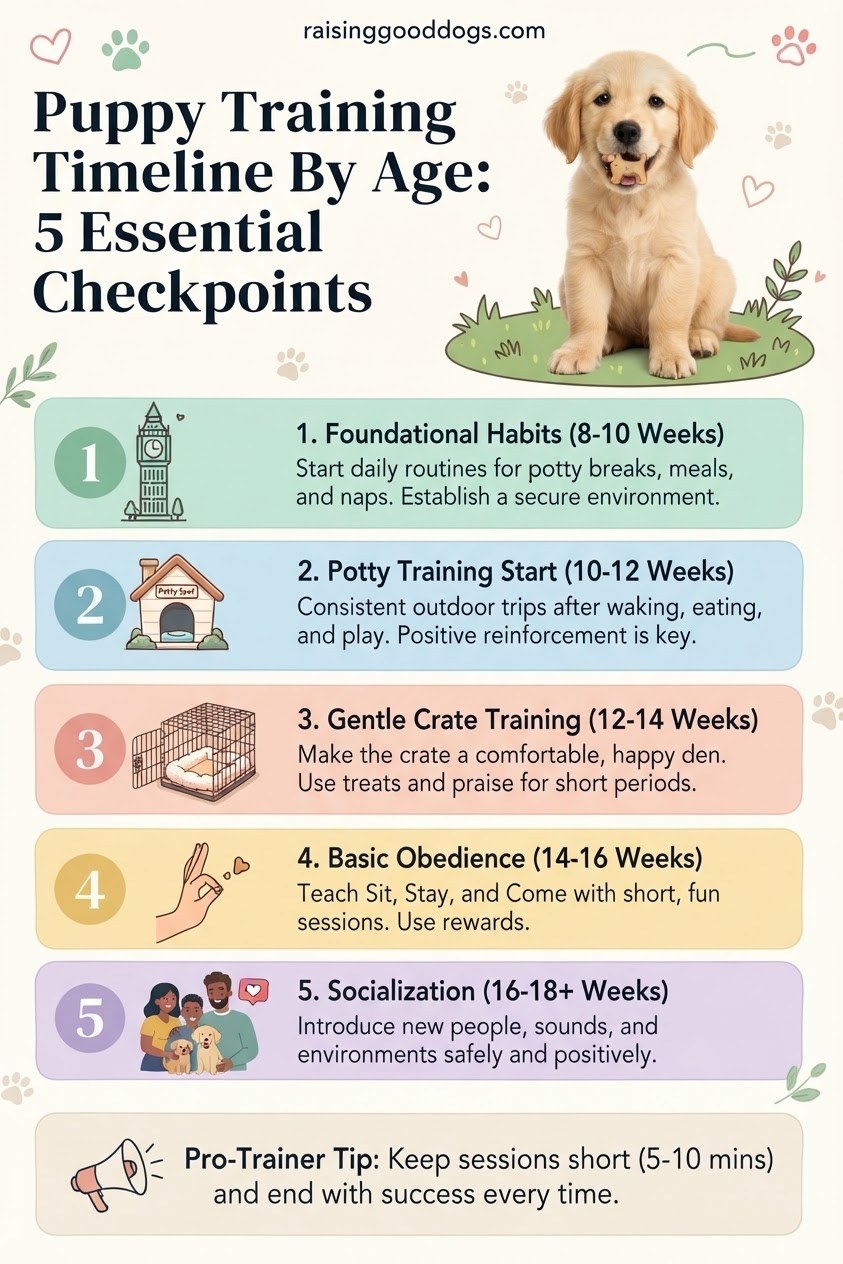
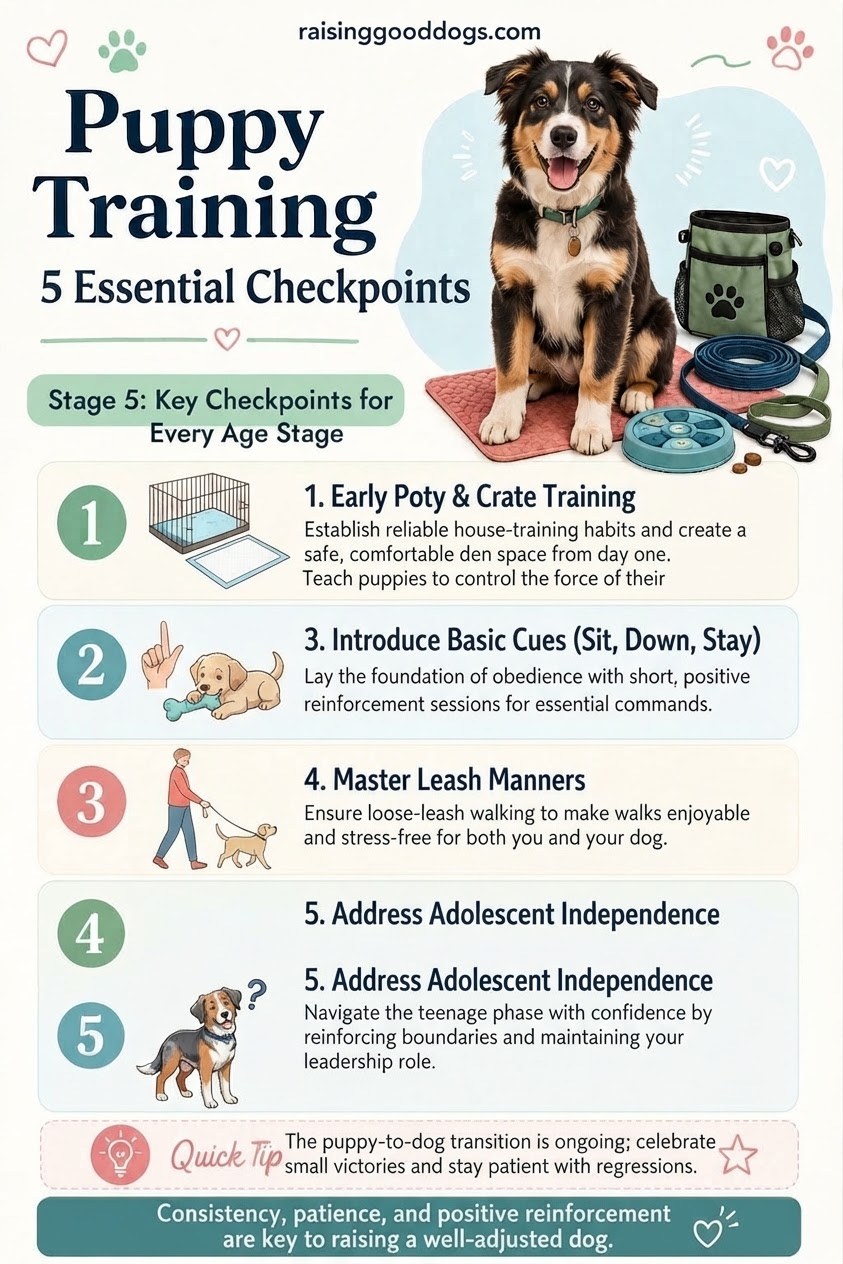
The chart on the fridge always makes puppyhood look like a tidy staircase, one birthday to the next. Real puppies don't climb it in order — a nine-week-old panics at the vacuum the same week a five-month-old finally holds a stay. I've run enough of these timelines with client dogs, and lived through Bruno's chaotic first year, to know the ages matter less than what you're building at each one. Here are five checkpoints worth aiming for, in the order that actually earns a dog's trust rather than the order a calendar suggests.
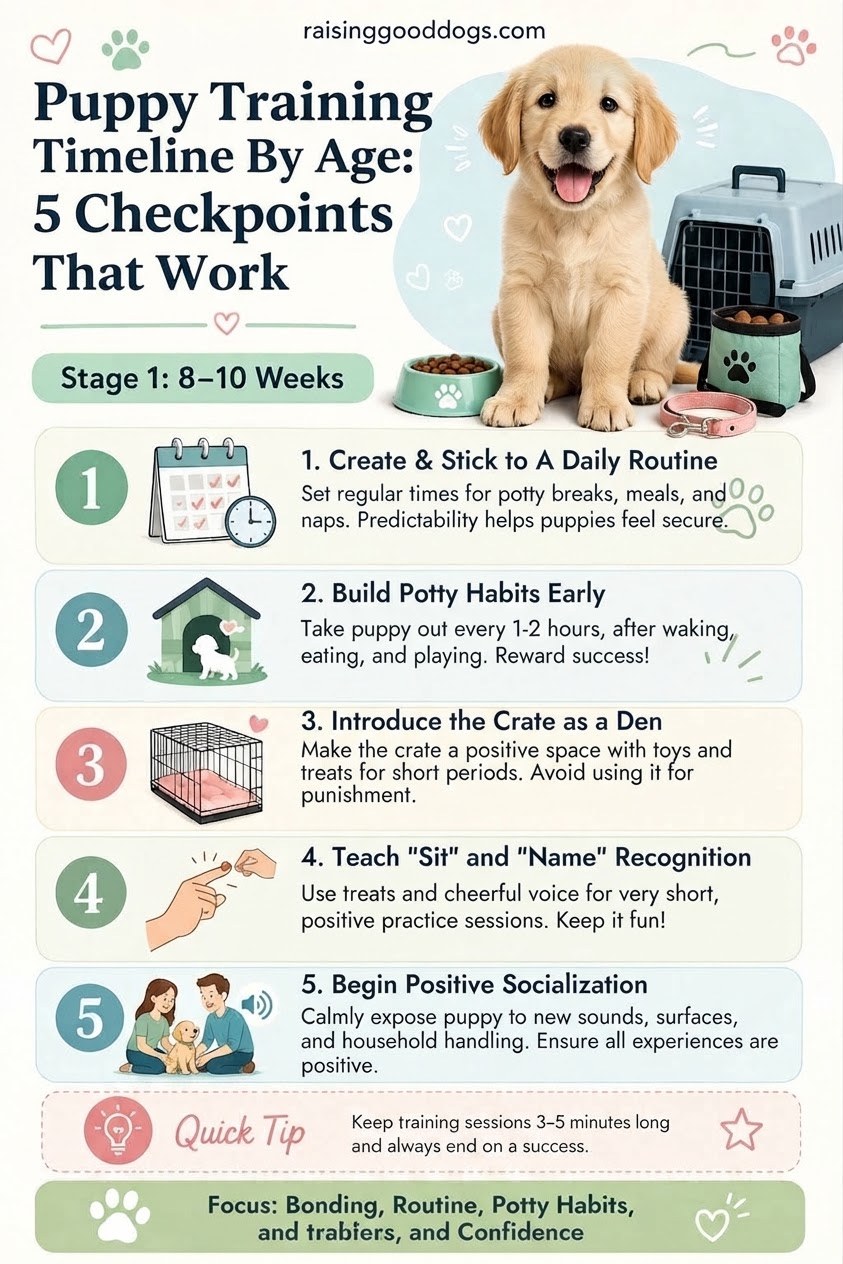
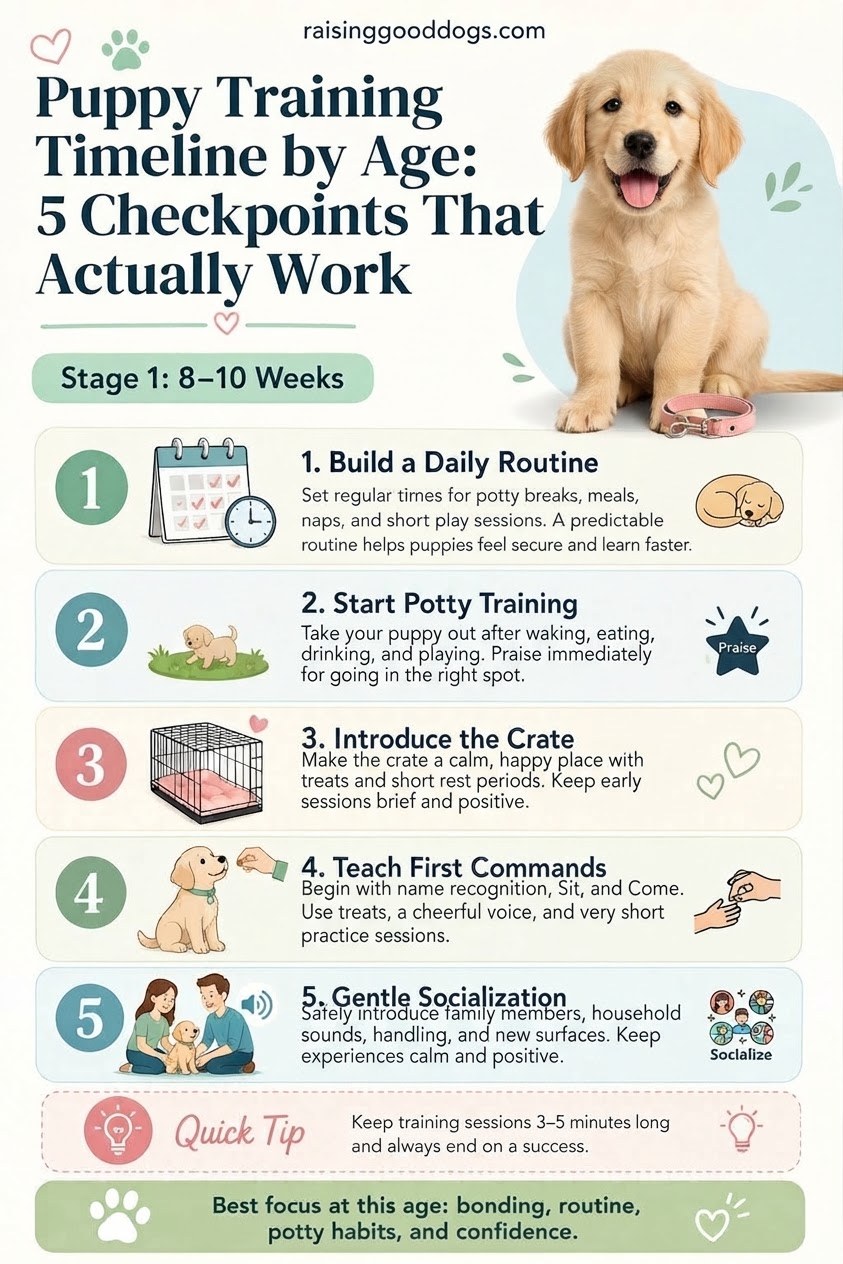
Eight to Ten Weeks: The Routine Is the Training
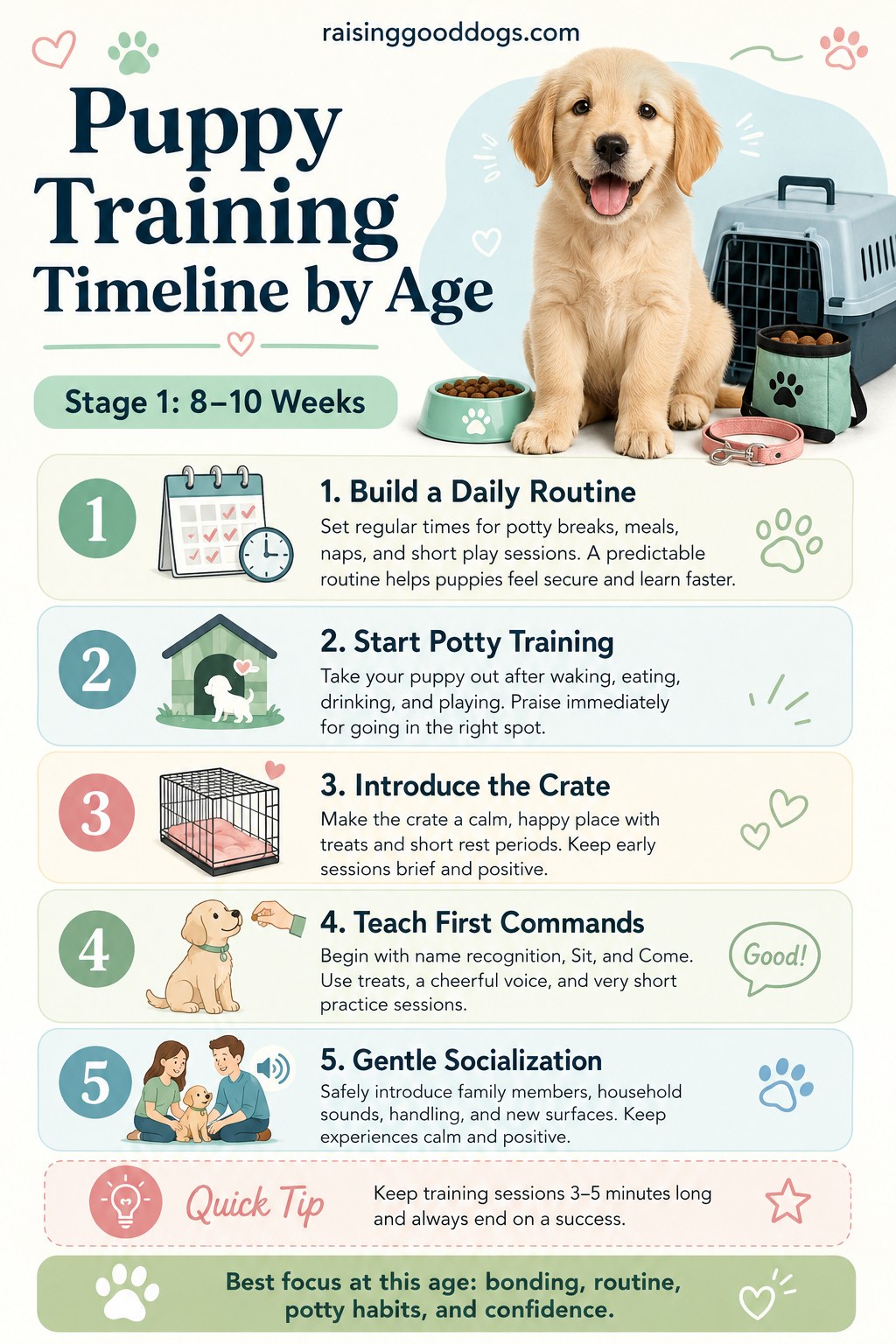
At this age, the schedule is the curriculum. Nothing you teach in a five-minute session matters as much as whether meals, naps, potty breaks and play happen at roughly the same times every day. A predictable rhythm is management in disguise — it prevents the accidents and meltdowns you'd otherwise be 'training' your way out of later.
- Potty training starts the moment the puppy wakes, drinks or plays — take them out, and praise the second they go, not thirty seconds later.
- The crate gets introduced as a good place with meals and rest, never a timeout. If the puppy is shrieking, that's information, not defiance — shorten the sessions.
- First commands are name recognition, sit, and come, taught in sessions so short you'll wonder if you did anything at all.
Watch for a tucked tail or a frozen body during handling — a puppy this age can't tell you they're overwhelmed any other way, and pushing through it teaches the wrong lesson. Gentle, calm, short. That's the whole job right now.
Three to Four Months: Structured Play and the Start of Self-Control
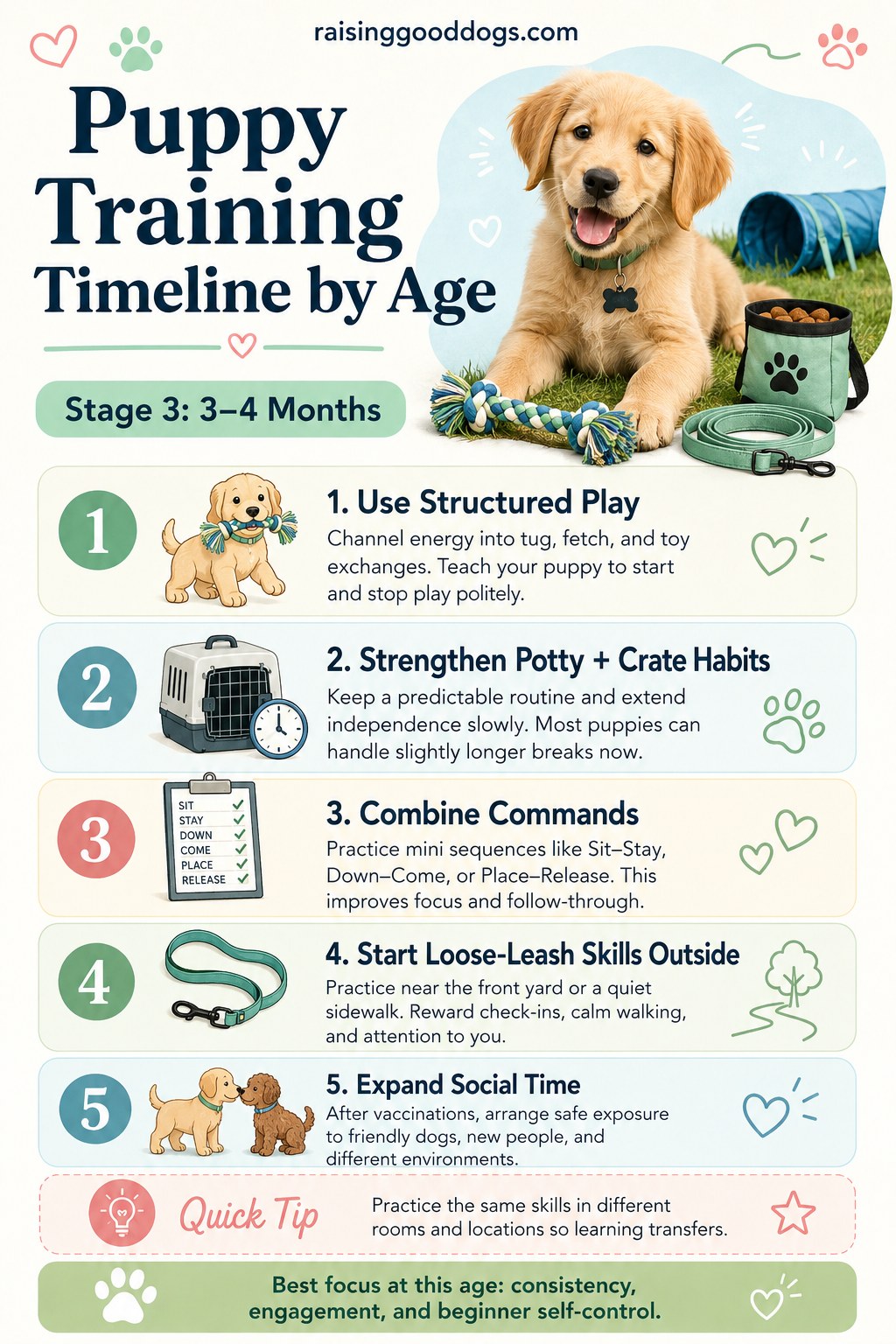
This is where I see owners either build a great foundation or accidentally teach a puppy that mouths and grabs win the game. Structured play — tug and fetch with a clear start and a clear stop cue — channels the same energy without the free-for-all. It's also prime teething season, so expect the biting to spike; that's development, not aggression, and it isn't punished.
The puppies who learn to stop a game politely at three months are the ones who don't body-slam guests at eight months. It's the same skill, just smaller stakes now.
Potty and crate habits should be stabilising — most puppies can hold slightly longer stretches, though bladder capacity still varies by breed and size, so don't force it on a schedule that doesn't match your dog. Start combining commands into short sequences like sit-stay, and take loose-leash practice into the quiet front yard before ever expecting it on a busy sidewalk. Expand socialising cautiously, matched to your vet's vaccine guidance, not a deadline.
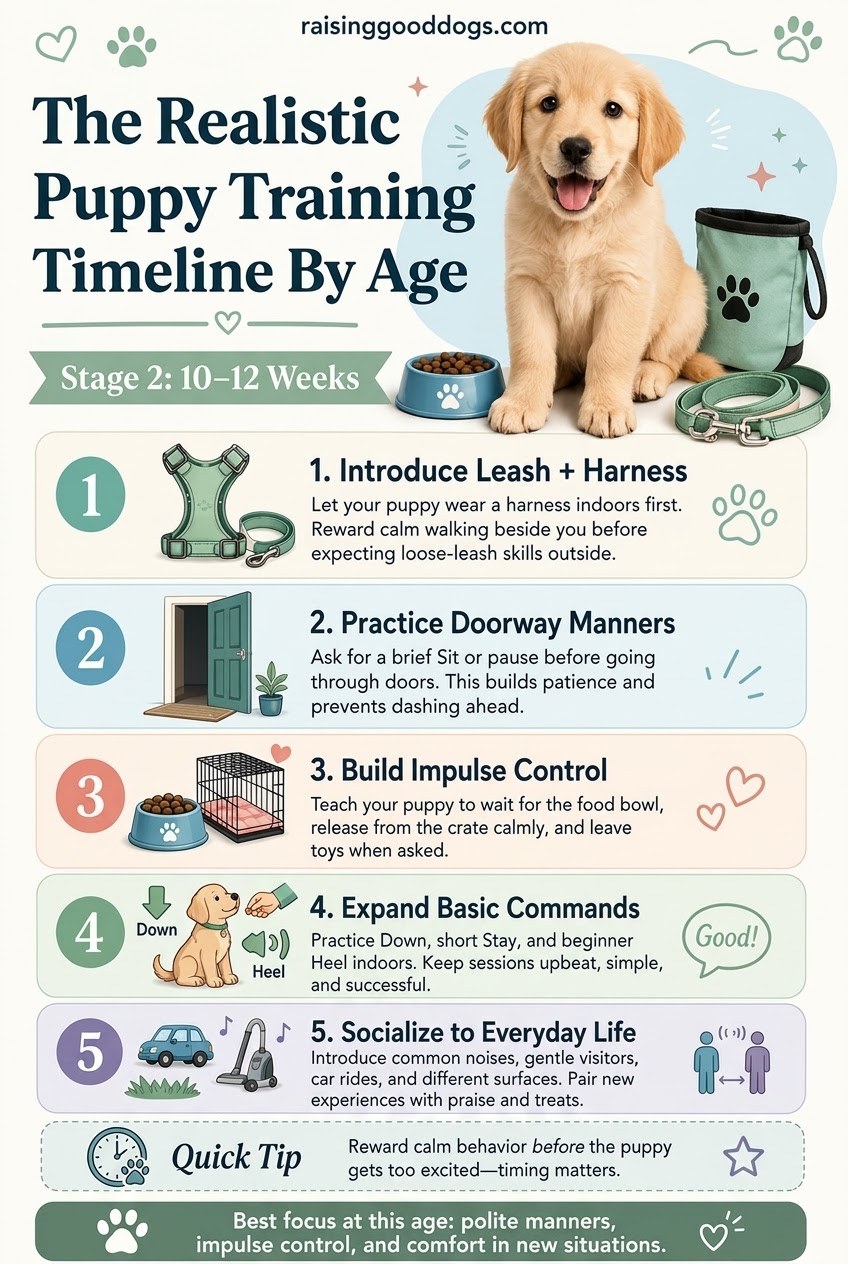
Ten to Twelve Weeks: Leash, Doorways, and Impulse Control
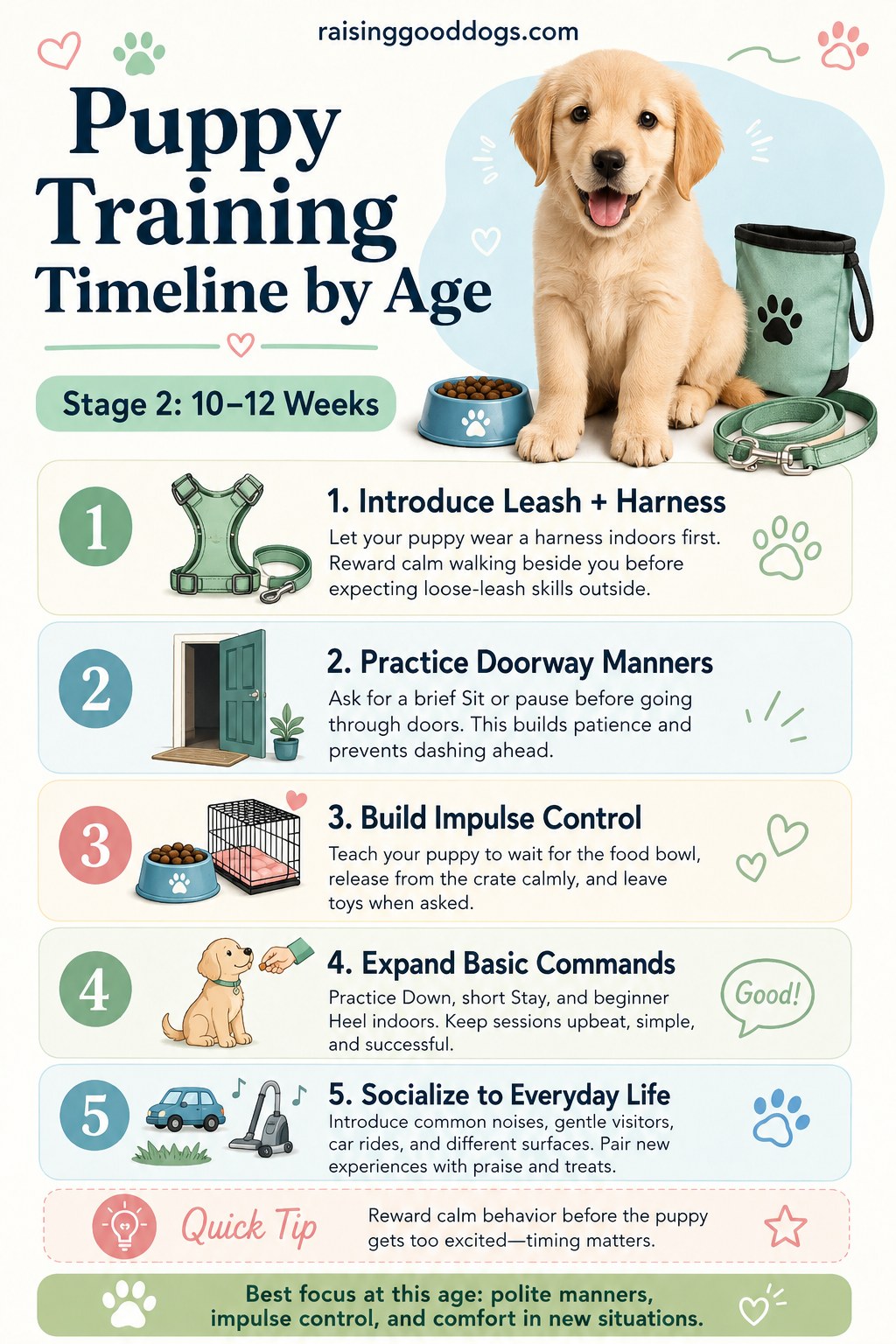
Before a harness ever touches pavement, I want a puppy wearing it comfortably indoors, rewarded for calm walking around furniture with zero distractions. Skipping that step is the single most common reason first outdoor walks go badly — the equipment feels wrong before the world even gets loud.
What I'm building here
- Doorway manners: a brief sit or pause before the door opens, which quietly prevents the bolting problem nobody notices until it's a habit.
- Impulse control: waiting for a released food bowl, leaving toys on cue — small, low-stakes practice for the self-control you'll need everywhere else.
- Everyday sounds: car rides, doorbells, gentle household noise, introduced at a volume the puppy can shrug off, not one that makes them flinch.
Timing is everything at this stage — reward the calm behaviour before the puppy escalates into excited, not after. That single habit saves months of over-arousal work down the line.
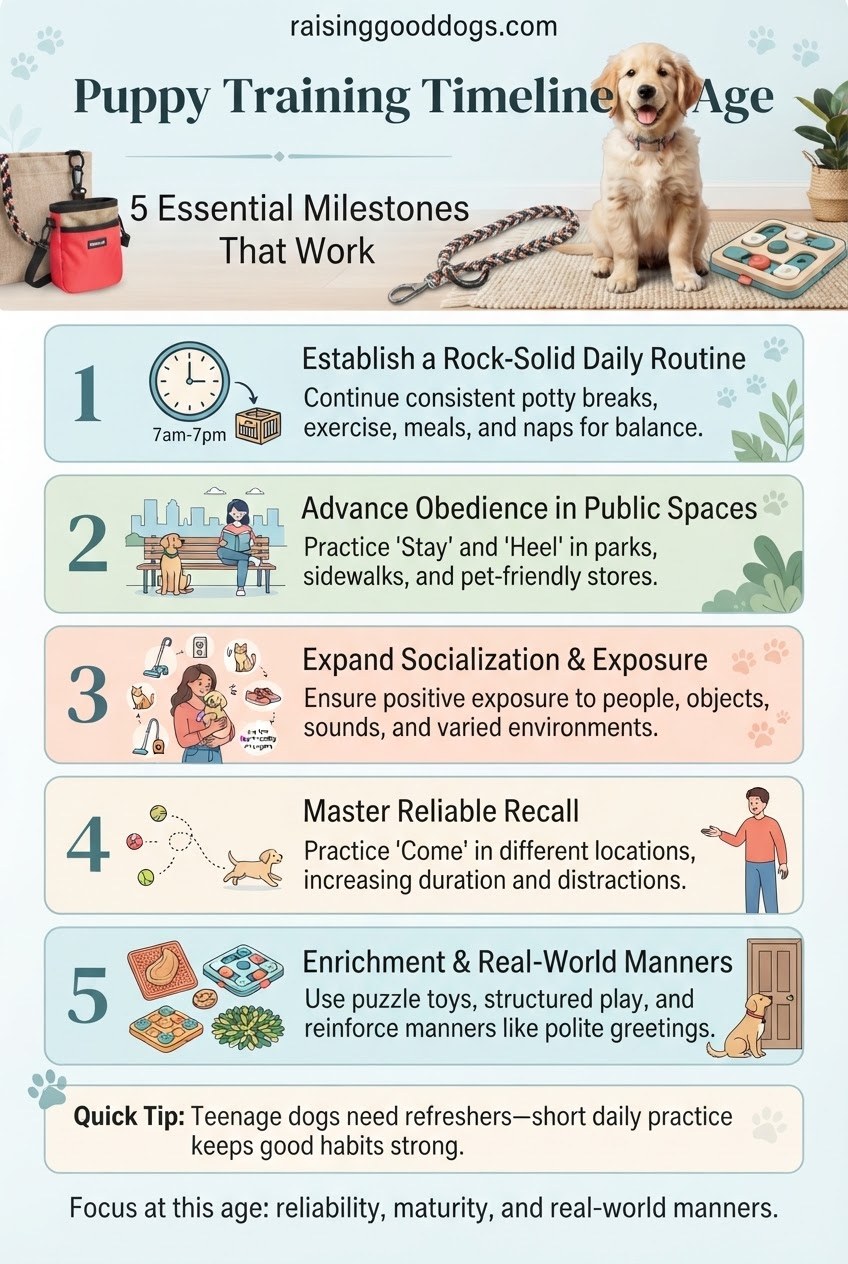
Six Months to a Year: Where Reliability Gets Tested
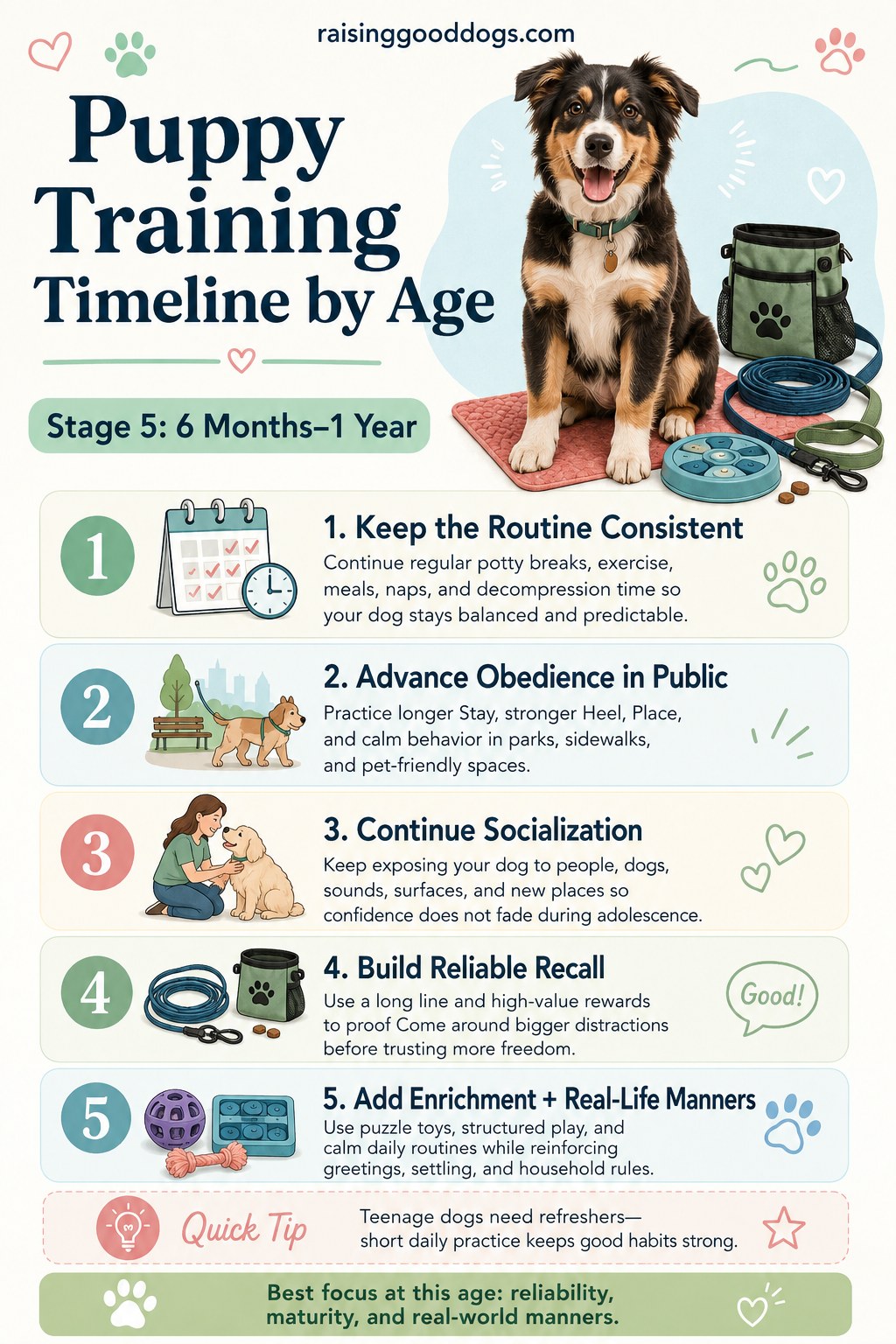
This is adolescence, and I'll say plainly what the charts never do: your dog may get worse before it gets better. A teenage brain is genuinely rewiring, and skills that looked solid at four months can wobble hard. That's a plateau, not a failure, and it's the point where a lot of owners quietly give up because nobody warned them.
Keep the daily routine boringly consistent — potty breaks, exercise, decompression time, all still doing quiet work. From there, push the skills that matter in public: longer stays, a steadier heel, calm behaviour in parks and pet-friendly spaces where the temptation is real. Recall gets built with a long line and high-value rewards before you ever trust an open field. And socialising doesn't stop — confidence built at three months fades if it isn't maintained through the awkward teenage stretch.
- Add enrichment — puzzle toys, structured play, and daily mental work to burn off a brain that's outgrowing basic games.
- Refresh often — short daily practice keeps skills sharp without turning training into another chore.
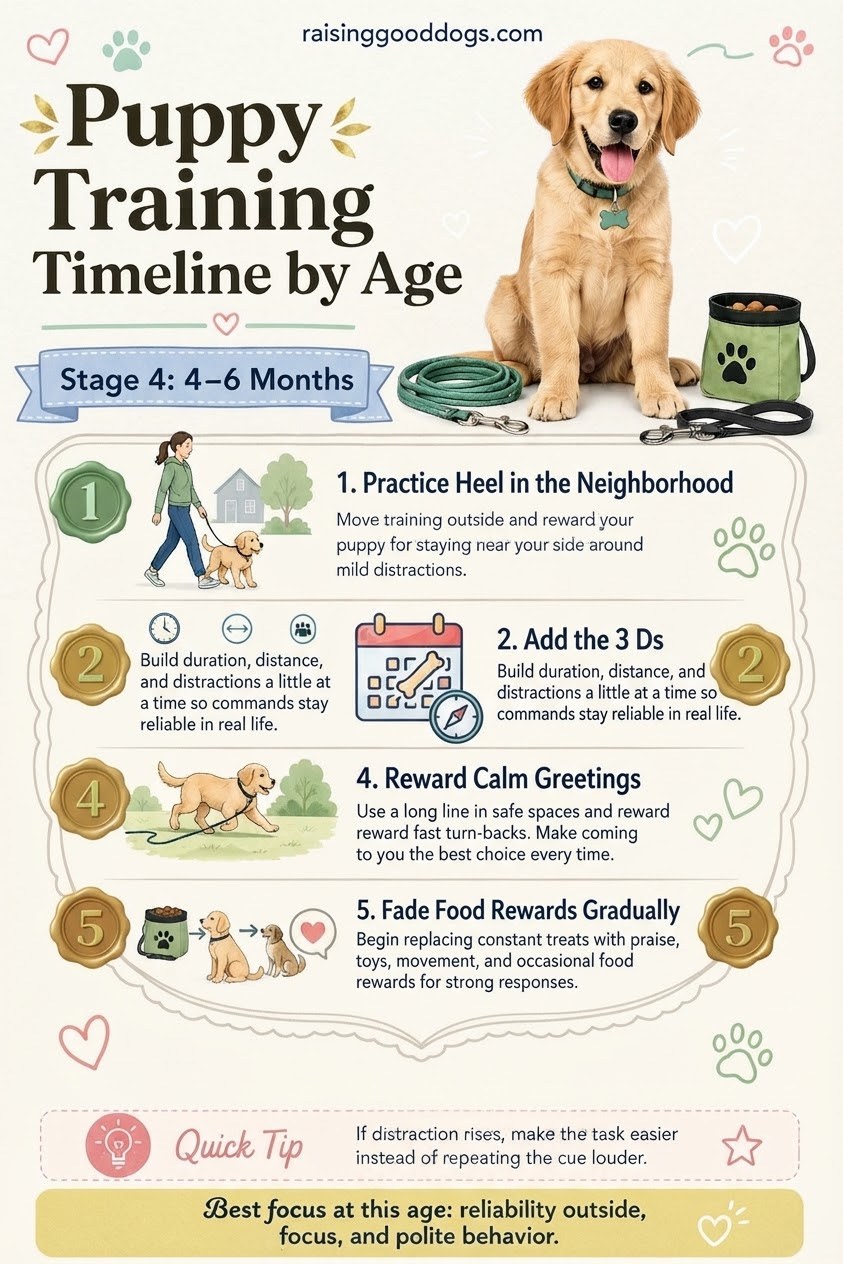
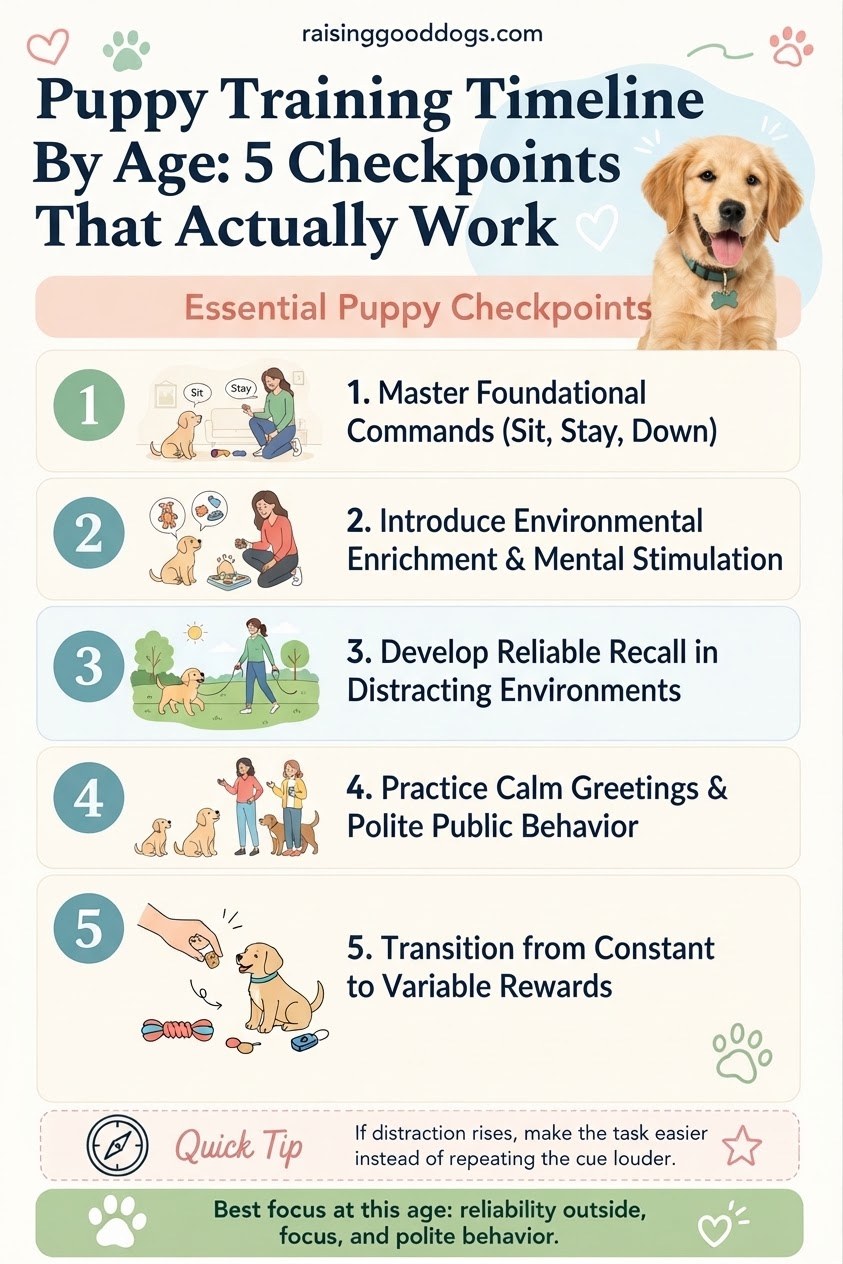
Four to Six Months: Taking the Training Out the Front Door
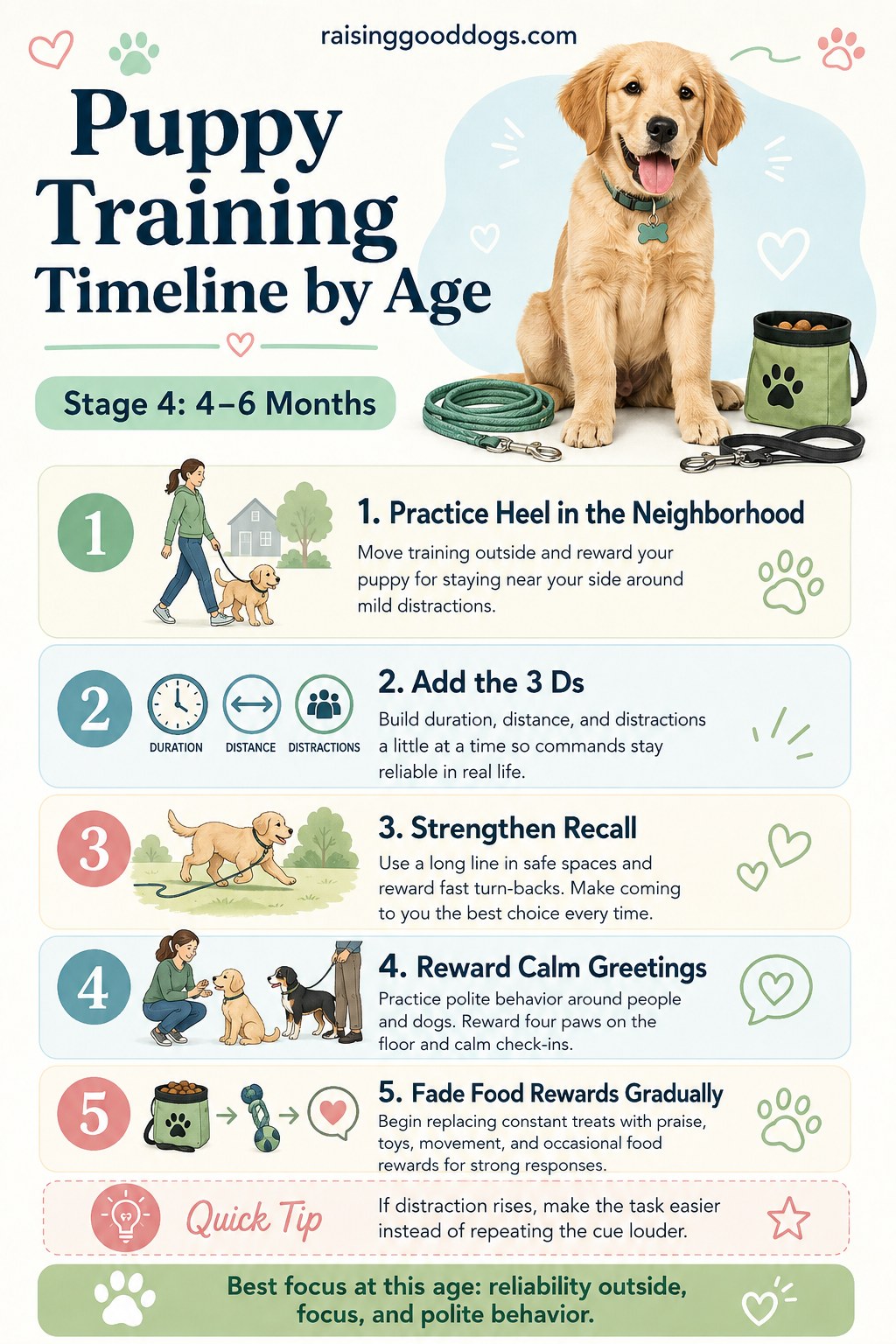
Somewhere around four months, training has to leave the yard, and this is where I see the fastest progress and the fastest frustration in the same week. The trick is the three D's — duration, distance, distractions — raised one at a time, never all together. A heel that's perfect in your kitchen falls apart on a sidewalk with a jogger, and that's not the dog being difficult, that's the criteria jumping too far too fast.
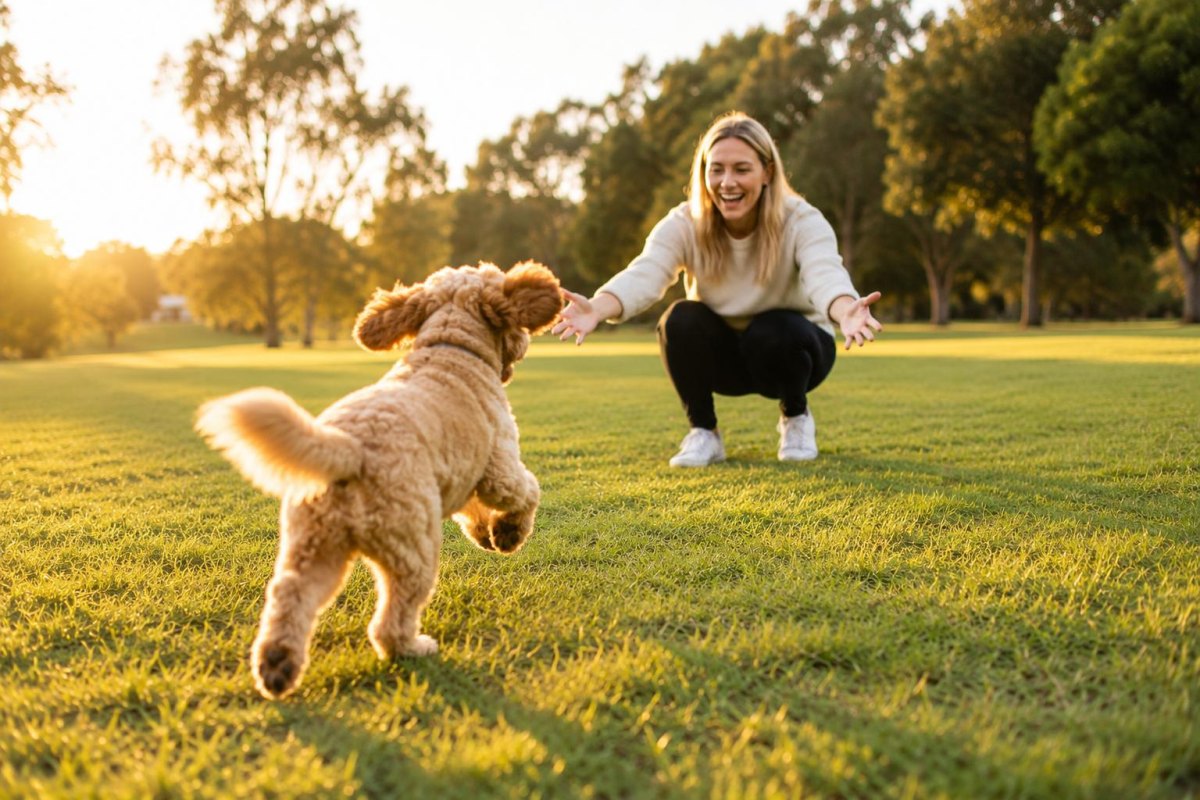
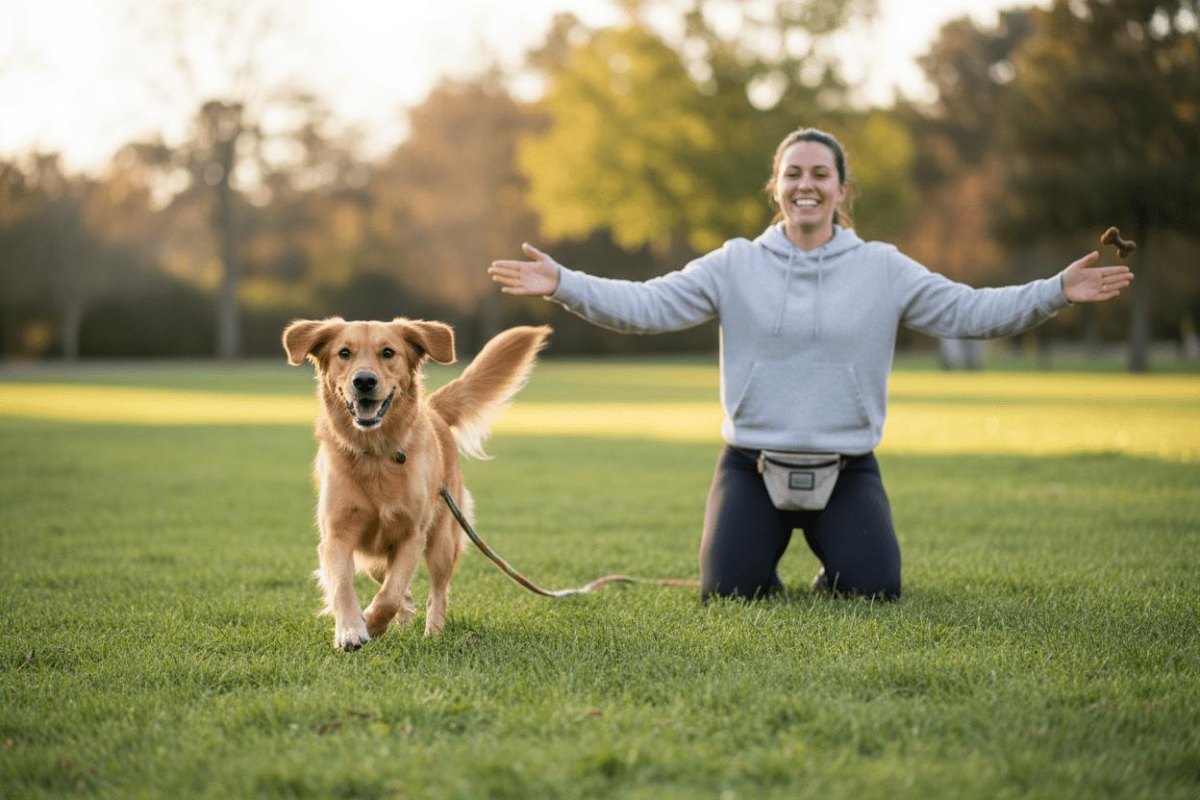
Recall gets its real foundation here, on a long line in a safe space, with a fast, obvious reward every single time the puppy turns back toward you. Calm greetings — four paws on the floor, not a launch at a stranger's knees — get practiced deliberately, not left to chance. And this is the age to start fading constant food rewards toward praise, play and the occasional jackpot, so the dog isn't working purely for cookies forever.
If a distraction is too big, make the task easier — more distance, less duration — rather than repeating the cue louder. Louder never taught a dog anything except that the first cue didn't count.
None of these five checkpoints are a countdown you can rush through with enough repetitions. They're more like layers, each one leaning on the last, and a puppy is allowed to be a little behind on one and ahead on another — mine certainly was. Aim for the goals, expect the mess in between, and you'll end up with a dog who's reliable for real life, not just for a chart.





Your Questions, Answered
My puppy was doing great and now, at seven months, everything's fallen apart. Did I do something wrong?
Almost certainly not — this is the classic adolescent plateau, and it's one of the most predictable, least talked-about parts of puppy raising. Go back to easier versions of the skill, shorten distance and duration, and rebuild. If it's a sudden, dramatic change rather than a gradual wobble, it's worth a vet visit to rule out anything physical first.
Is it too late to socialise my puppy if we missed some of the early window?
You can still build confidence outside the classic sensitive period, it just takes more patience and slower exposure at the dog's pace — never flooding them with everything at once. It's a different, longer project than early socialising, but it's not a lost cause.
My puppy still bites hard at five months. Is that aggression?
No — that's development, and it's very common through the teething months. Redirect to appropriate toys and keep teaching bite inhibition through play; punishing it tends to backfire and can make a puppy warier of hands rather than gentler with its mouth.