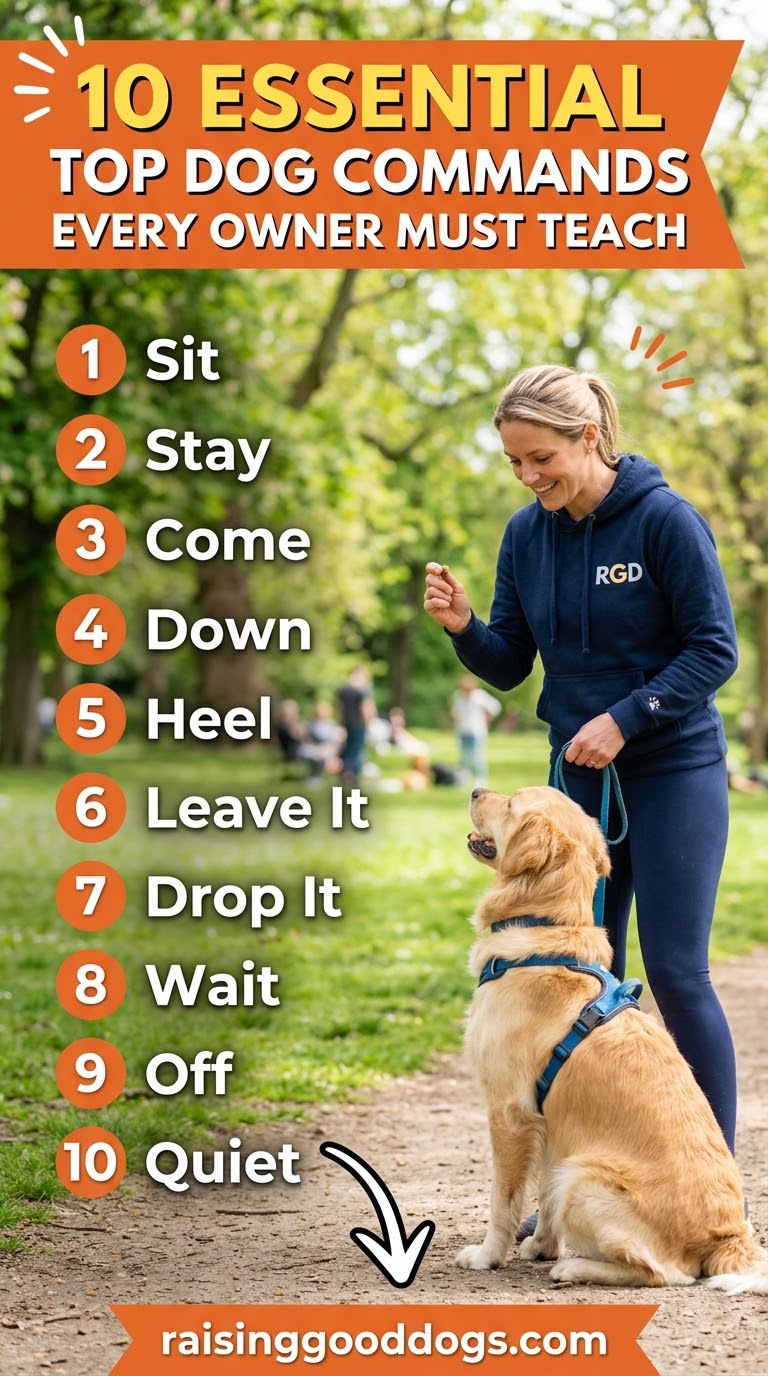
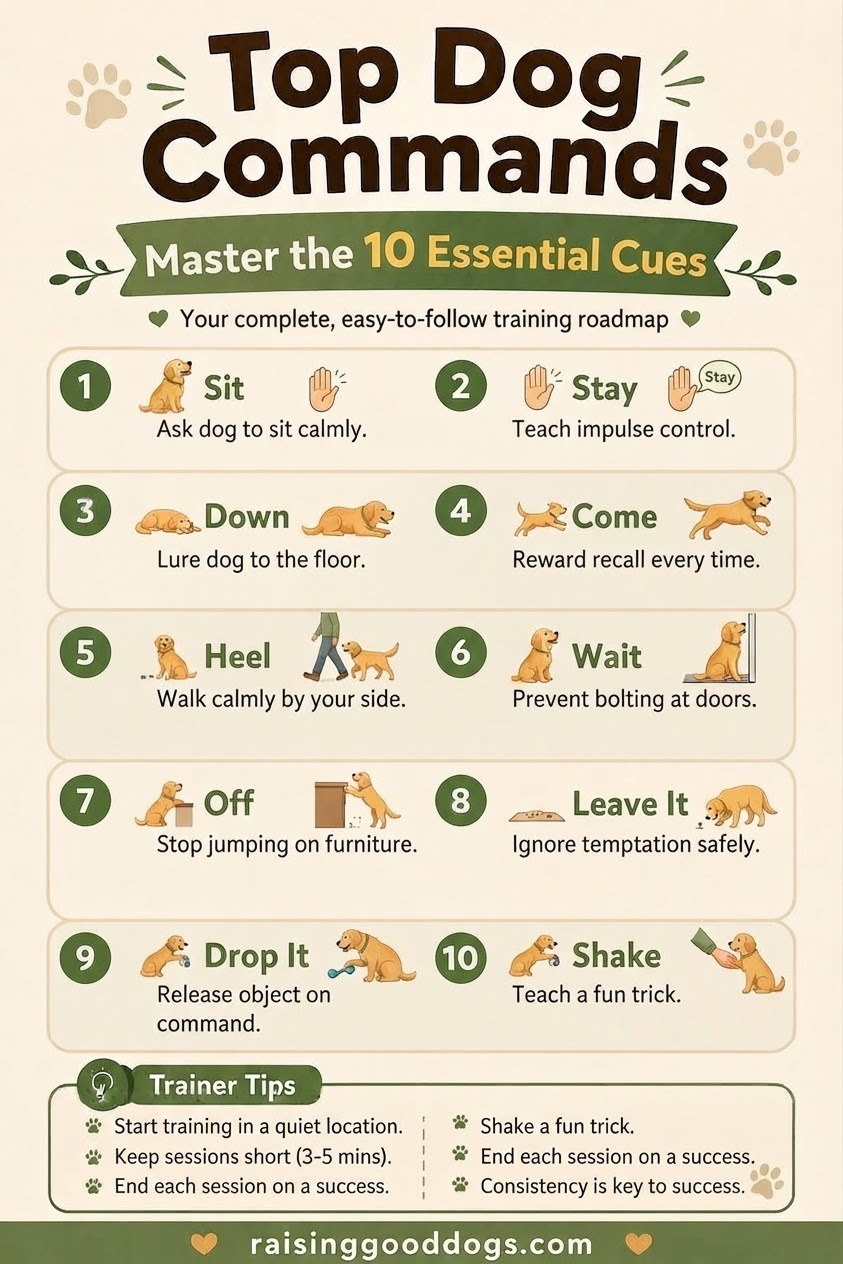
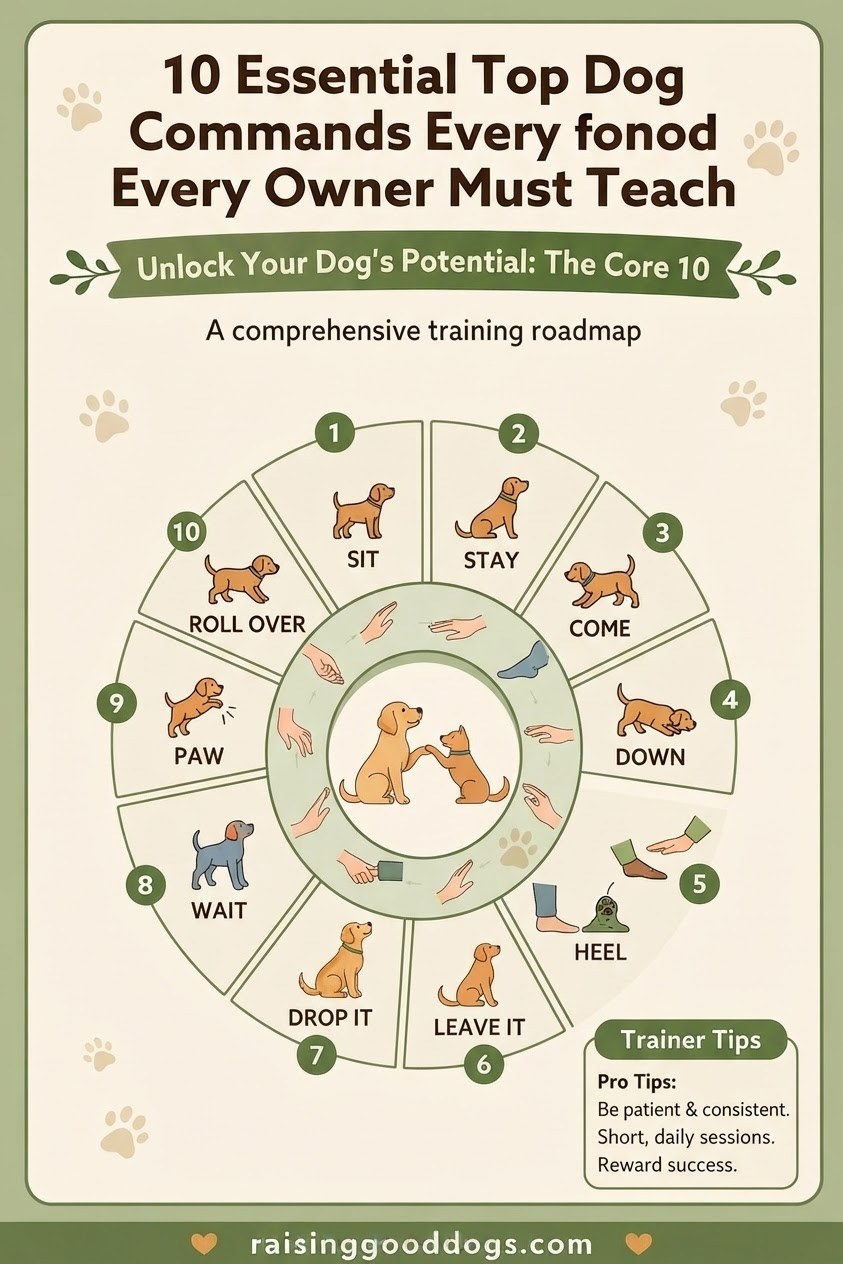
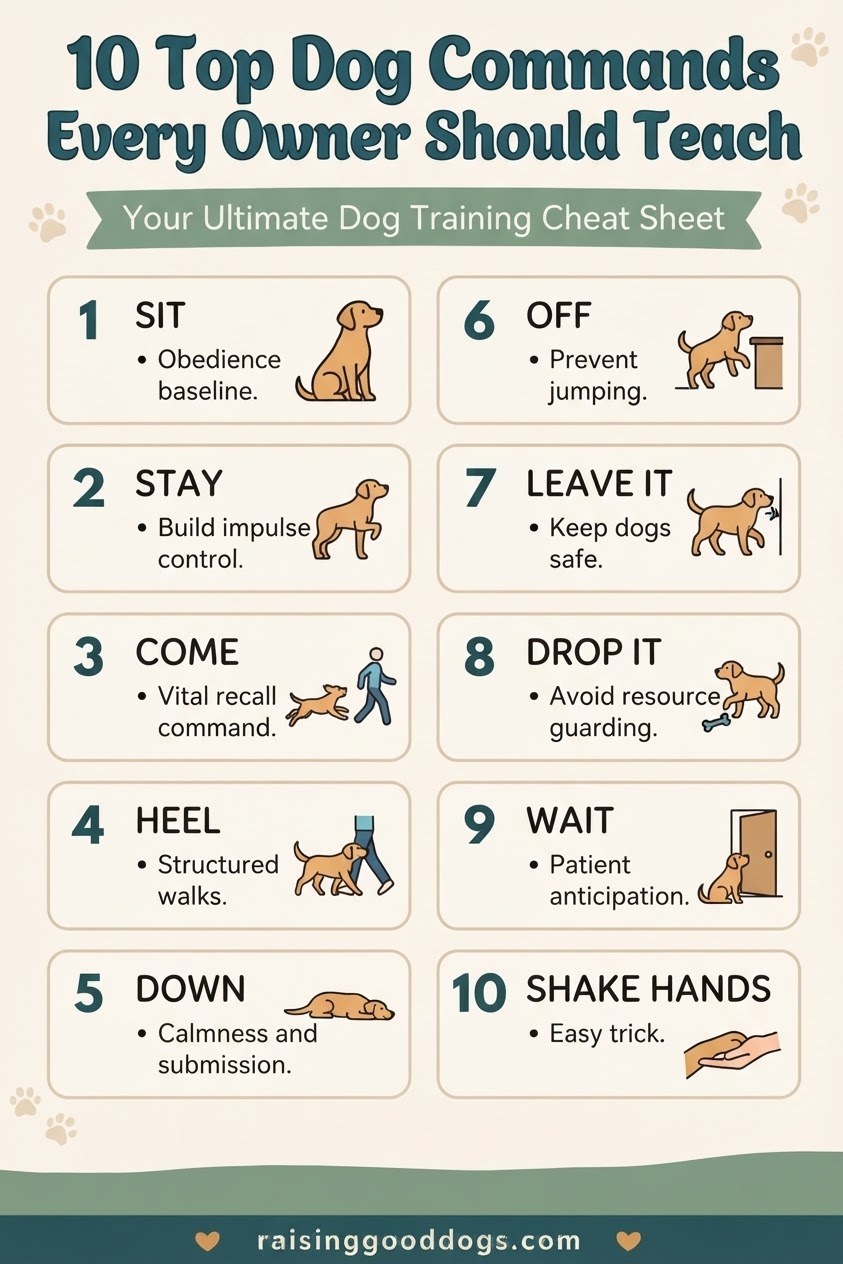
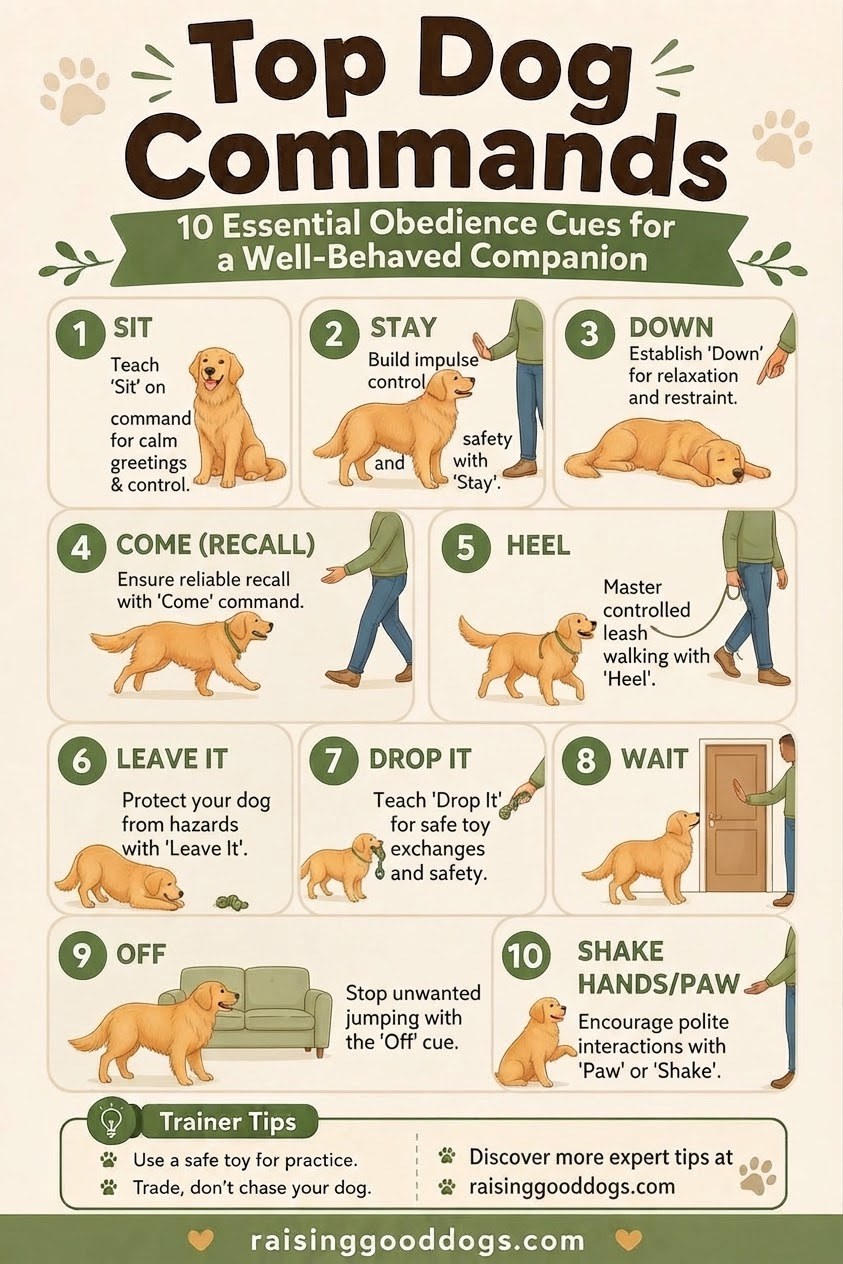
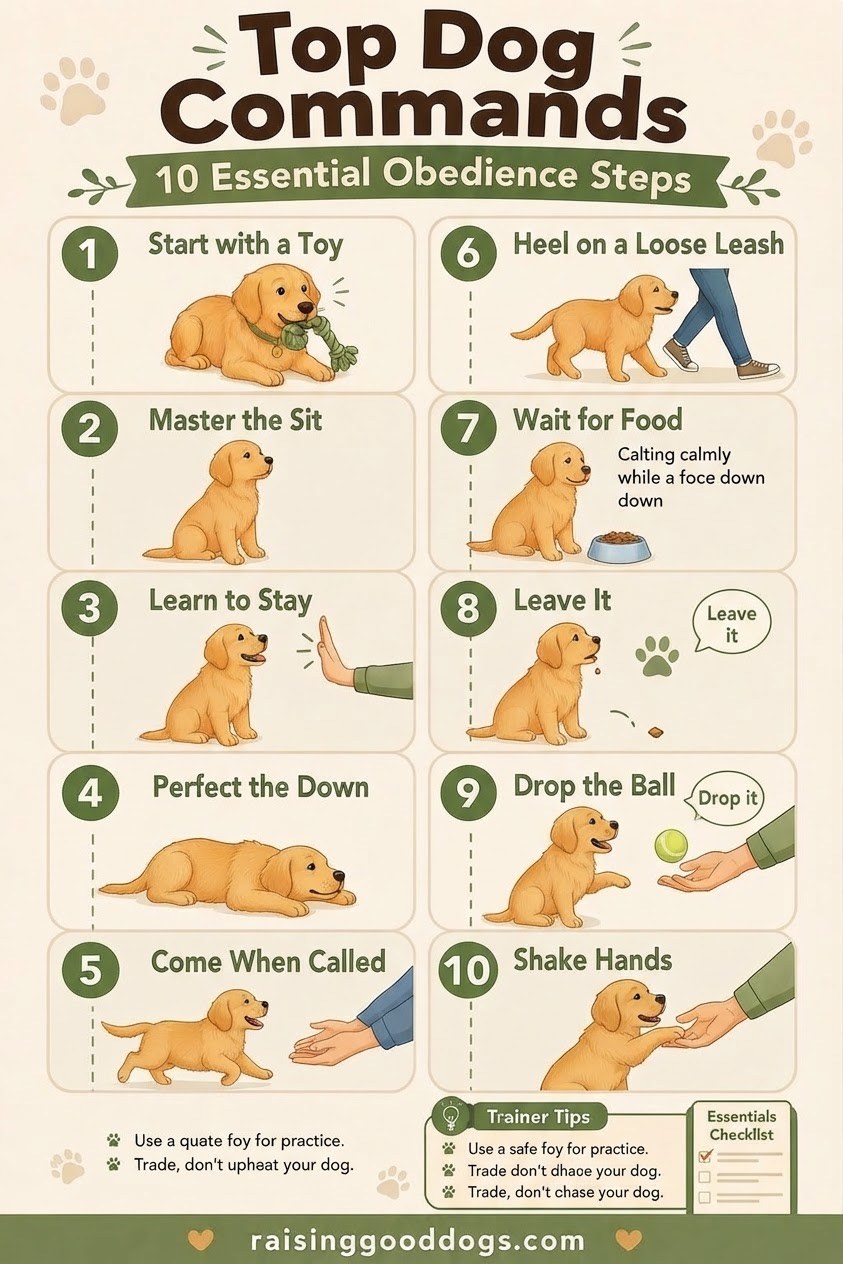
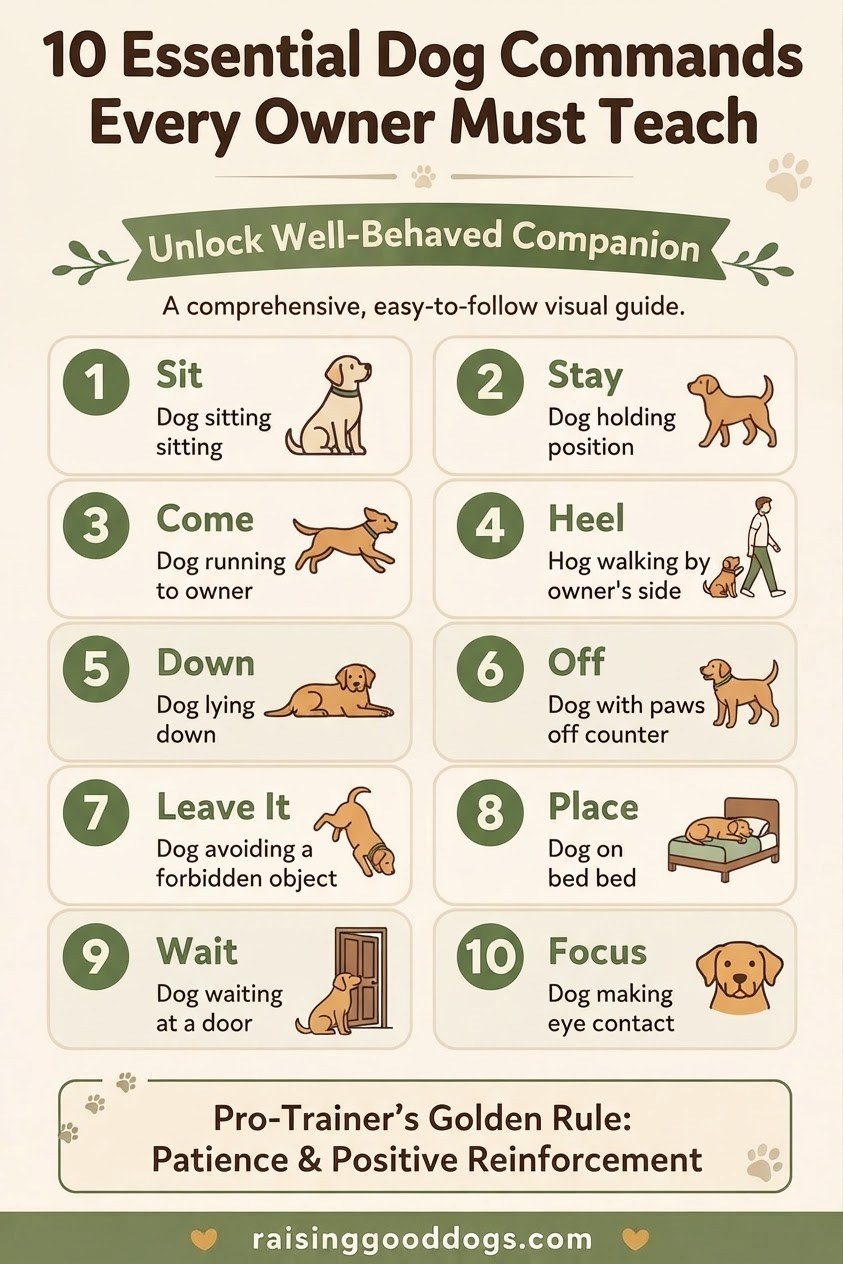
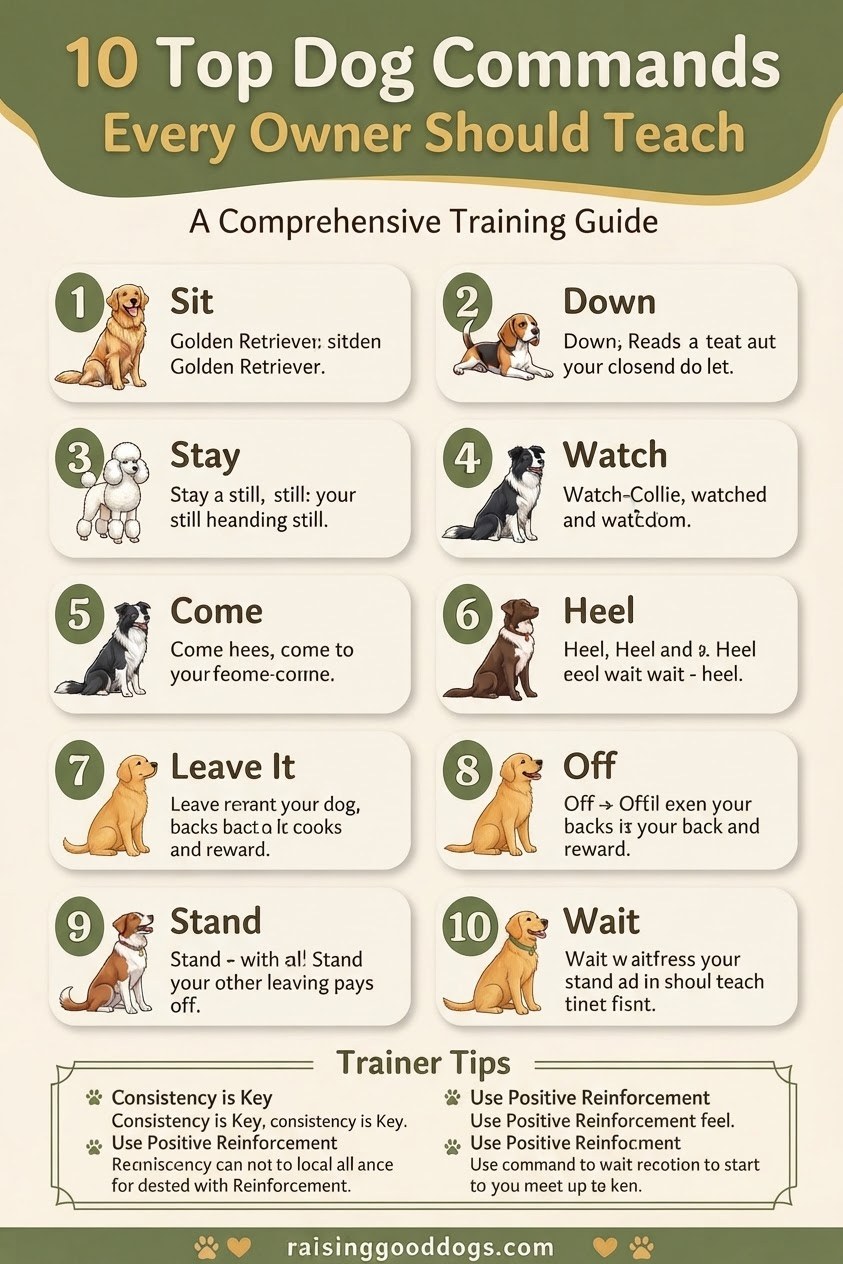
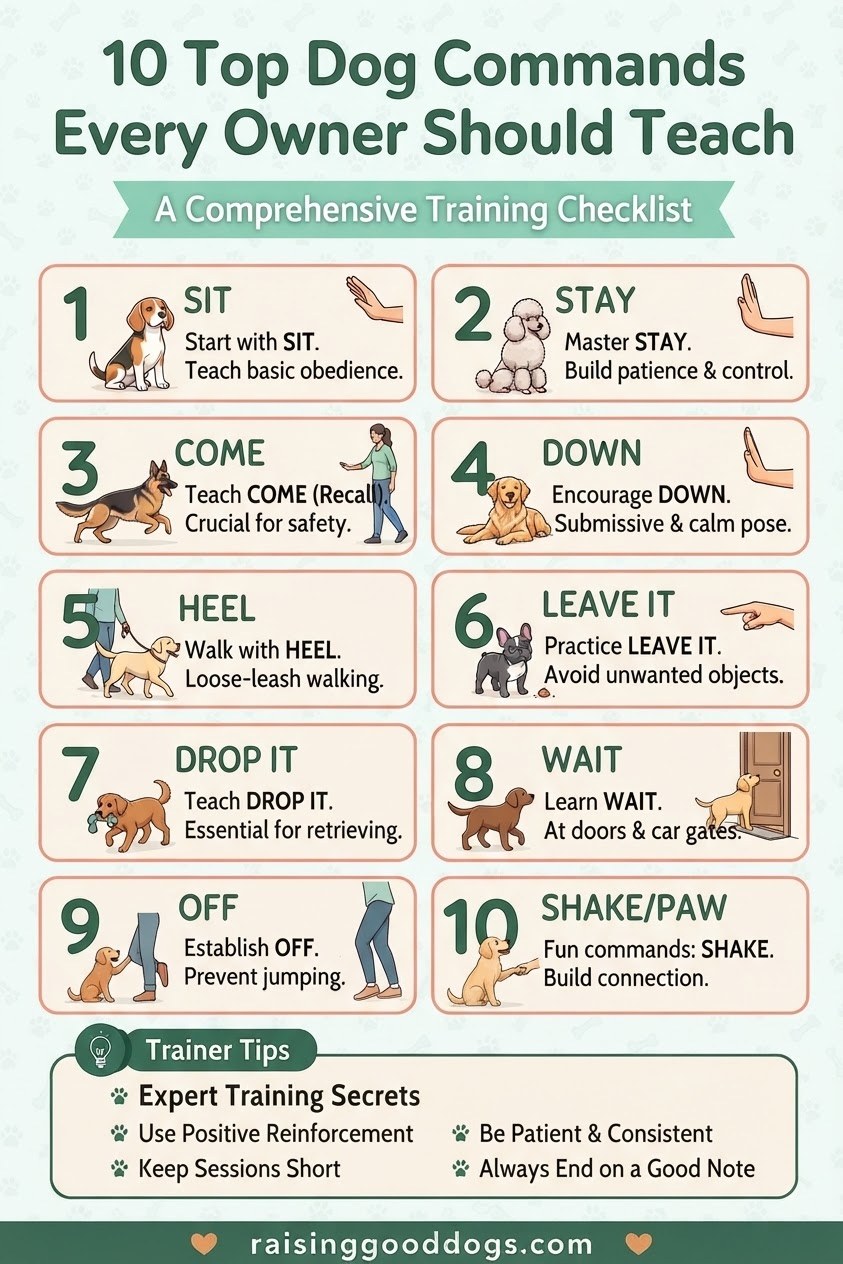
Every week someone in my training room in the old mill building tells me their dog knows sit, and then can't get a sit at the vet's office with a treat in hand — because sit at home and sit in the real world are two different skills. These ten commands are the backbone of almost every training plan I run, from puppy basics to the reactivity cases I do down at the harbour. None of them require force, and none of them happen in one session, so I've built in the pacing along with the steps.
Sit — the foundation cue
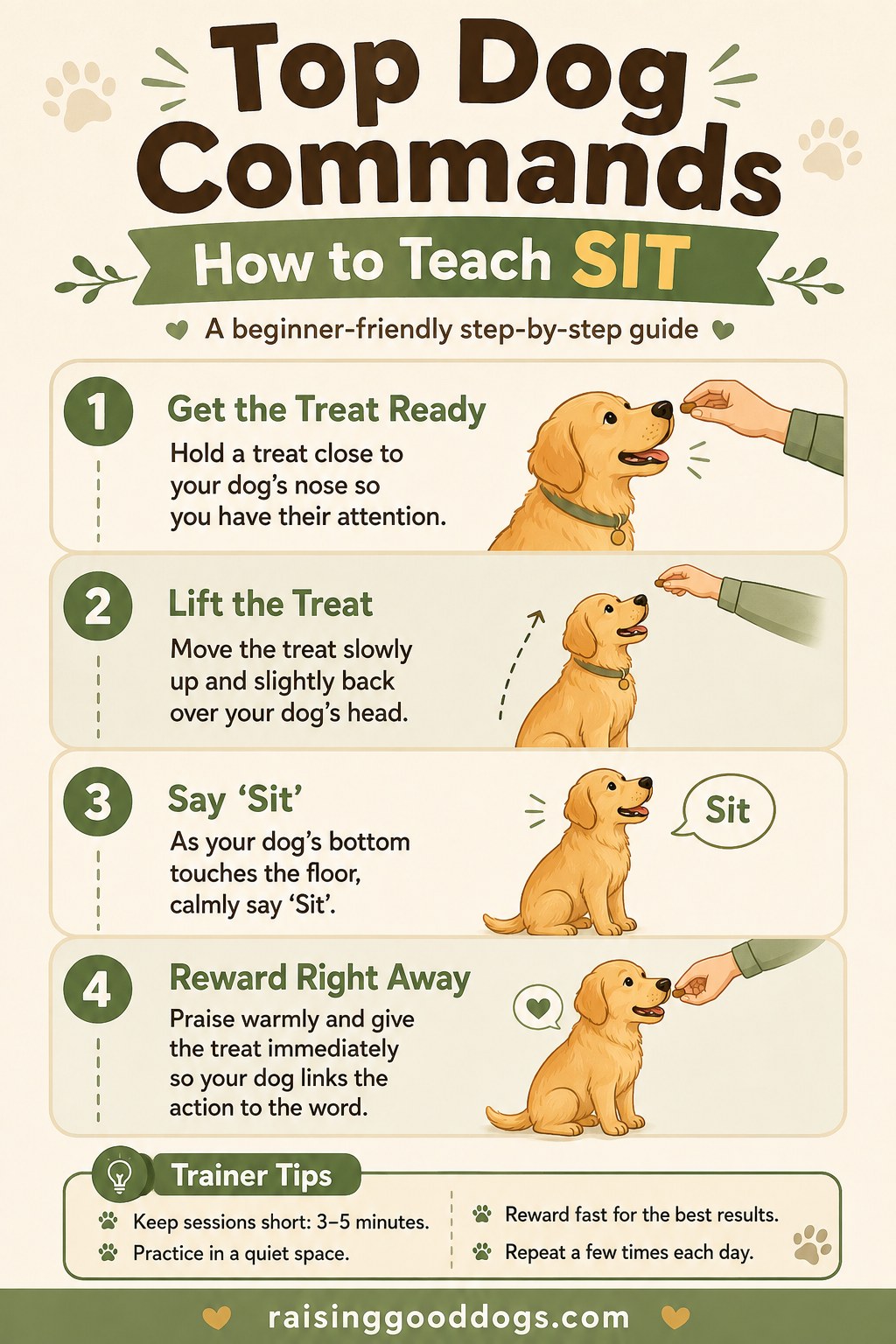
Sit is the first thing I teach almost every dog, not because it's magic, but because it gives you a default behaviour you can ask for anywhere — at the door, at the curb, when a stranger wants to say hello. The mechanics are simple: treat at the nose, lift it slowly back over the head so the dog's bottom naturally lowers, and you say the word only as it happens, not before.
- Keep the treat close to the nose the whole time — lifting it too high just teaches jumping.
- Say ‘Sit’ once, as the bottom touches down, so the word gets paired with the action, not the anticipation.
- Sessions of three to five minutes beat one long, frustrating one, for you and the dog.
Most healthy dogs get a reliable sit in a week of short daily reps. Older dogs or ones with hip or knee soreness may sit more slowly or reluctantly — if a dog who used to sit easily suddenly won't, that's a conversation for the vet before it's a training problem.
Stay — teaching duration, not just position
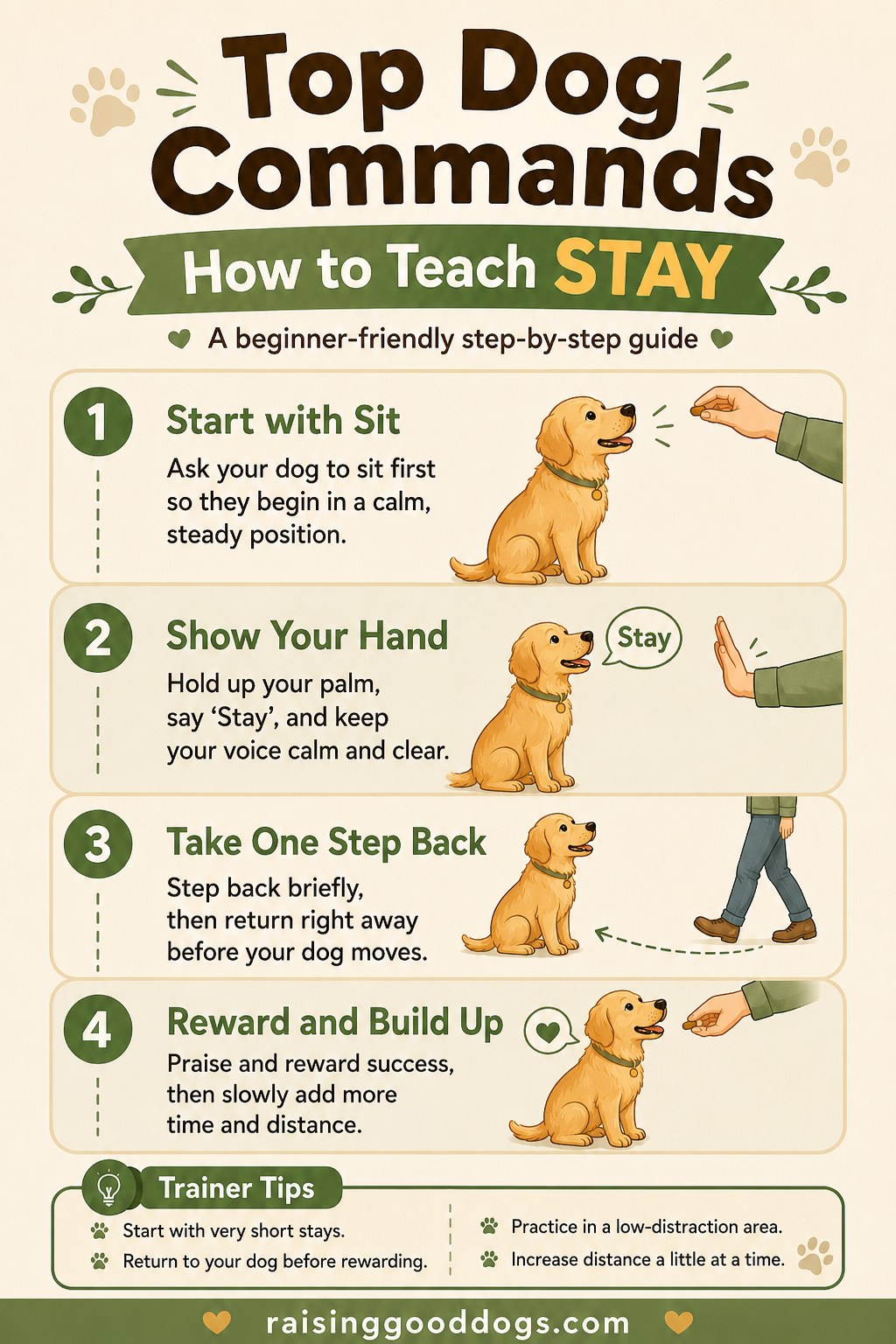
Stay is where I watch most people accidentally set their dog up to fail, by adding distance and time in the same session. Build one variable at a time. Ask for the sit, show an open palm, say the word once in a calm voice, and return before your dog has any reason to move.
The release is doing half the work here — if you never tell your dog the stay is over, you can't blame them for guessing.
Start with stays measured in single seconds, not minutes. Practice in a boring room before you ever try it near the front door or another dog. If your dog breaks the stay, that's information, not defiance — it means you asked for more than the dog was ready for, so dial it back rather than repeating the cue louder.
Realistic timeline: a solid two-second stay usually happens within days; a genuinely reliable stay with distance and distraction takes several weeks of layered practice.
Come — the one cue that must never sour
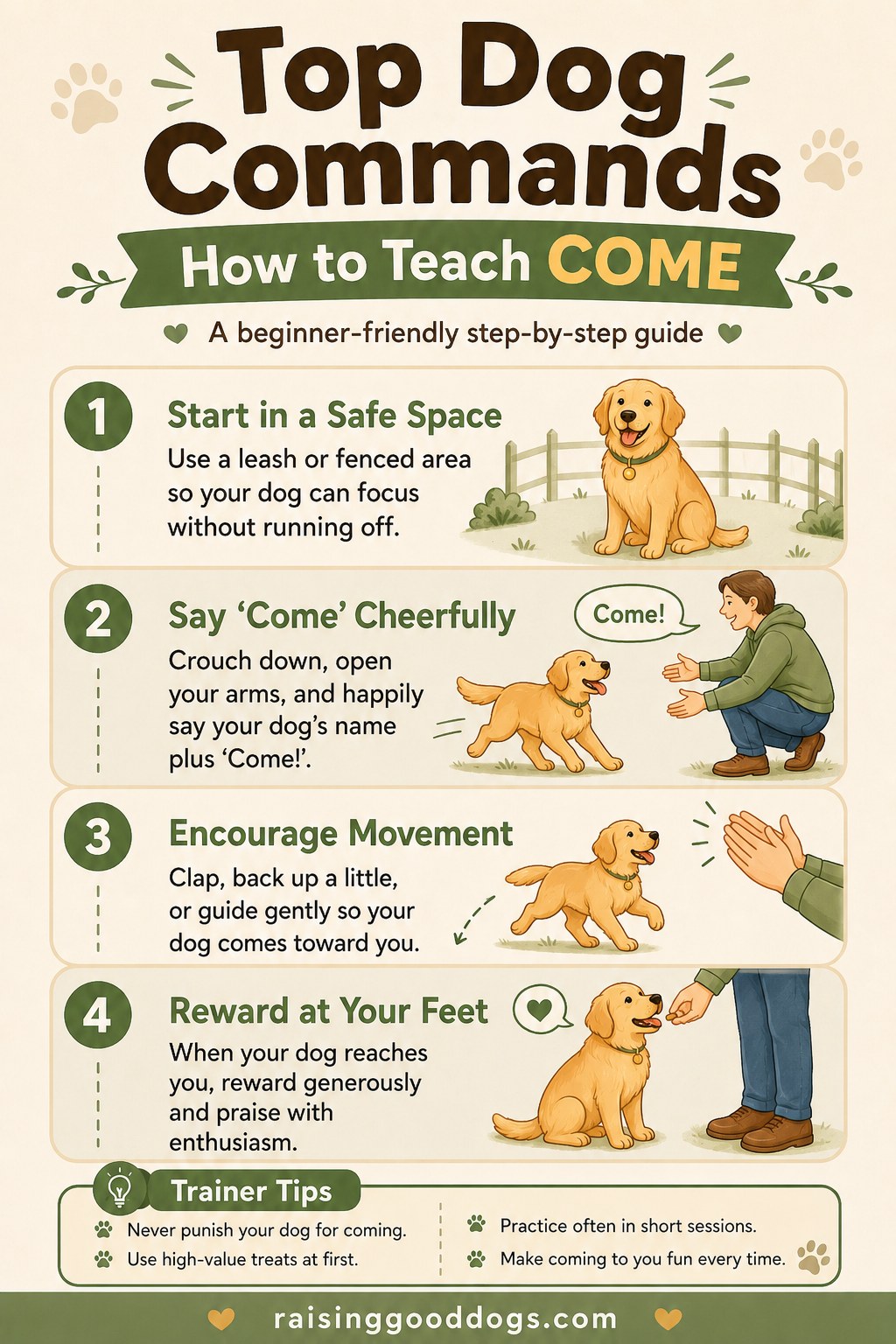
This is the command I'm most protective of, because a poisoned recall is genuinely hard to undo. Never call your dog to you for anything unpleasant — not the bath, not the nail trim, not to end play at the park. Once ‘Come’ predicts something the dog dreads, you can spend months rebuilding it.
- Practice on leash or in a fenced space first, so the dog can't rehearse ignoring you by simply running off.
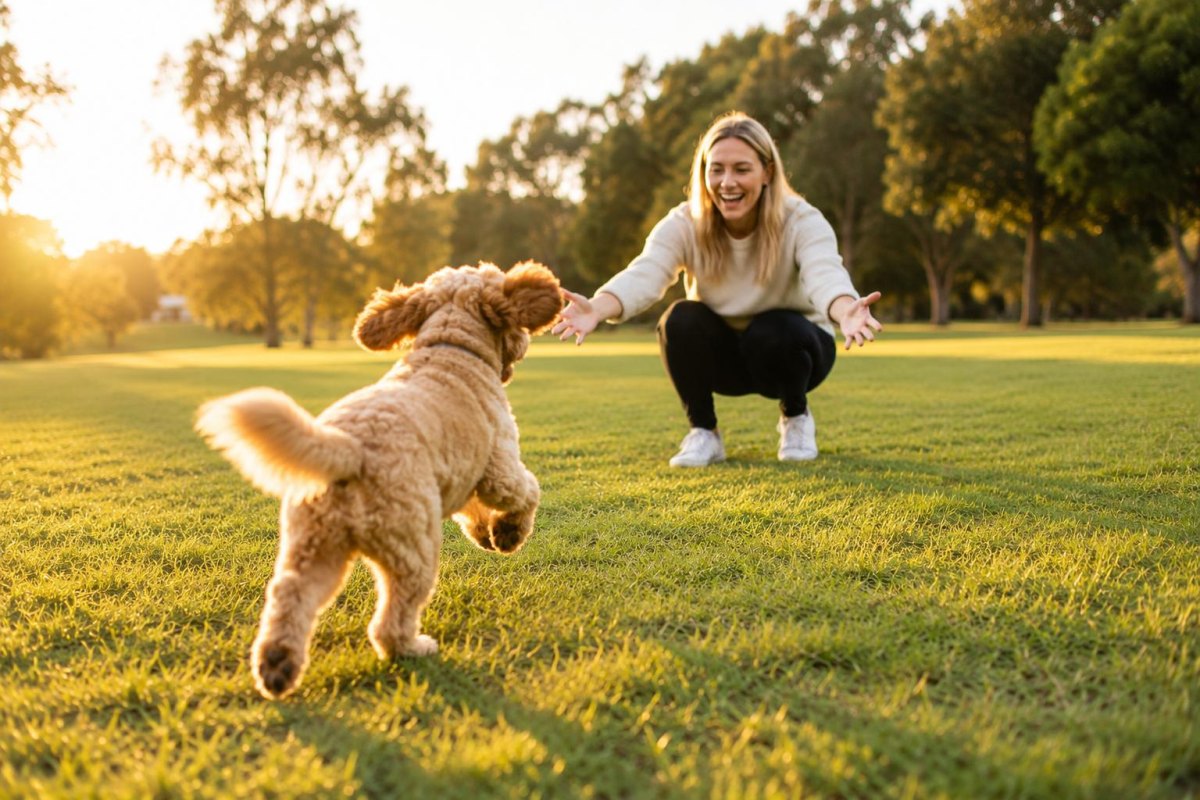
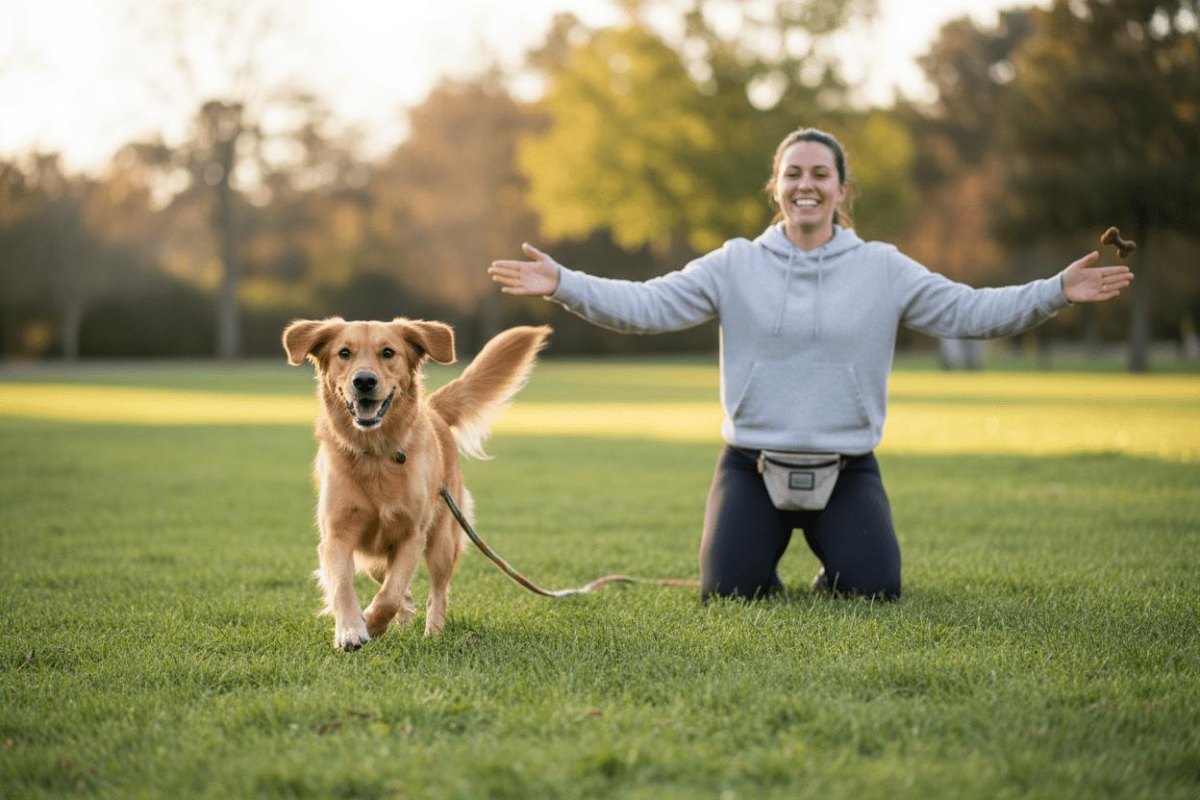
- Crouch, open your arms, use an upbeat voice — recall should feel like the best invitation of the day.
- Reward generously at your feet, every single time, especially early on.
I still use a long line with recall work in my own sessions, even with dogs who mostly get it — off-leash reliability around real distractions is a late-stage skill, not a week-two one, and for some dogs it never becomes appropriate off leash at all, which is a fine and honest outcome.
Down — a vulnerable position that deserves patience
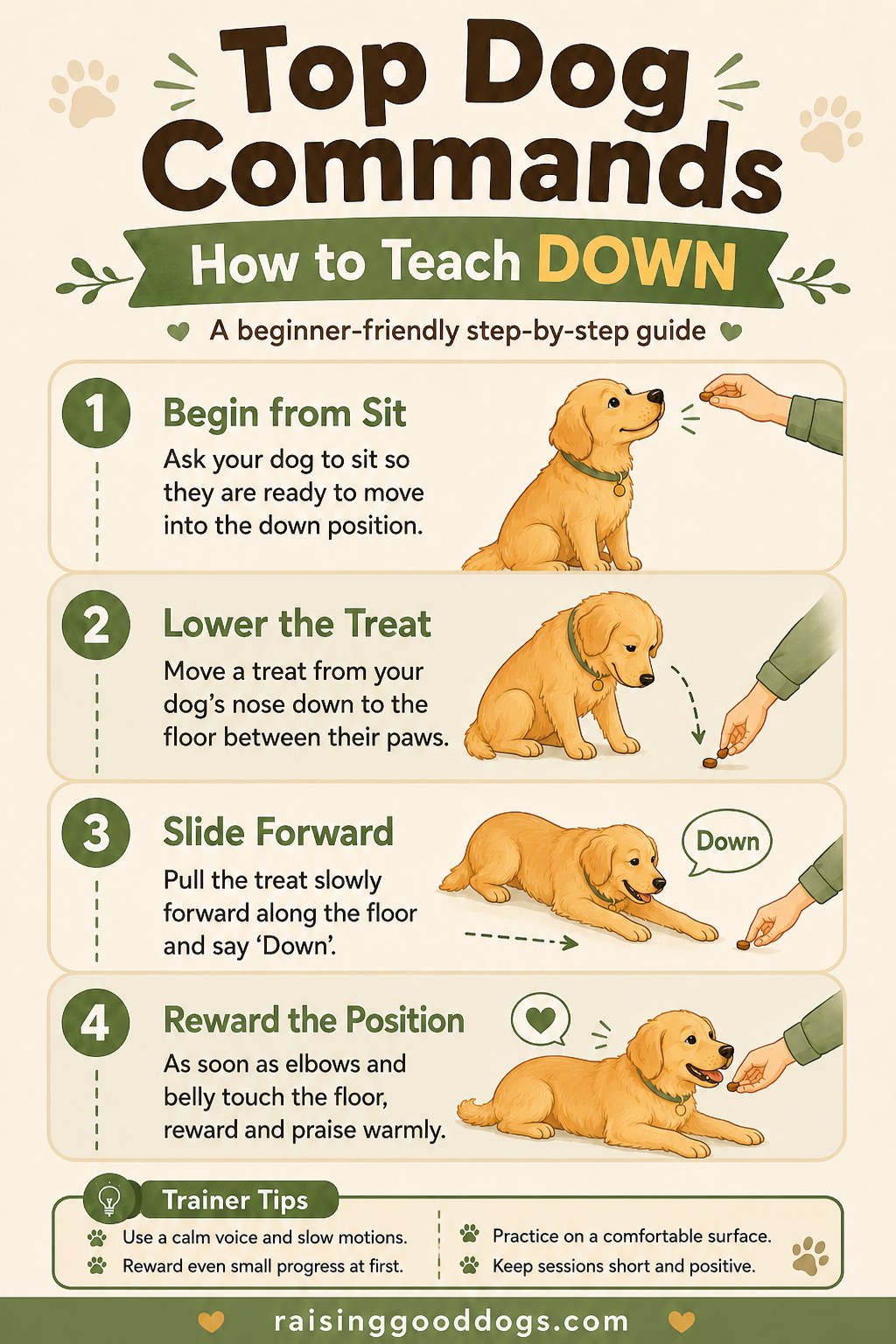
Down asks a dog to put their whole body on the ground, which is a bigger ask than it looks. From a seated position, lower the treat straight down to the floor between the paws, then draw it slowly forward so the dog's front end follows it into the down.
- Reward partial progress — a lowered chest before the elbows fully touch is still worth marking early on.
- Use a non-slip surface; dogs avoid lying down on floors that feel unstable underneath them.
- Keep your voice calm, not commanding — a soft down is more likely to stick than a barked one.
Some dogs, particularly nervous ones, find down genuinely exposing in new environments — a dog who won't lie down in an open space isn't being stubborn, it's often a body-language tell that they don't feel safe there yet.
Heel — loose leash walking, redefined
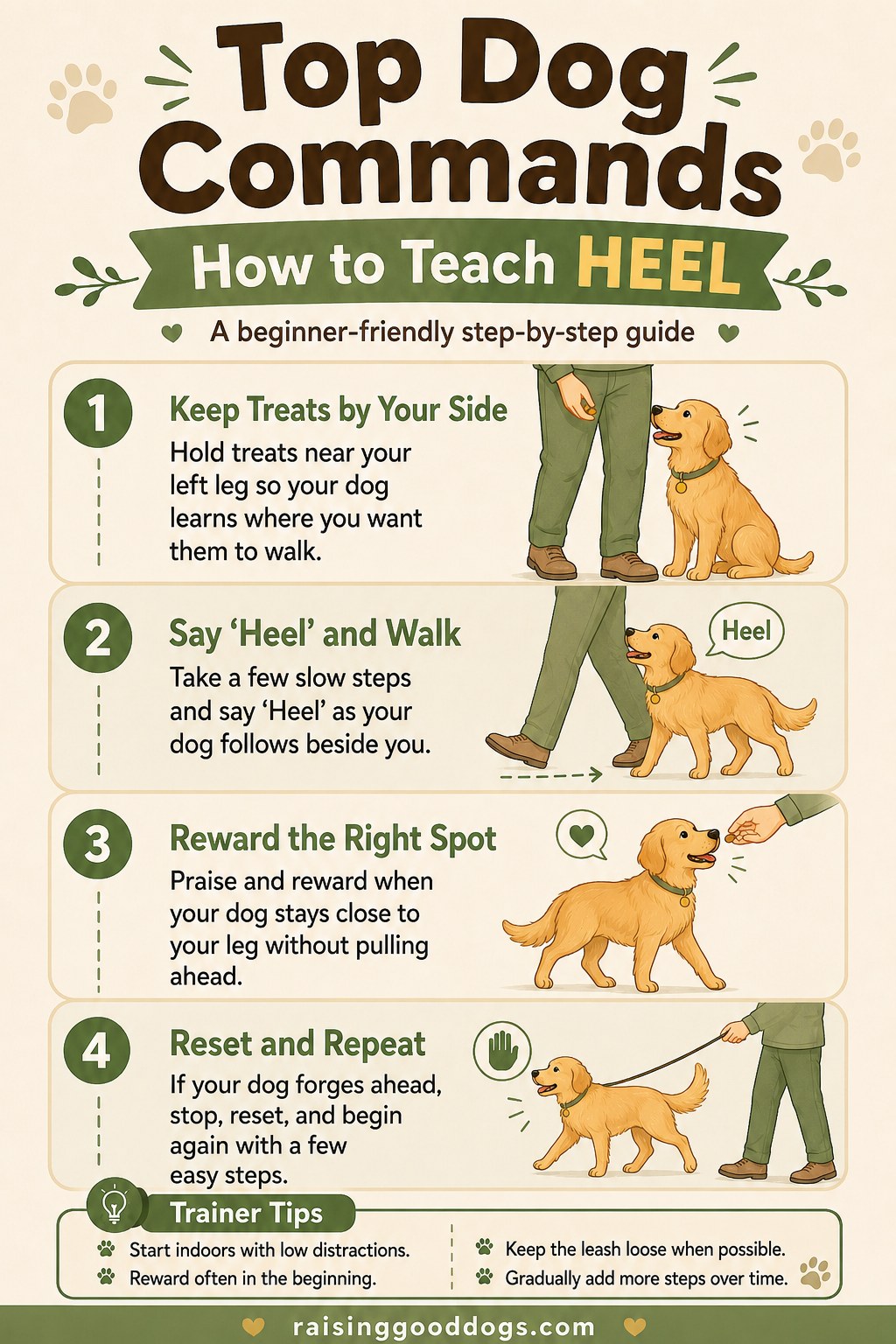
Heel is really just leash manners with a name on it, and it's the piece of training clients ask me for most, usually while their arm is being pulled out of the socket in a parking lot. Keep treats at your side leg so the dog learns that's the profitable spot to be, take a few slow steps, and reward while they're still beside you — not after they've drifted ahead.
Reset without frustration when your dog forges forward: stop walking, wait for slack in the leash, then begin again. The leash going tight should mean the walk pauses, every time, consistently.
I tell every client the same thing about this one: the first two weeks are the slowest walks you will ever take. You'll cover half a block in the time it used to take to cover the whole route. That's not a sign it's failing — that's what building the habit actually looks like before it gets fast again.
Leave It — impulse control, not punishment
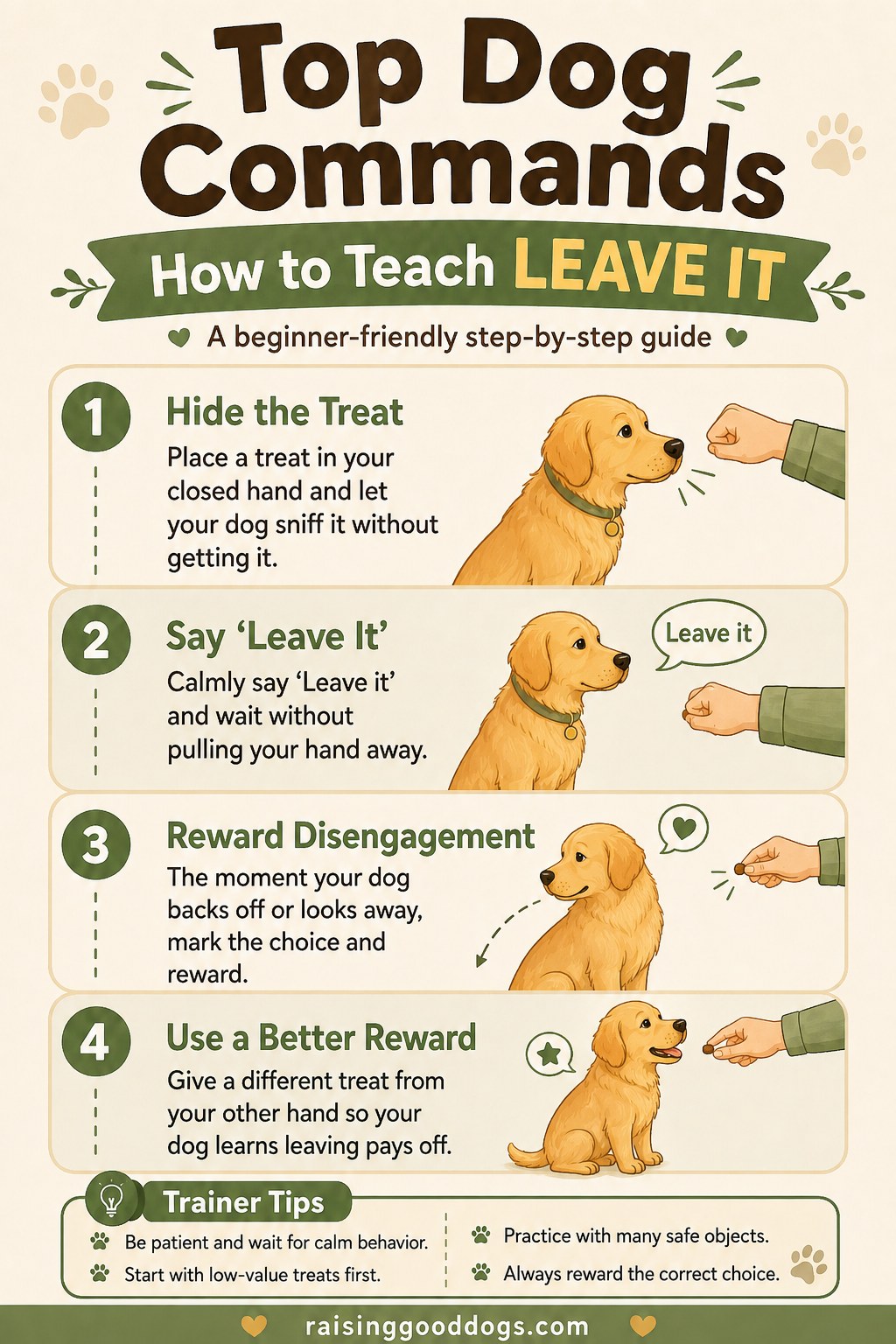
Leave It teaches a dog to disengage from something tempting because a better option is coming, and it should never be taught by snatching things away. Start with a treat hidden in a closed fist — let the dog sniff, paw, even mouth at your hand, and simply wait it out.
- Say ‘Leave It’ once, calmly, while your hand stays still and closed.
- The instant the dog backs off or looks away, mark that choice — that's the behaviour you're paying for.
- Reward from your other hand, with something different, so leaving the first thing is always the better bet.
This is one of the few cues I ask clients to practise with genuinely boring items at first. Save the exciting stuff — the chicken, the dropped medication, the dead thing on the trail — for once the behaviour is already fluent on low-stakes objects.
Wait — the pause that prevents doorway chaos
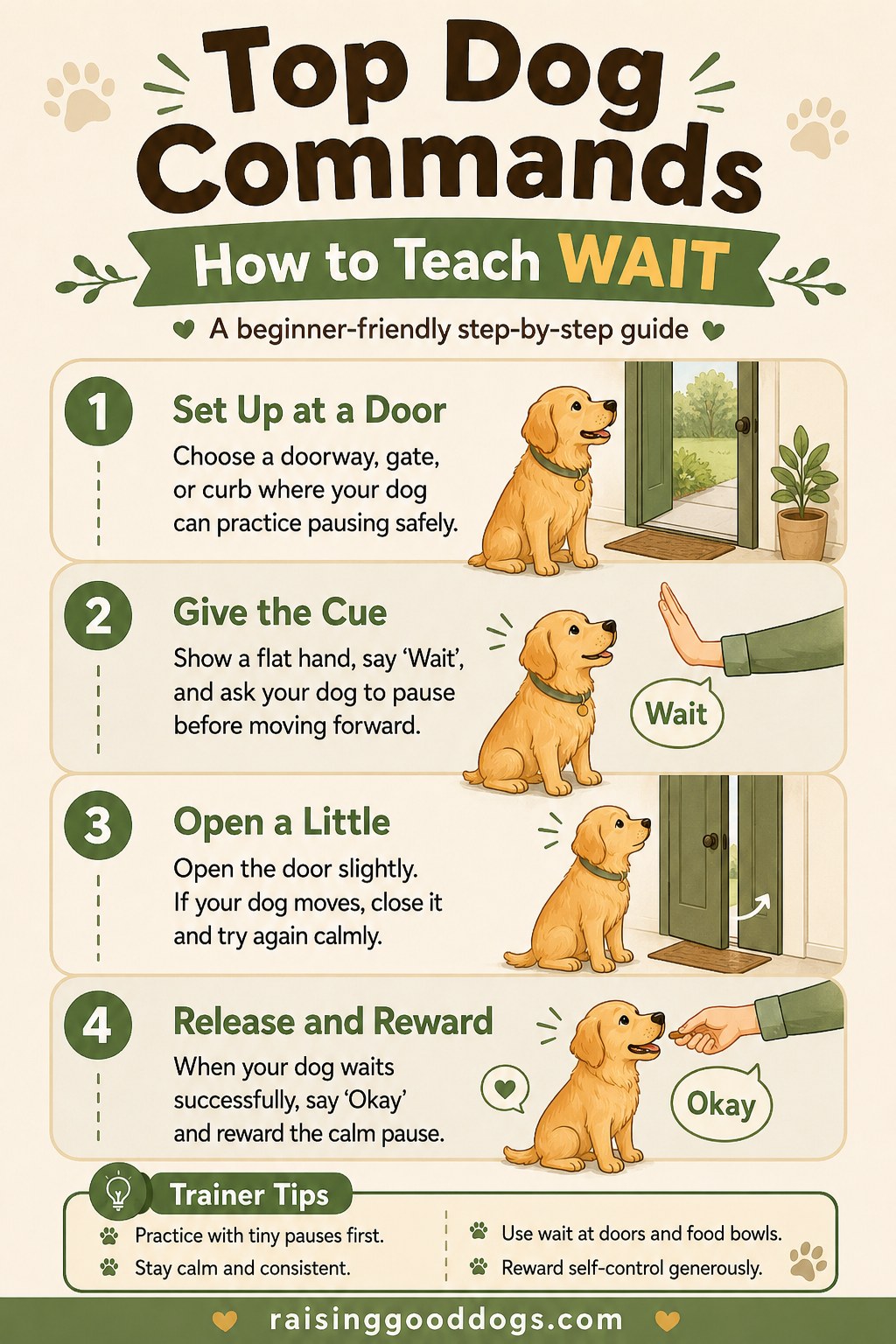
Wait is a shorter ask than stay — it's a pause before a threshold, not a held position — and it's the single most useful cue for keeping a dog from bolting out a front door or a car. Practice at the actual doorway where the behaviour matters, with a flat raised palm and a calm ‘Wait’.
- Open the door only a crack at first, and close it again the moment your dog leans forward.
- Release with a clear word like ‘Okay’, so the dog learns the pause always has a defined end.
- Practise at food bowls too — it builds the same self-control muscle in a lower-stakes setting.
I use this one constantly with my own dogs — Bruno, my twelve-year-old shepherd, still gets a Wait at the door before every outing, partly for manners and partly because his hips need a slower start these days than his brain wants to give him.
Quiet — addressing the bark, not just silencing it
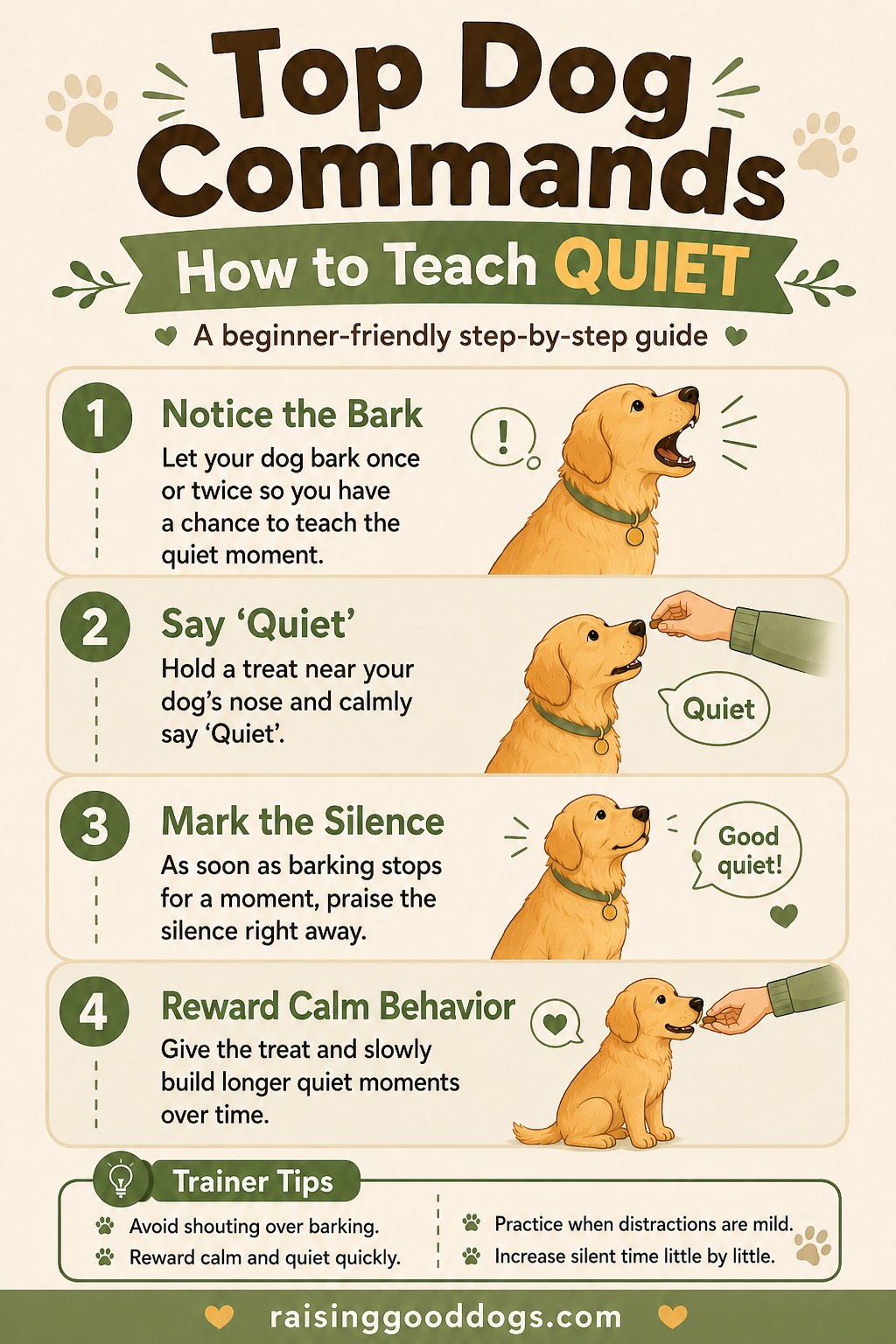
Barking is communication, and Quiet only works if you've figured out what the bark is saying first — alert, boredom, frustration or genuine distress each need a different response, not just this cue layered on top. That said, this is how you teach the word itself: let one or two barks happen so there's something to interrupt, then hold a treat near the nose and say ‘Quiet’ calmly.
Shouting over a barking dog just sounds like joining in — I've never once seen it work, and I've watched a lot of people try.
Mark the silence immediately, even a one-second gap at first, and build duration gradually. If the barking is driven by something more serious — separation-related distress, for instance, where the dog is panicking rather than just noisy — this cue alone won't touch it, and that's a different, longer conversation.
Drop It — trading up, never taking away
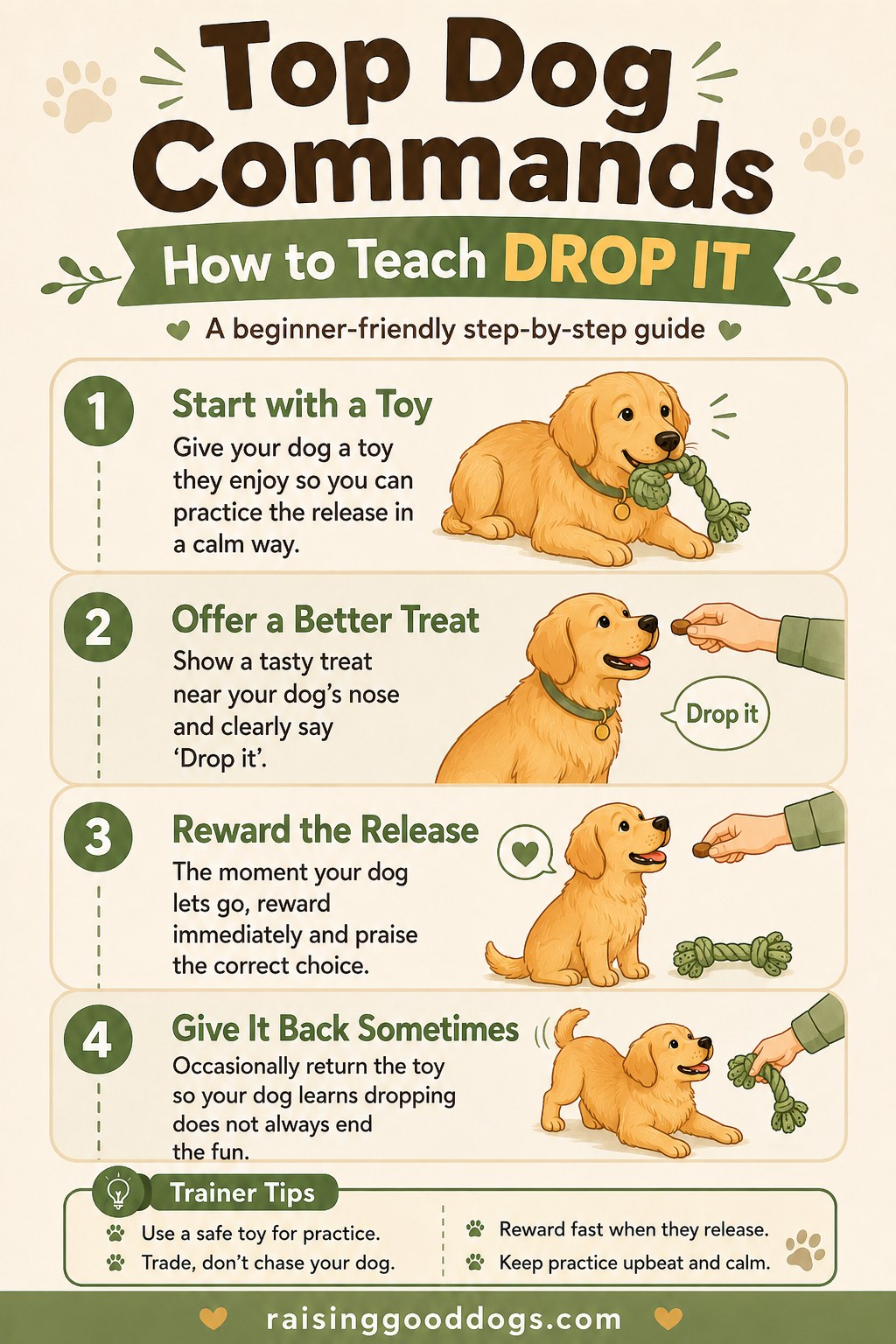
Drop It should always feel like a good deal to the dog, never a confiscation. Start with a toy they like but aren't obsessed with, offer a genuinely better treat near the nose, and say ‘Drop It’ as they release.
- Reward the instant it drops, even if it lands on the floor rather than in your hand.
- Give the toy back sometimes, so dropping doesn't always mean the fun item disappears forever.
- Trade, never chase — chasing a dog for an object almost always teaches them to run off with things faster next time.
One flag I take seriously: if a dog stiffens, freezes, or growls over an object rather than simply holding onto it, that's resource guarding, not stubbornness — and if there's any bite history attached to it, that's a case for an in-person certified trainer, not a DIY fix from a blog post.
Go to Bed — an off-switch you'll actually use
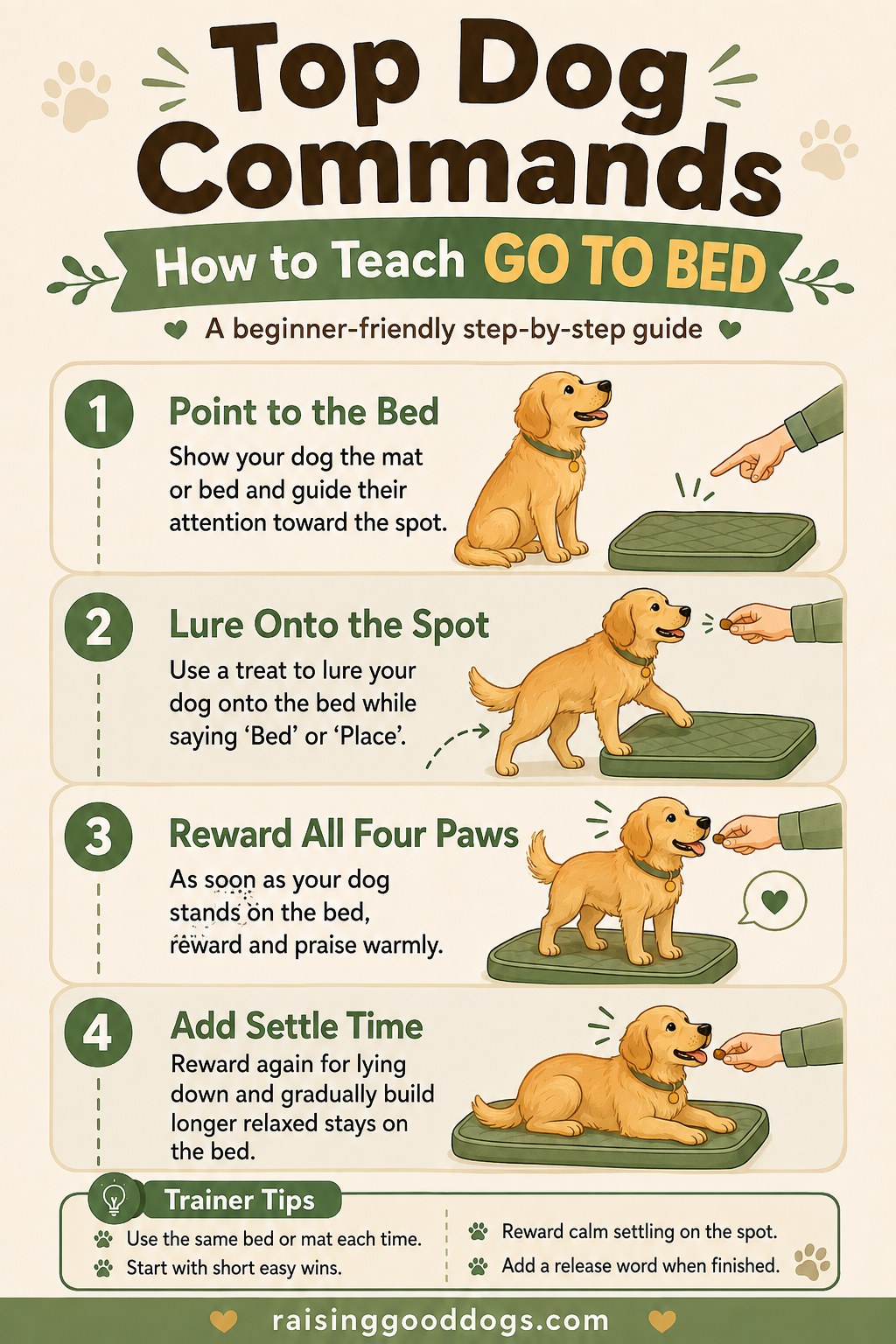
This is the cue clients thank me for most, six months in — a place your dog can settle without being told to stop doing something. Use the same mat or bed every time at first, so the location itself becomes part of the cue. Point to it, lure the dog on with a treat, and reward all four paws landing on the spot.
Add settle time gradually — reward the initial arrival, then start rewarding for staying and lying down there, stretching the duration slowly across sessions rather than all at once. A release word at the end matters just as much as the cue that starts it.
This is the command that's quietly saved my own dinner table more times than any other — Pickle, our terrier, has strong opinions about being underfoot at mealtimes, and a well-trained place cue means everyone eats in peace, including her.
None of these ten will click on the first try, and that's not a sign you're doing it wrong — it's just what learning a new language looks like from the dog's side of the leash. Pick two to start, keep the sessions short and boring-room-quiet, and let the rest wait their turn.





Frequently Asked Questions
What order should I teach these commands in?
I usually start with Sit, then Come and Leave It early, since those have real safety value, followed by Down, Stay, Wait, Drop It, Quiet, Heel and Go to Bed as the dog builds focus. There's no strict rule, but safety-relevant cues earn priority in my sessions.
How long does it really take to get a reliable command?
A basic response usually shows up within a week of short daily practice, but reliability around real distractions — other dogs, a busy street, a visitor at the door — typically takes several weeks to a few months of layered practice. Anyone promising a finished, bomb-proof command in days is skipping the distraction phase.
Do I have to keep using treats forever?
No — once a behaviour is reliable, you shift to intermittent rewards, praise, and life rewards like a walk or a game, rather than a treat every single time. But in the early learning phase, paying generously and consistently is what builds the behaviour in the first place, so I don't rush weaning it off.
My dog knows a command at home but ignores it outside — what's wrong?
Nothing is wrong, that's just how learning generalises. A behaviour taught in a quiet room doesn't automatically transfer to a park full of smells and other dogs. Go back a step in difficulty, practise in new locations deliberately, and build up distraction the same slow way you built the original cue.