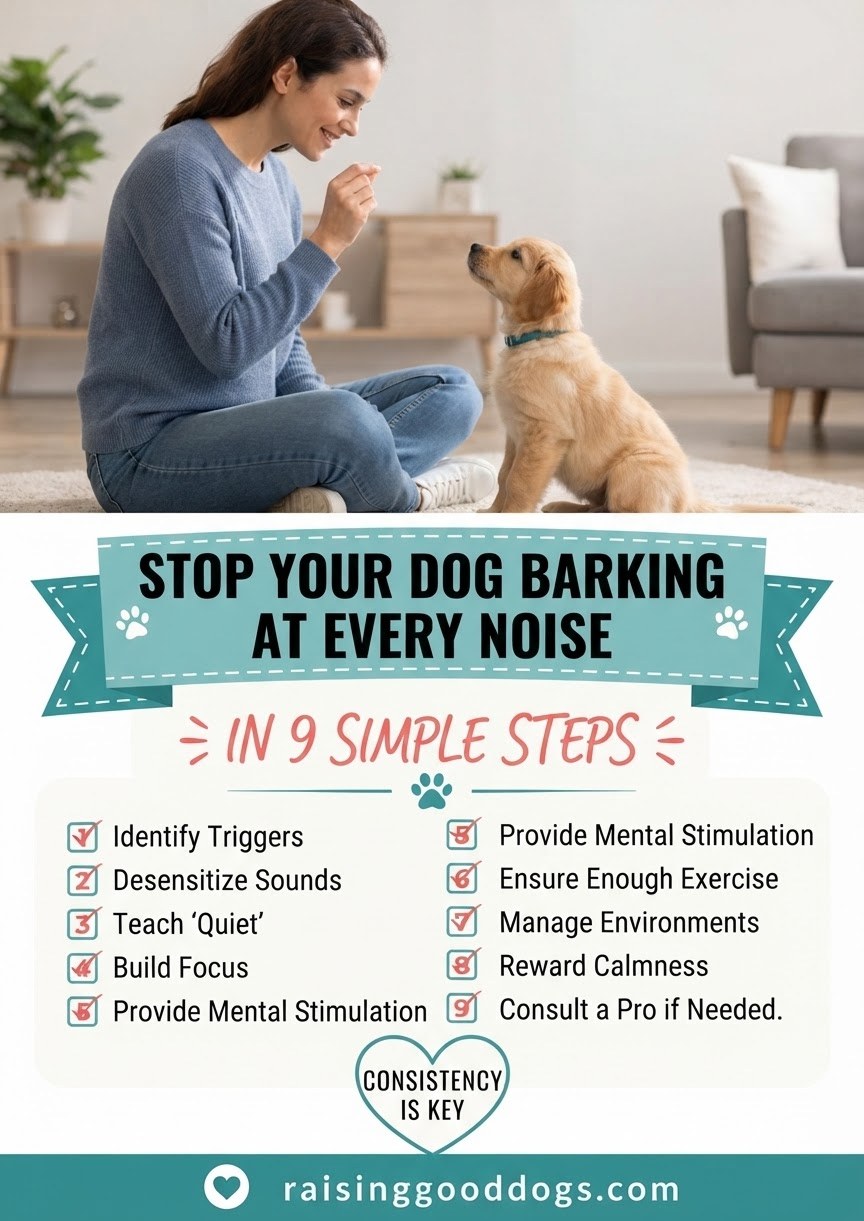
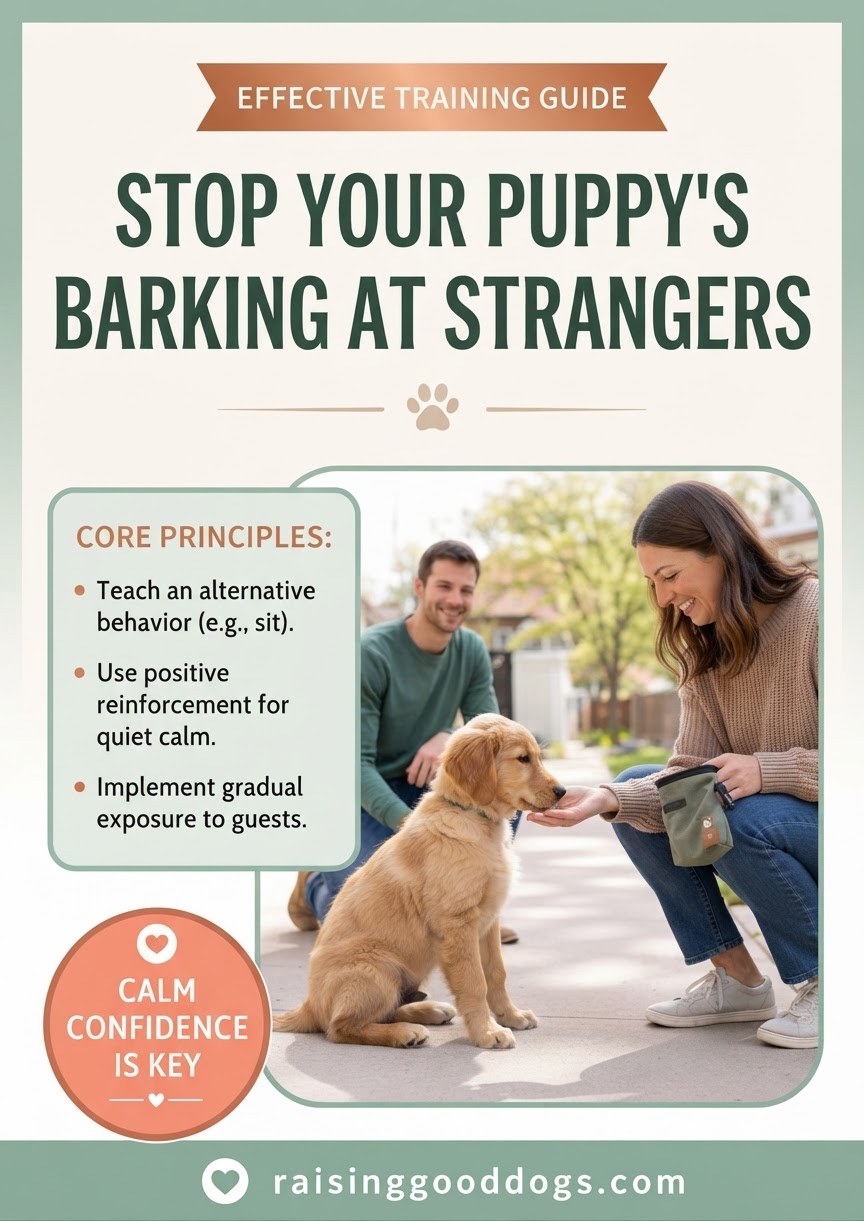
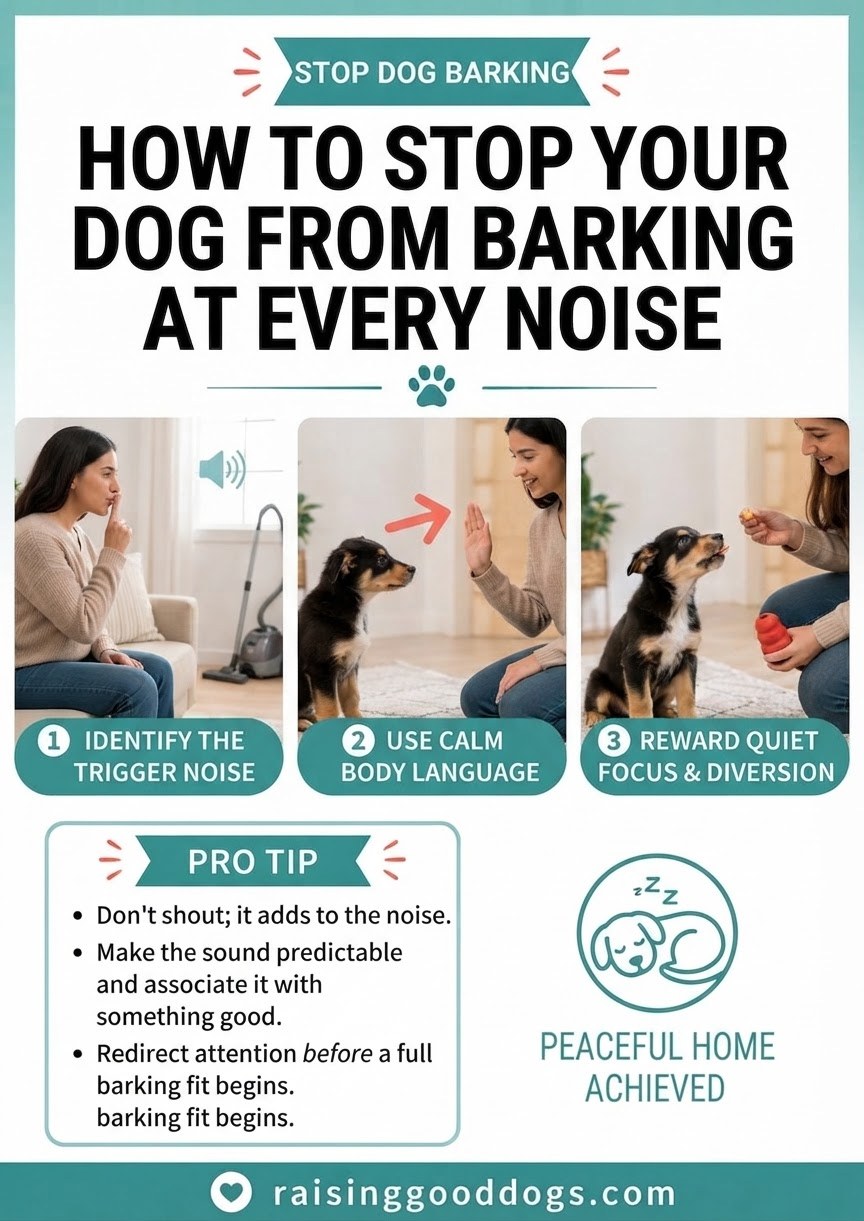
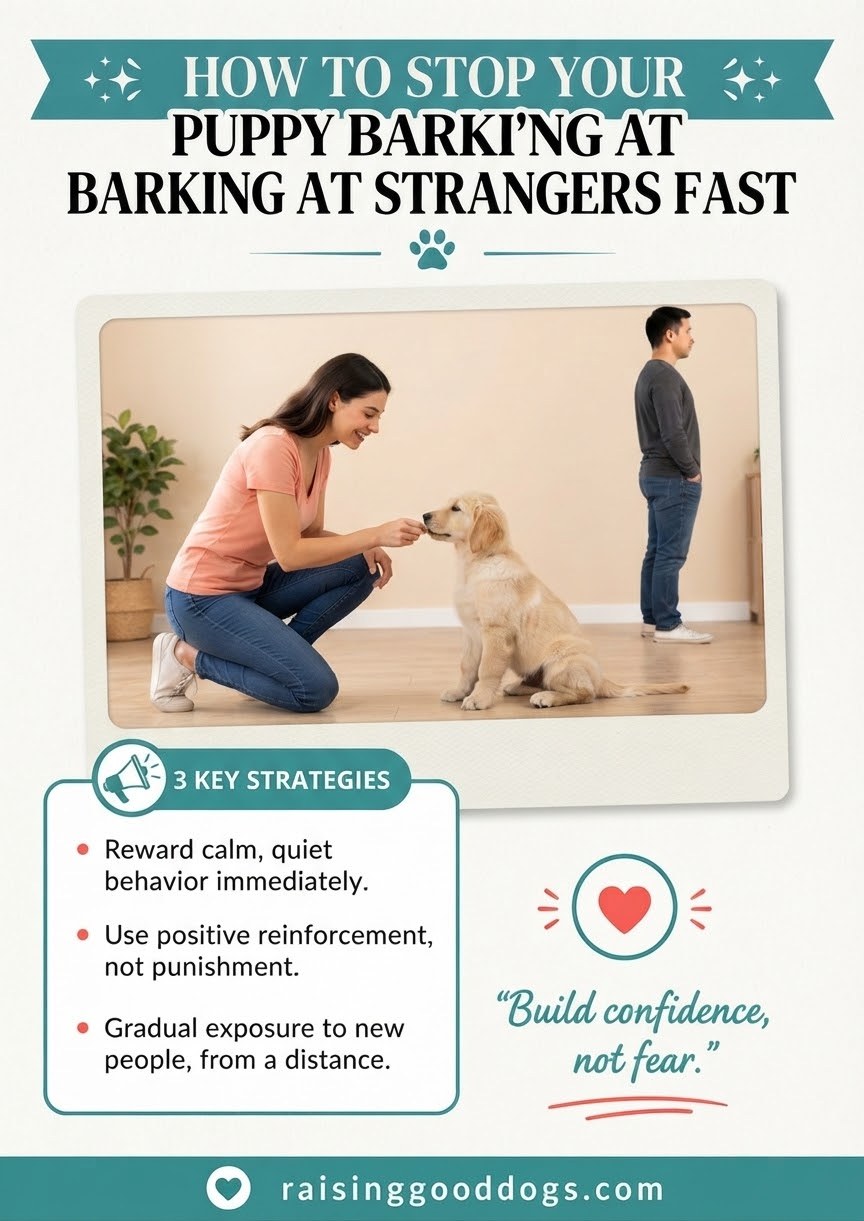
A puppy erupting at the mail carrier or the neighbour with the stroller feels bigger than it is, but in several hundred behaviour cases I've rarely seen it be an emergency. This is a straightforward, eight-step plan I actually run with clients — no yelling, no corrections, just distance, timing, and a lot of short, boring repetitions that quietly work.
What's Actually Going On Here
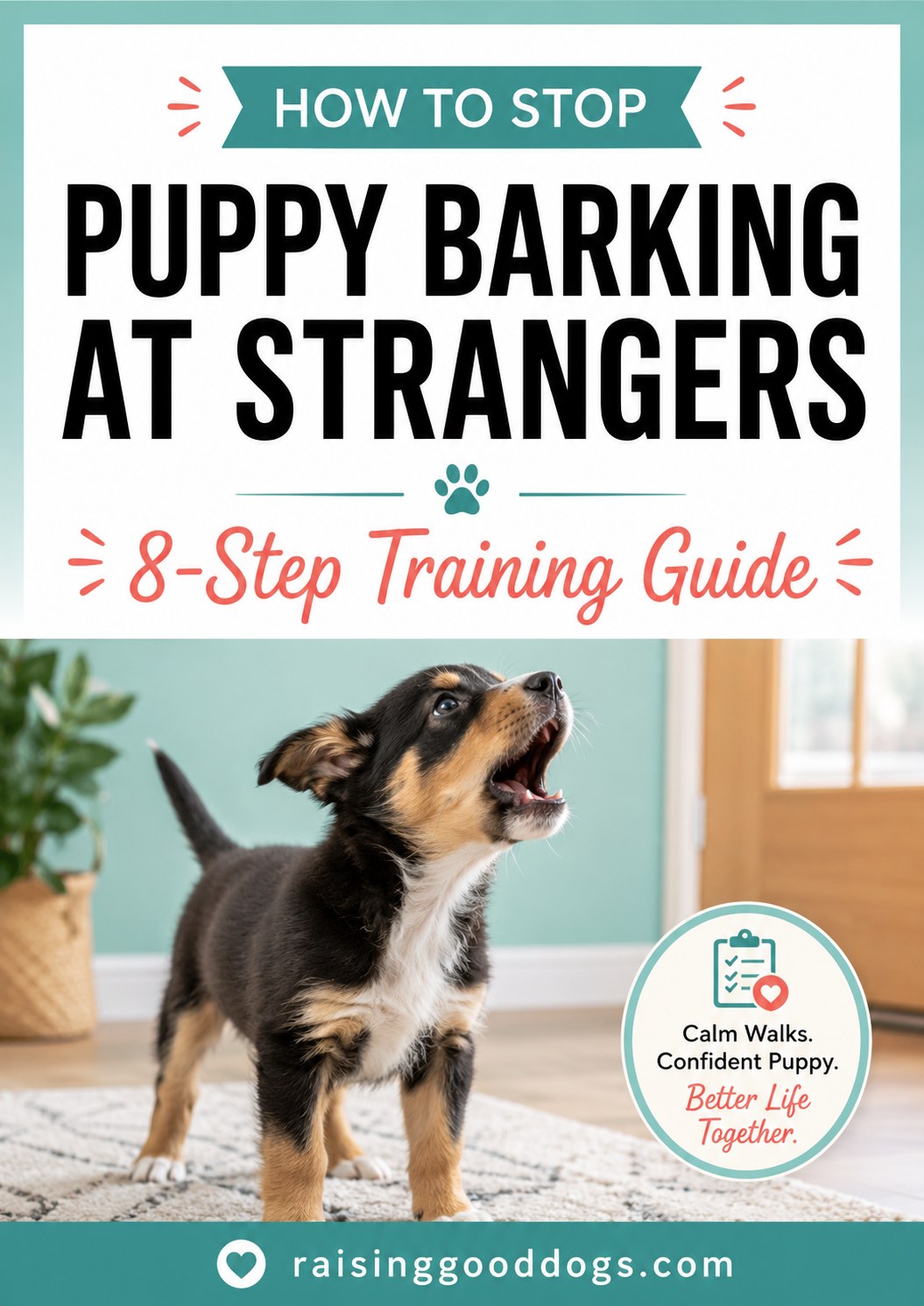
Most puppies bark at strangers somewhere between eight weeks and six months, and across several hundred behaviour cases, it is rarely the emergency owners think it is. A puppy alert-barking at the mail carrier or the man with the umbrella is usually just announcing something new — that is communication, not aggression, and it is not something I would ever punish out of a puppy.
What actually matters is catching it early, before the barking gets rehearsed into a habit. Every plan I run starts the same way: fewer chances to practice the bark, more chances to practice calm. The eight steps below are the plan I hand clients in session, adapted for home use.
One caveat before you start: if your puppy is lunging, snapping, or freezing with a tucked tail and whale eye rather than doing a quick bark-and-look, that is a different situation, and worth a call to a certified trainer or your vet sooner rather than later.
Step 1: Identify the Trigger
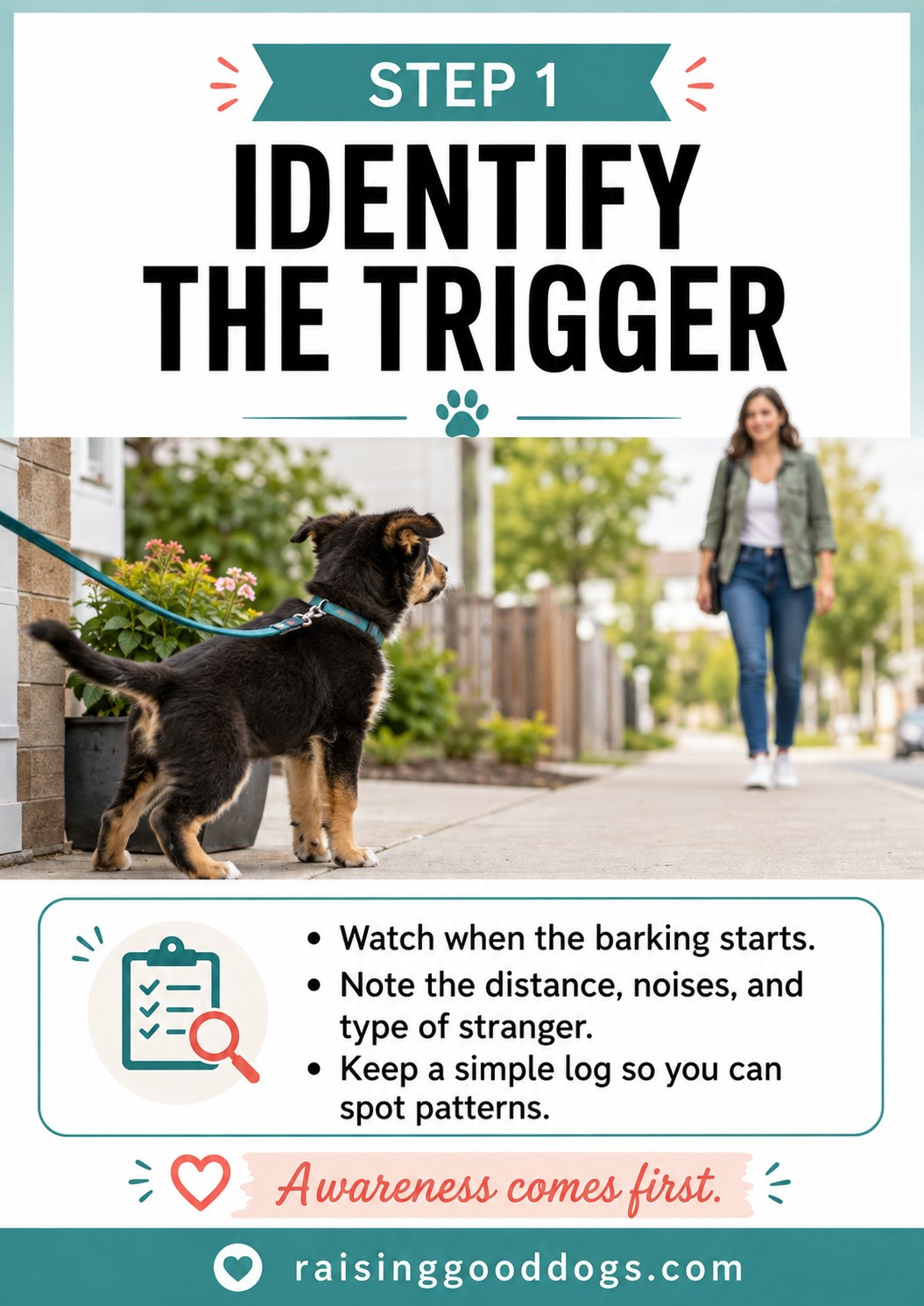
Before you change anything, spend three or four days just watching. You cannot fix a pattern you have not actually seen.
- Distance — how close does a stranger get before the barking starts? That number is your starting point for every session after this one.
- The stranger — hats, beards, sunglasses, uniforms, strollers, skateboards, kids running. Puppies often generalise a fear to a category of person, not a specific one.
- The sound and movement — a jogger, a loud laugh, a screen door. Sudden or fast triggers a different response than someone walking calmly.
Keep a simple notebook log. I still tell clients this, fourteen years in: the pattern you find in week one usually explains the whole case.
Step 2: Start Far Enough Away
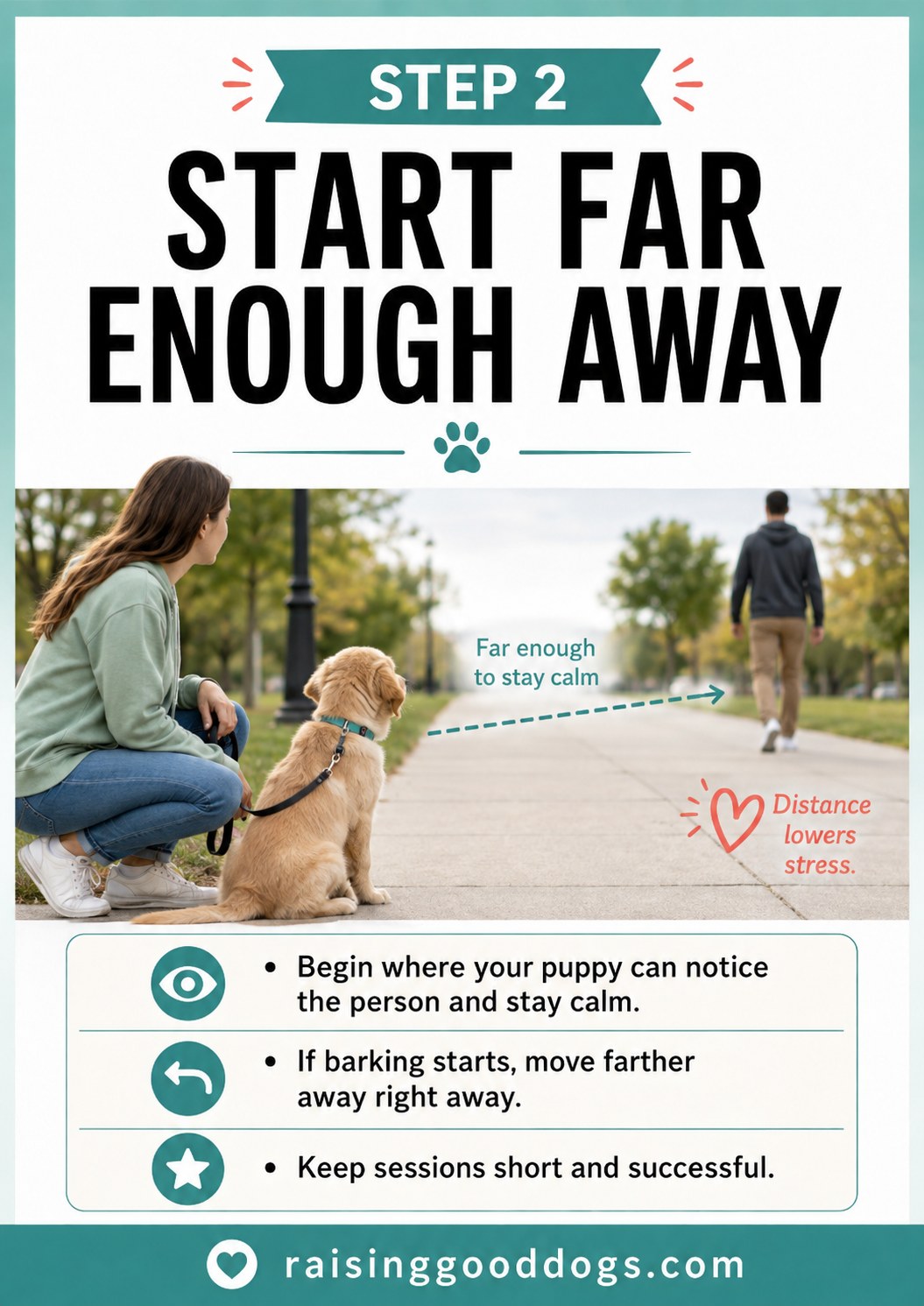
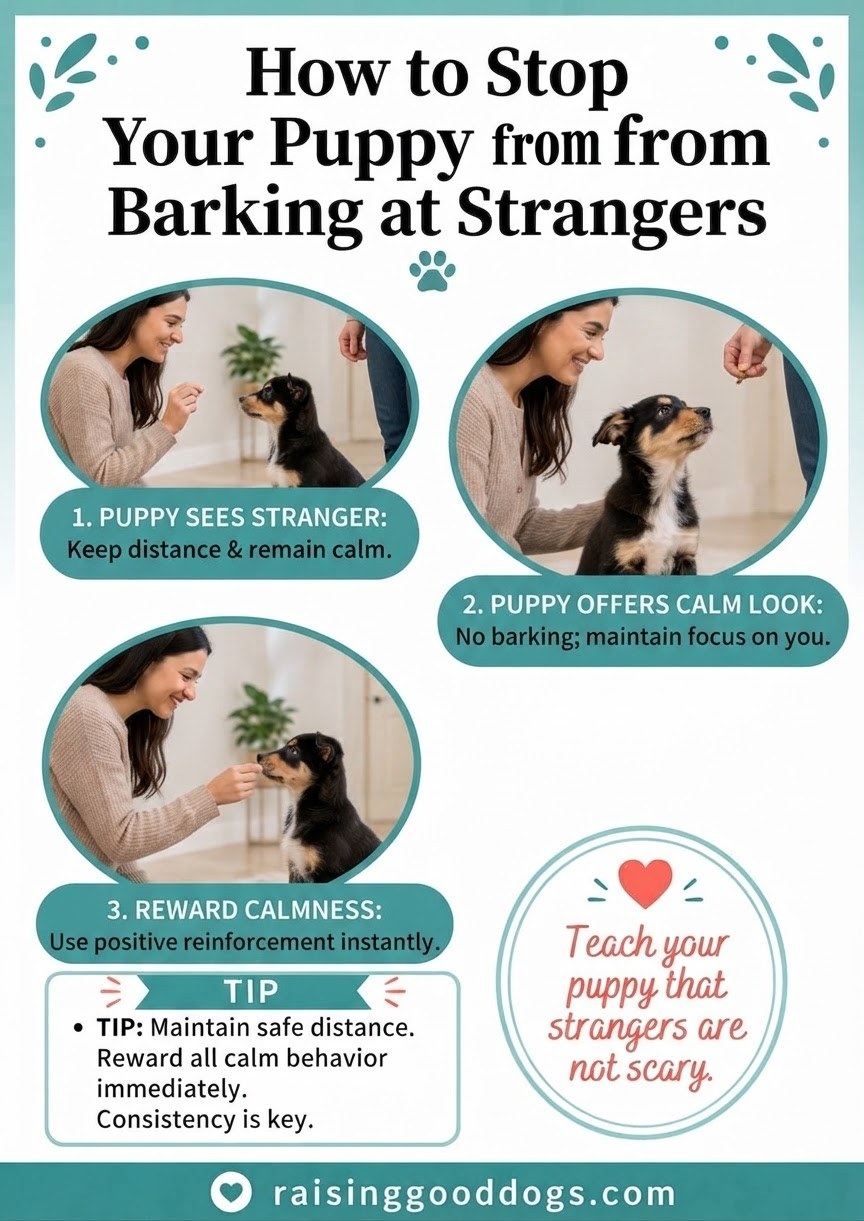
Distance is the single most powerful tool in this entire plan, and it is the one people skip because it feels like giving up ground. It is not. Find the spot where your puppy can see the stranger, register them, and still take a treat with a soft mouth and a loose body — that is your working distance, not the distance you wish you had.
If your puppy cannot eat, cannot look away, or is stiff and staring, you are too close — move back before you do anything else. Training under threshold is the whole plan; everything past that point is just rehearsal of the bark.
Start sessions here, and expect that working distance to shrink over several weeks, not several days. If it grows instead — your puppy needs more space today than yesterday — that is not failure, it is information, and it usually just means back up and shorten the session.
Step 3: Reward Calm Looking
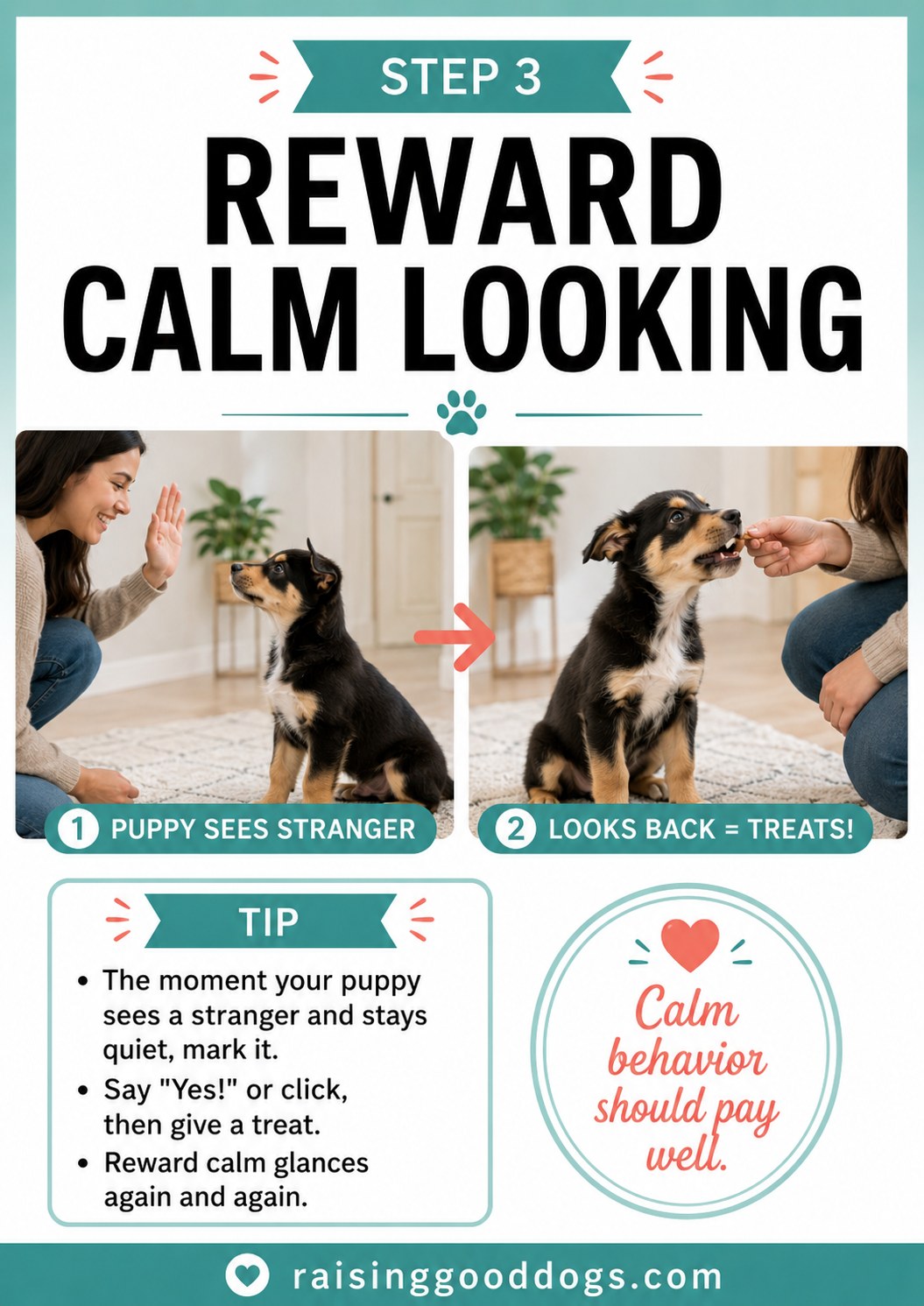
This step is about timing, not luck. The instant your puppy notices a stranger and stays quiet — even for half a second — mark it. I use a verbal “yes,” some clients prefer a clicker, either works as long as it is immediate.
- See stranger, stay calm, get marked — in that exact order, every time.
- Reward generously — small, high-value, fast. This is not the moment for kibble.
- Repeat often — you are building a habit of glancing and returning to you, not staring and escalating.
Puppies who get good at this step early tend to move through the rest of the plan faster, because you have taught the most important skill already: noticing a person is not the same as reacting to one.
Step 4: Teach “Watch Me”
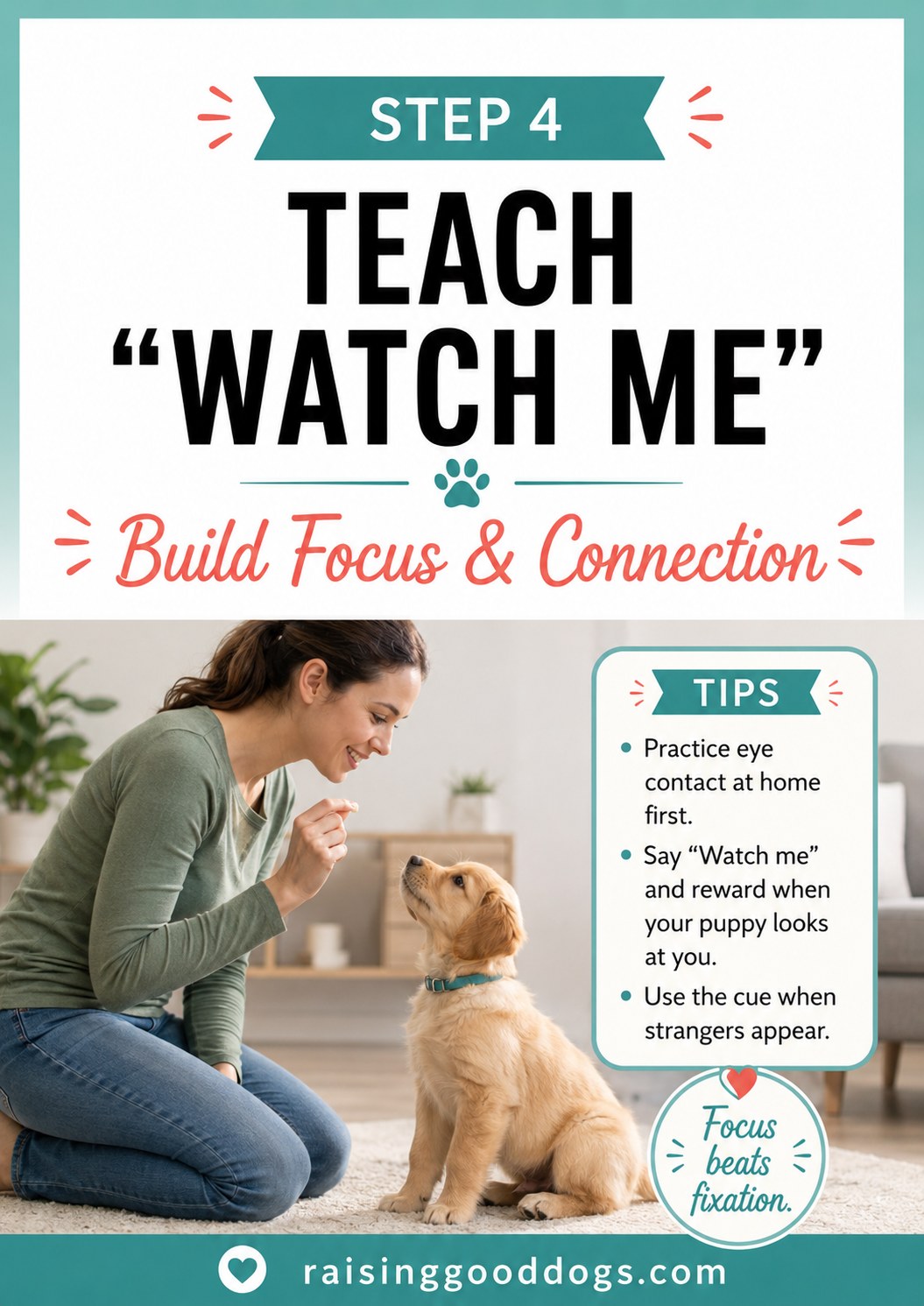
I teach “watch me” at home first, with zero distractions, long before I ever expect a puppy to use it near a stranger — most of my early sessions happen at seven in the morning on an empty school field for exactly this reason, no audience, no pressure, just repetition.
Say the cue, puppy looks at your eyes, treat appears. Do this ten or fifteen times a day in short bursts until it is fast and automatic indoors. Only then do you bring it outside, and only at a distance where your puppy can actually succeed.
Why this matters more than it looks like it should
“Watch me” gives your puppy a job to do instead of staring. A puppy with a job rarely spirals into a full alarm bark — the cue interrupts the pattern before it starts, which is the entire point.
Step 5: Pair Strangers With Treats
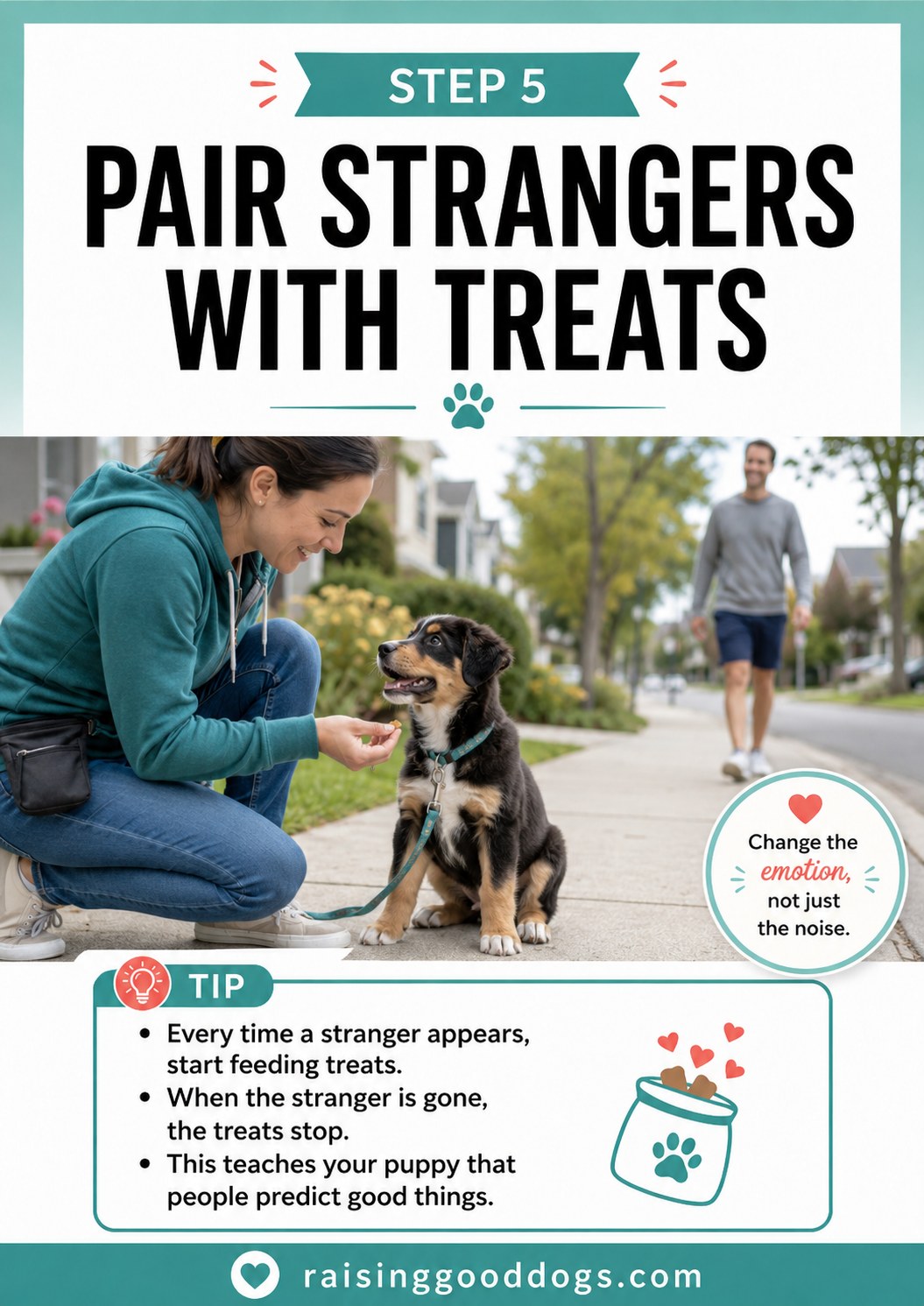
This is classical conditioning, and it is doing something different from Step 3 — you are not waiting for calm behaviour to reward, you are changing how your puppy feels about strangers appearing at all.
The mechanics are simple: stranger appears, treats start flowing, no cue needed, no “good boy” required. Stranger leaves or passes, treats stop. Over dozens of repetitions, your puppy starts predicting that people mean good things, before you have asked for a single behaviour.
This is the step that actually shifts the underlying emotion rather than just managing the symptom, and it is why I run it alongside Step 3 rather than after it. Change the feeling, and the behaviour tends to follow on its own.
Step 6: Practice With Friendly Helpers
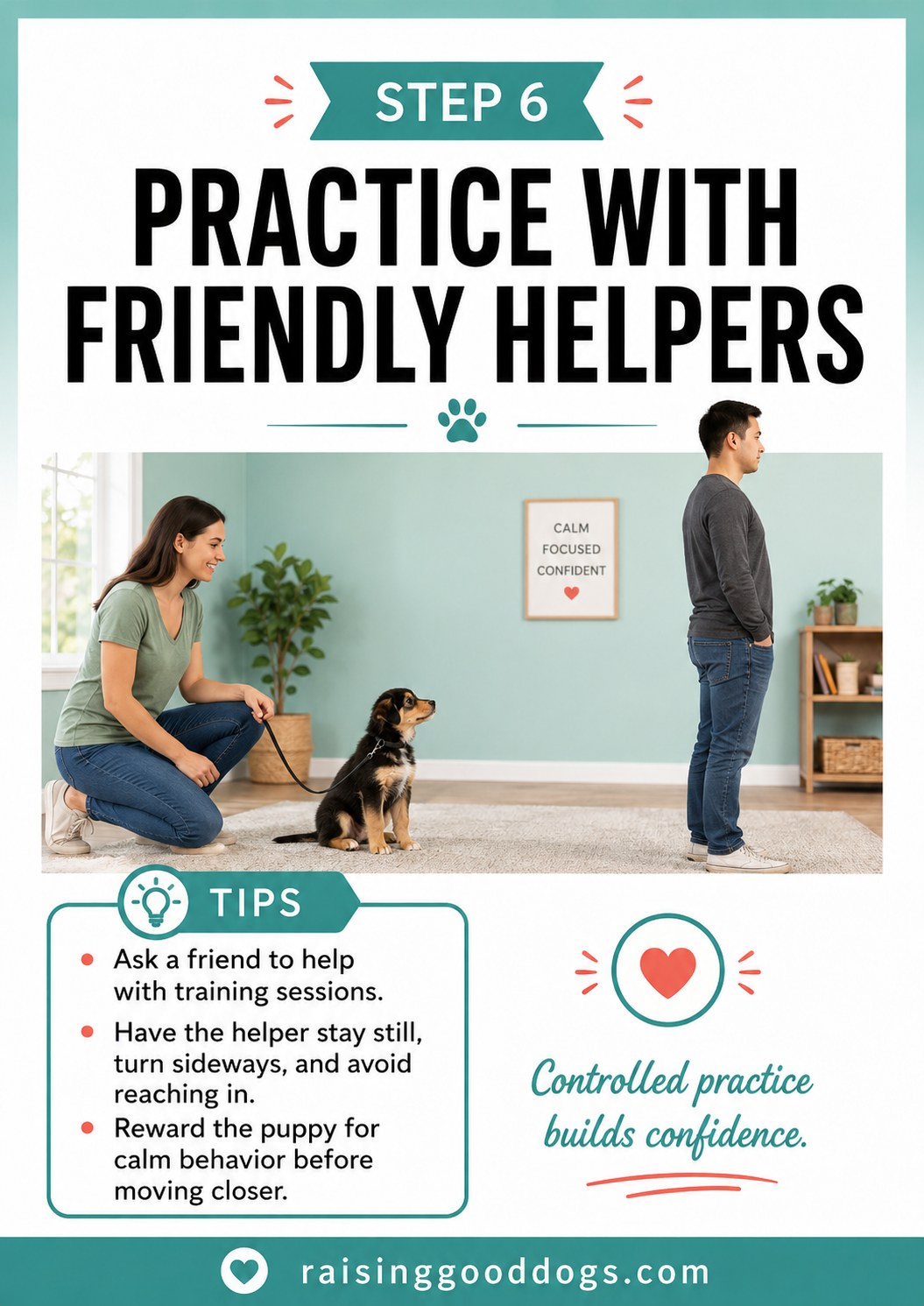
Enlist a friend or neighbour who can follow instructions, because the instructions matter more than their dog-charm. Have them stand still, turn sideways rather than facing your puppy head-on, and resist every urge to crouch down and reach in — that is flooding, not socialisation, and it undoes the last five steps in about four seconds.
- Helper stays still and sideways — no approaching, no talking directly at the puppy at first.
- You control the distance — start where Step 2 told you to start, not closer.
- Reward calm before moving in — only shrink the gap once your puppy has stayed loose and quiet for several repetitions.
This is where progress usually shows up first, because a helper who takes instruction is far more predictable than a stranger on the sidewalk.
Step 7: Practice Polite Greetings
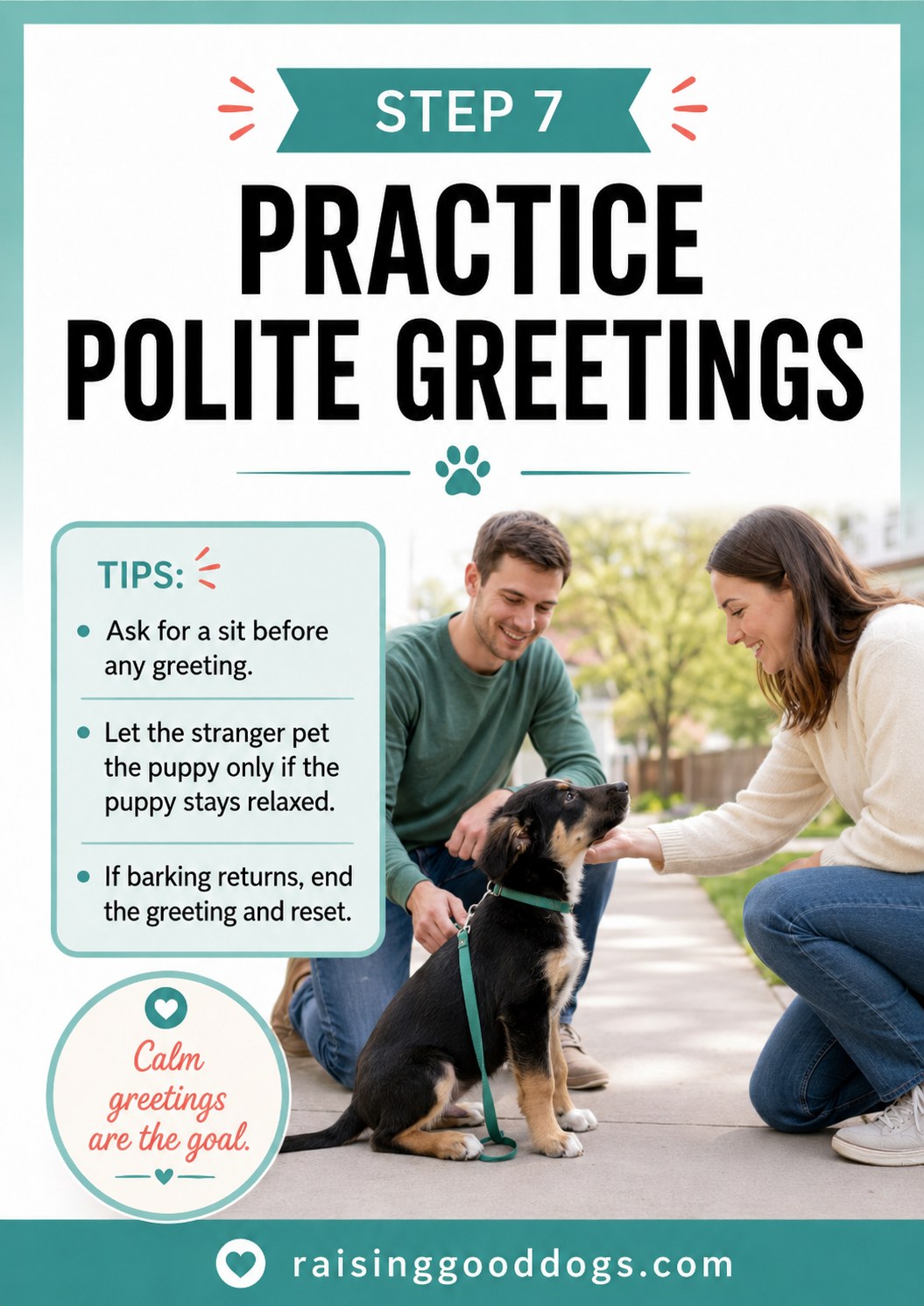
Ask for a sit before any greeting begins — it gives your puppy something familiar to do with an unfamiliar person standing close, and it gives you an easy read on whether he is actually relaxed or just holding still.
Let the stranger pet only if the puppy stays loose — soft eyes, wiggly body, no stiffening. If the barking comes back, that is your puppy telling you the interaction moved too fast; end it there, add distance, and try again another day rather than pushing through.
A quick safety note, because I would rather say it than assume it: if greetings ever involve snapping or a bite, stop doing them entirely and bring in a certified professional — that is no longer a blog-post situation, and it is not something to work through alone.
Step 8: Stay Consistent
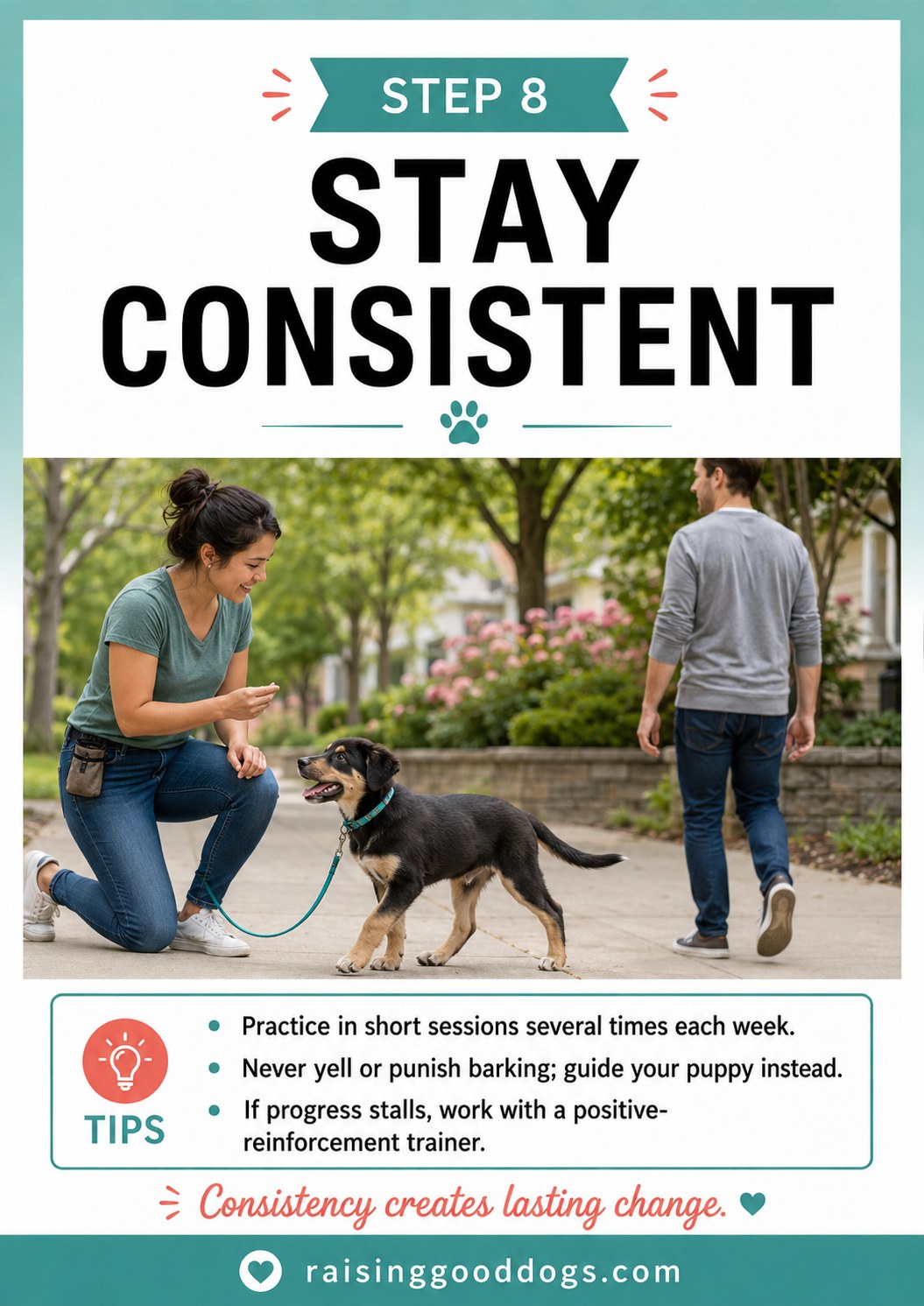
This is the step that actually determines whether the first seven hold up, and it is the one nobody wants to hear: expect this to take somewhere between six and twelve weeks of short, regular sessions, sometimes longer for a puppy who came into it especially cautious. There will be a week where progress seems to stall completely — that is a plateau, not a failure, and it almost always resolves if you keep the sessions short and keep the distance honest.
Never yell at or punish the bark itself. It suppresses the warning without touching the feeling underneath it, and I have watched that trade go badly for a lot of dogs over the years. Guide instead, redirect instead, and if progress genuinely stalls for several weeks running, bring in a positive-reinforcement trainer to look at what your particular puppy is telling you.
None of this happens in one walk. It happens in dozens of short, quiet ones, most of which look like nothing is happening at all — right up until the week your puppy notices someone at the far end of the street and just doesn't bark. That's the plan working.





Common Questions
Is it normal for puppies to bark at strangers?
Yes — alert barking at new people is a normal developmental phase, not aggression. What's not typical is lunging, snapping, or freezing with a tucked tail, which points toward fear and is worth a professional's eyes.
How long does it take to stop a puppy barking at strangers?
In my experience, plan on six to twelve weeks of short, consistent sessions, sometimes longer for a naturally cautious puppy. Expect a plateau somewhere in the middle — that's normal, not a sign the plan has failed.
Should I correct or punish my puppy for barking at a stranger?
No. Punishment can suppress the bark without touching the fear or excitement underneath it, which often makes things harder to read later. Redirecting to a cue and rewarding calm works better and builds trust instead of eroding it.
When does this need a professional instead of a blog plan?
If barking has become snapping, biting, or prolonged freezing and fear rather than a quick bark-and-look, stop the DIY approach and bring in a certified professional trainer, with a vet involved if anything about the change seems sudden.