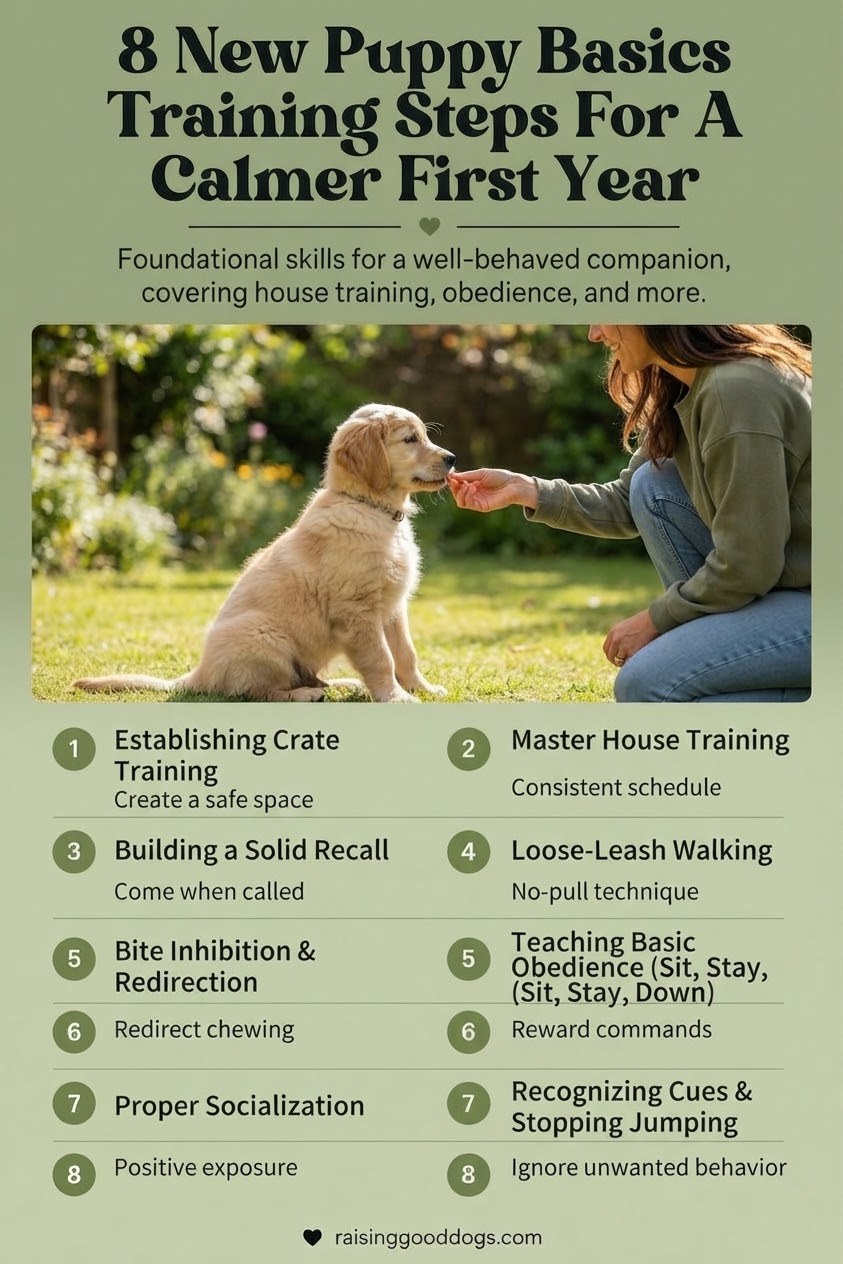
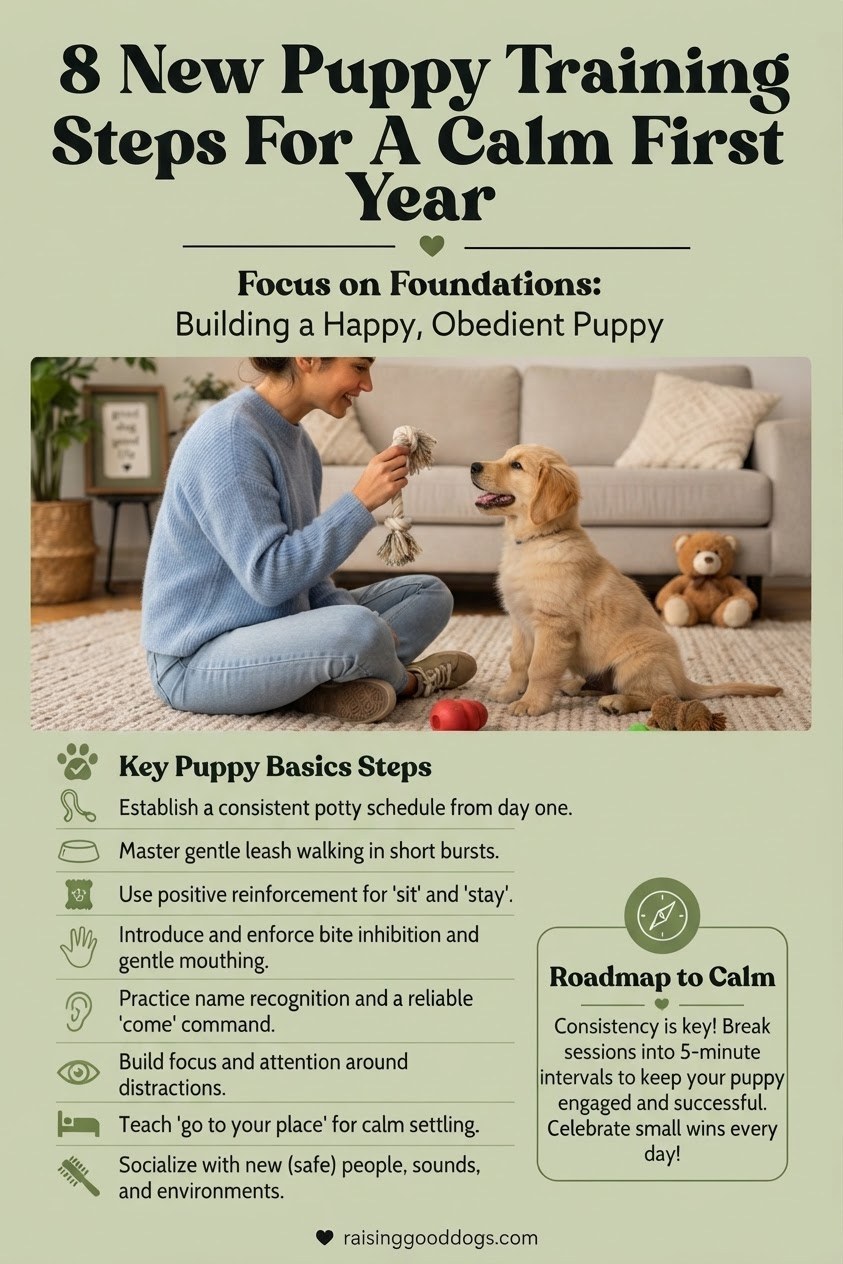
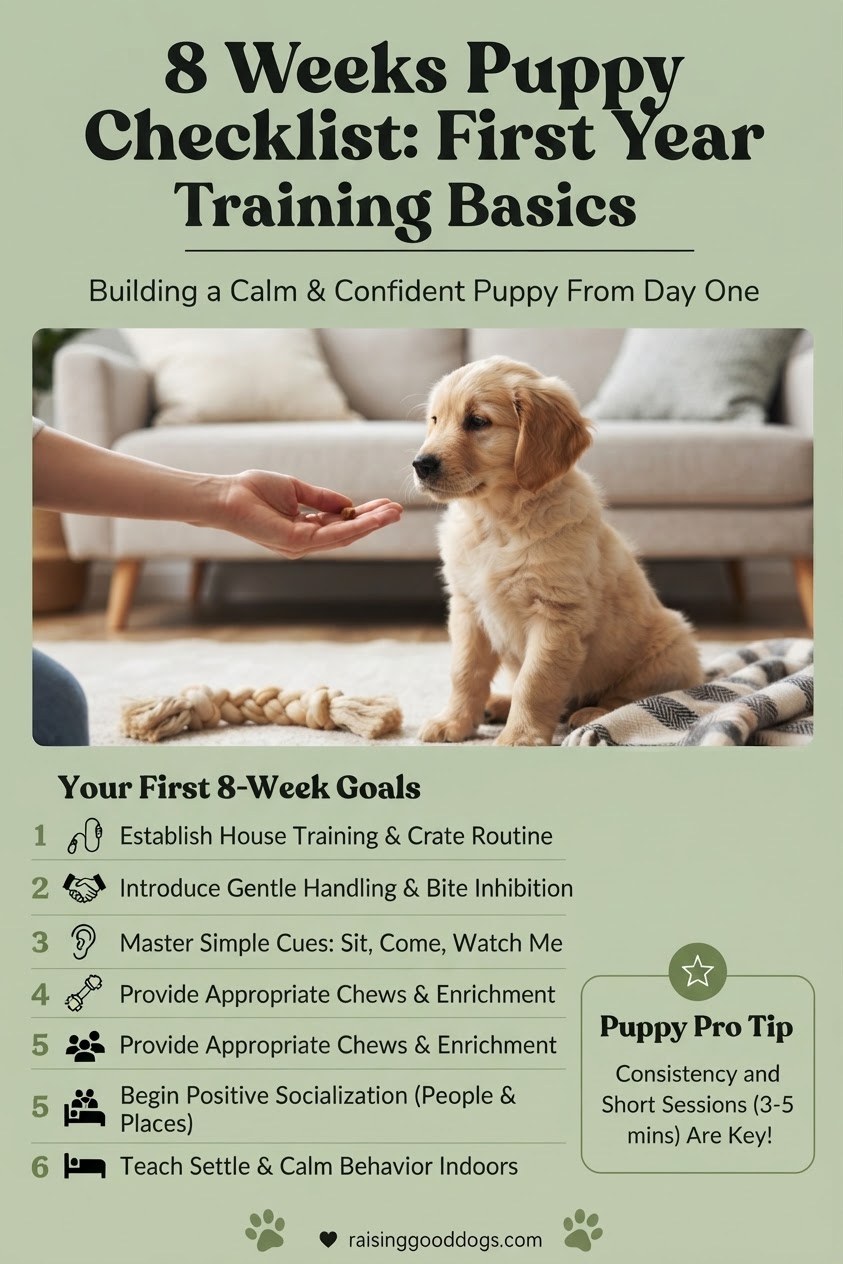
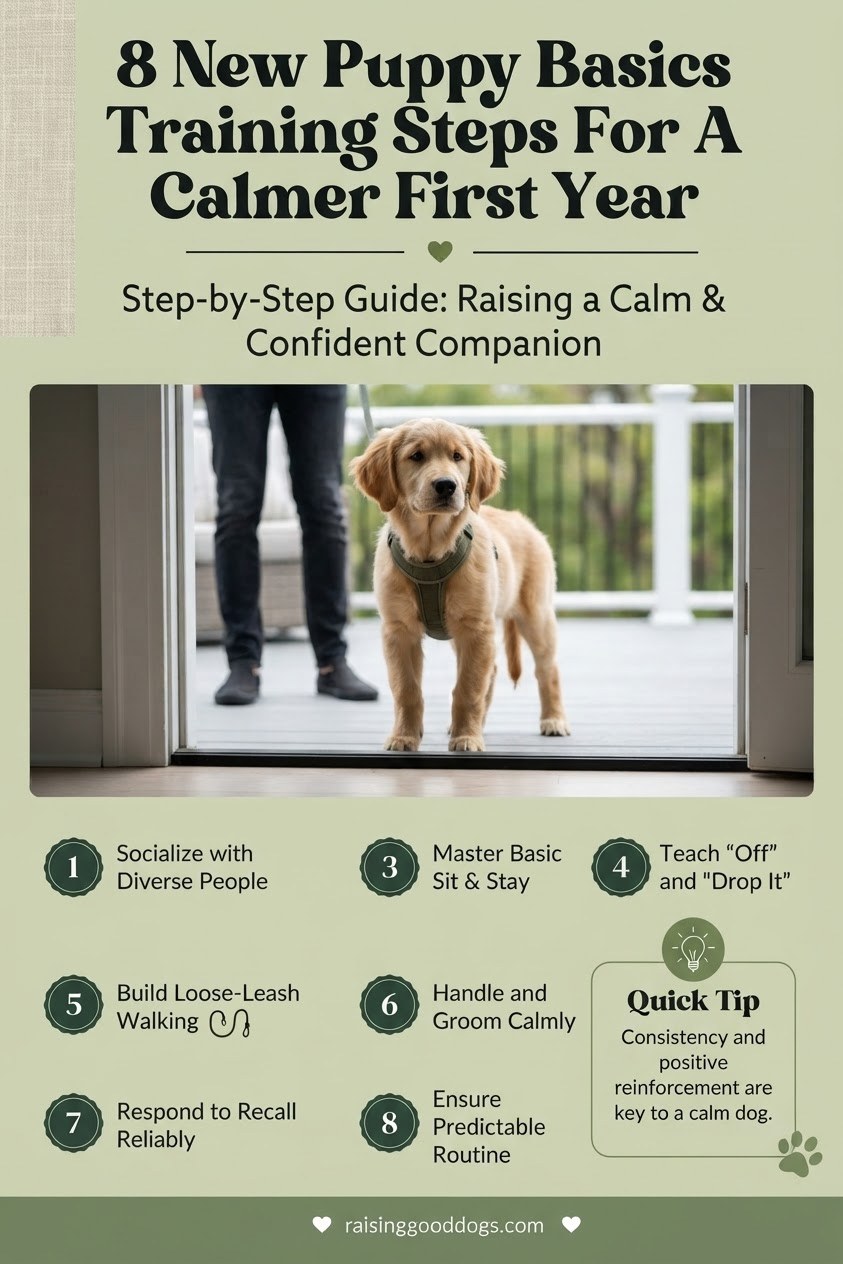
I still remember my vet-assistant years, watching adolescent dogs get surrendered for things nobody ever taught them as puppies — not because their owners didn't care, but because nobody handed them a realistic order of operations. This is the order I actually use with clients: eight foundational pieces, built in the sequence that keeps a puppy from rehearsing the wrong habits while you're teaching the right ones.
Build a Daily Routine
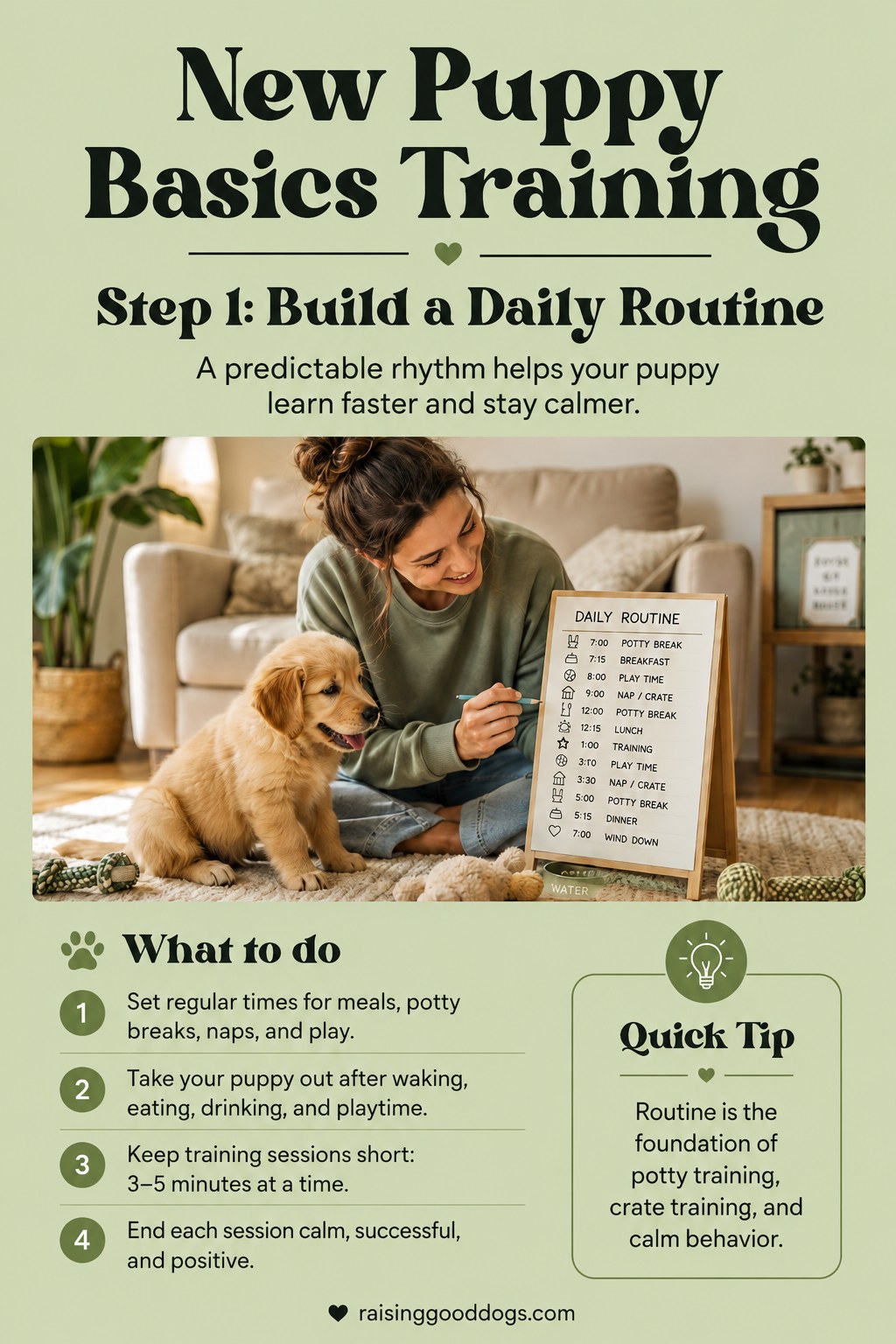
Before you teach a single cue, build the schedule that makes the cue possible. Puppies don't generalise well and they don't yet know when relief, food, or rest is coming — a predictable rhythm removes the guesswork that causes most of the early chaos owners call 'bad behaviour.'
- Fixed anchor points for meals, potty breaks, naps, and play — same rough times, every day.
- Out immediately after waking, eating, drinking, or a play session, no exceptions in week one.
- Three to five minutes per training session — a puppy's attention span won't give you more, and pushing past it teaches frustration, not focus.
- End on a win — always finish while your puppy is still succeeding, never after the fifth failed attempt.
This is the least glamorous piece of the whole plan and the one I've watched fix the most problems downstream. Potty accidents, crate meltdowns, and overtired biting spikes almost all trace back to a puppy whose day had no shape.
Potty Training Basics
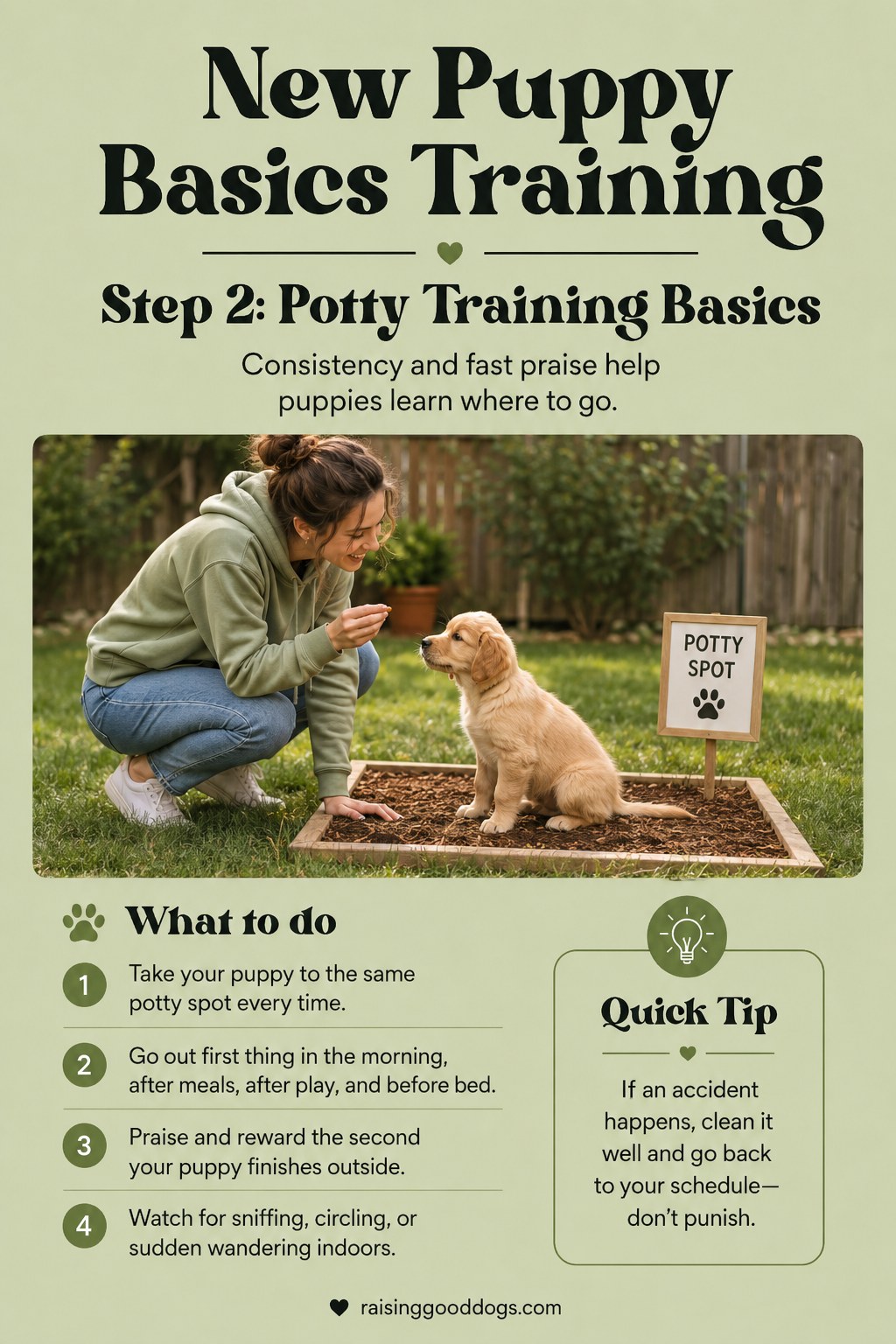
Potty training is a math problem before it's a behaviour problem: a puppy's bladder can generally hold about one hour per month of age, plus a bit — so a two-month-old puppy needs a yard trip roughly every two hours, awake, no matter how good your praise timing is.
- Same spot, every time — the scent cue does real work here.
- Go out first thing, after every meal, after every play session, and right before bed.
- Praise the second the behaviour finishes, not on the walk back inside.
- Watch the tells — sniffing, circling, sudden wandering off toward a doorway.
An accident is a missed data point, not a discipline problem — clean it fully with an enzymatic cleaner, adjust your timing, and move on. I have never once seen scolding speed this up.
If a previously reliable puppy suddenly starts having frequent accidents, that's a vet visit before it's a training plan — a urinary infection will wreck a schedule that was otherwise working fine.
Crate Training
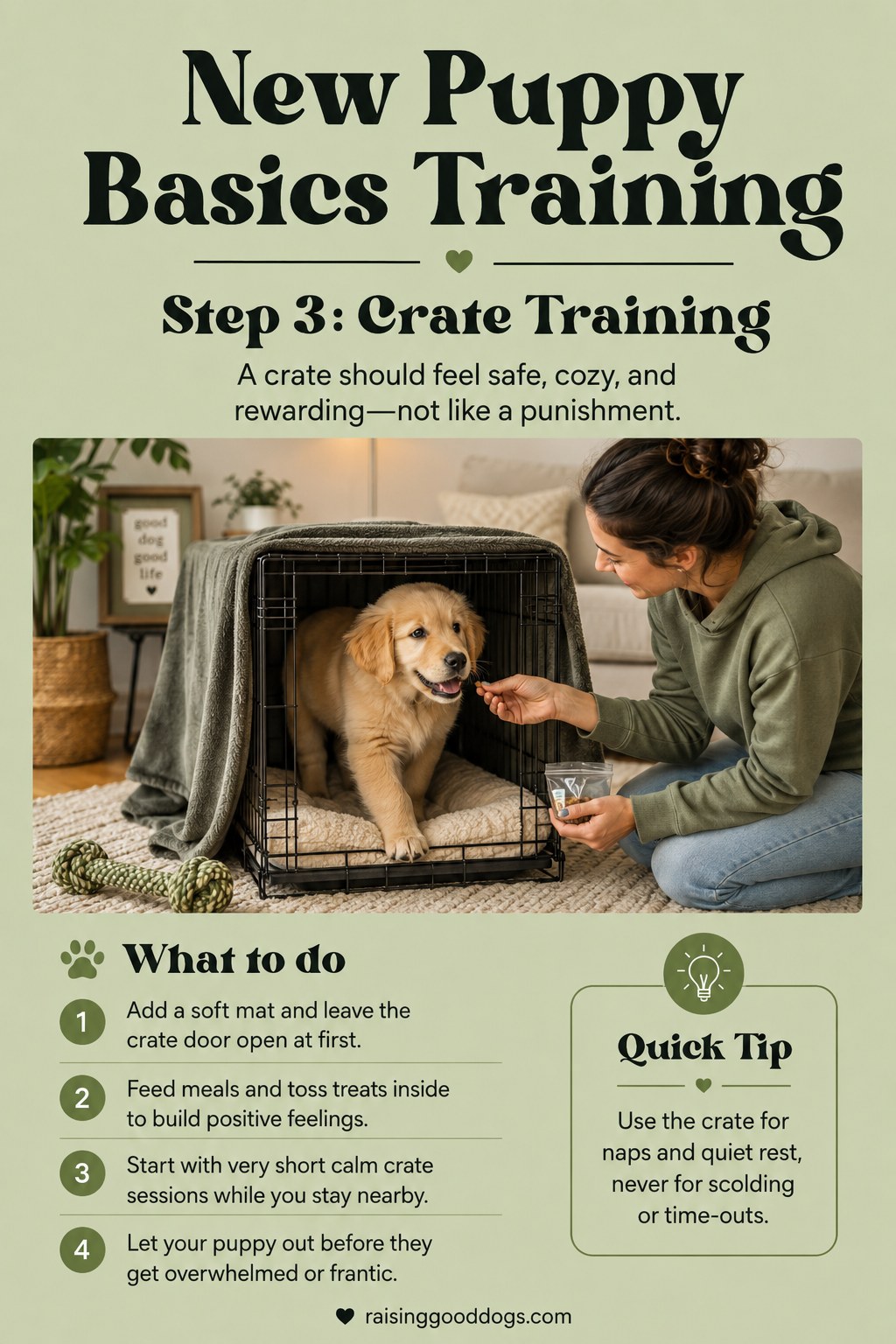
A crate is a resting space, not a consequence — and puppies read the difference in about a day, which is exactly why the introduction matters more than the equipment.
Set it up to feel good before you ever close the door:
- A soft mat, door left open at first, no forced entries.
- Meals and tossed treats delivered inside, building a genuine positive association.
- Very short calm sessions with you nearby before you leave the room.
- Let your puppy out before overtired or frantic — a crate session that ends in a meltdown teaches the opposite of what you wanted.
Duration limits scale with age — roughly an hour per month of age during the day, with longer stretches only overnight once bladder control catches up. If your puppy howls, scratches, or panics rather than settling, that's information, not defiance — some dogs genuinely do better with an exercise pen instead, and there's no shame in switching.
Name, Sit & Come
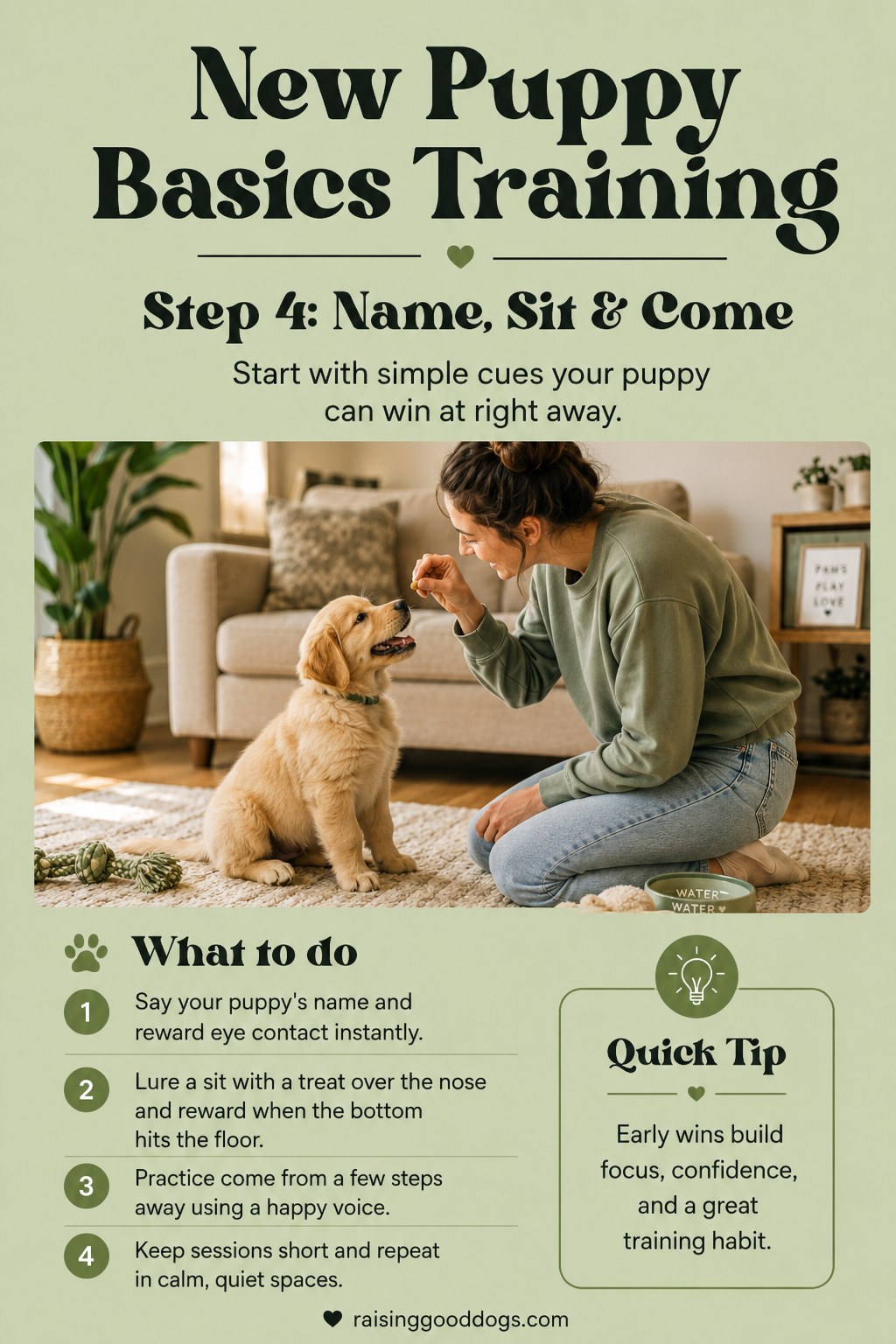
The first cues I teach any puppy aren't about control — they're about building a habit of winning. Name recognition, a lured sit, and a two-step 'come' are all cues a puppy can succeed at instantly, and early success is what makes the harder training later actually stick.
How to run it
- Say the name once, reward eye contact the moment it happens — no repeating the name into the void.
- Lure a sit with a treat over the nose, mark the instant the bottom touches the floor.
- Practice 'come' from a few steps away with a happy voice and an obvious reward, never as a summons for something unpleasant.
- Keep every session short, quiet, and set up so your puppy can't really fail.
Skip corrections here entirely — a puppy that gets it wrong needs an easier setup, not a firmer tone. This is the stage where confidence gets built or quietly undermined.
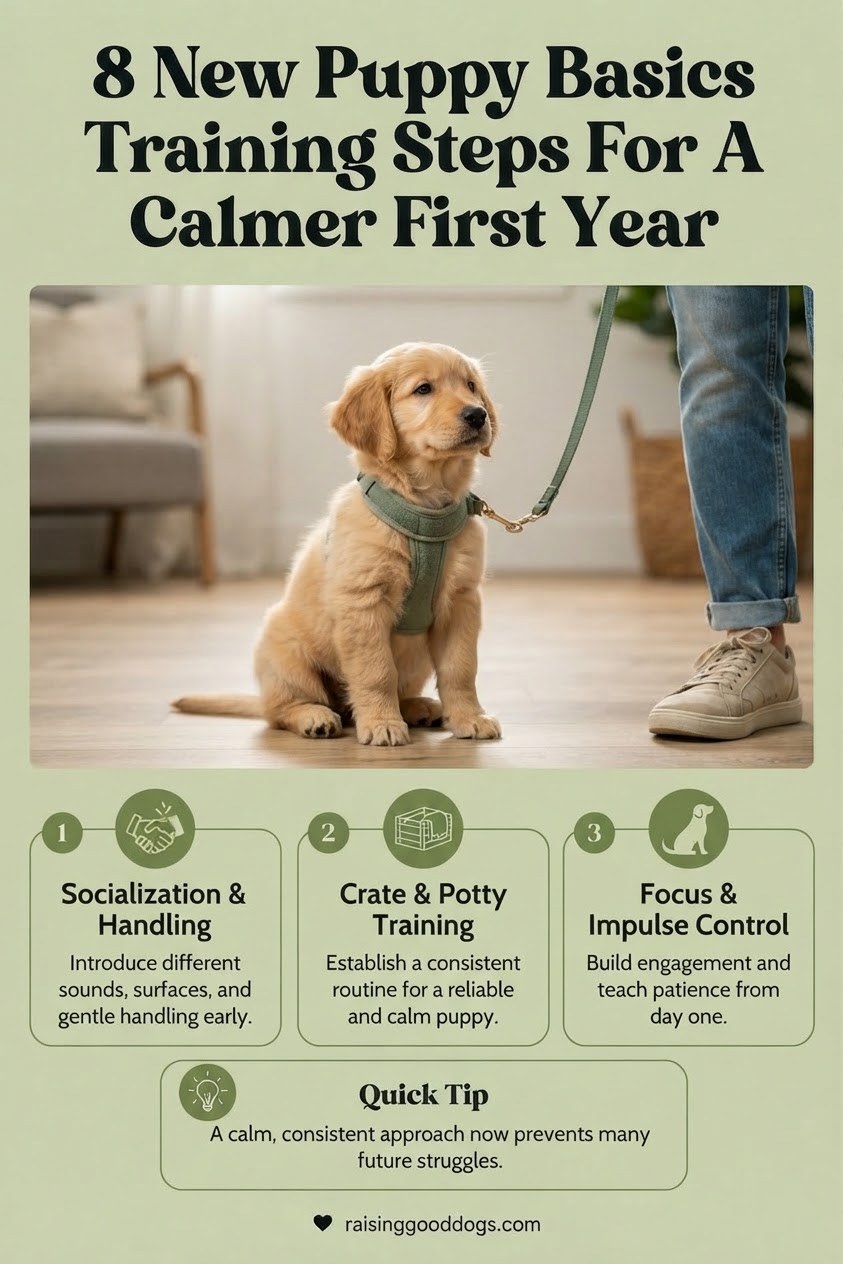
Leash & Harness Basics
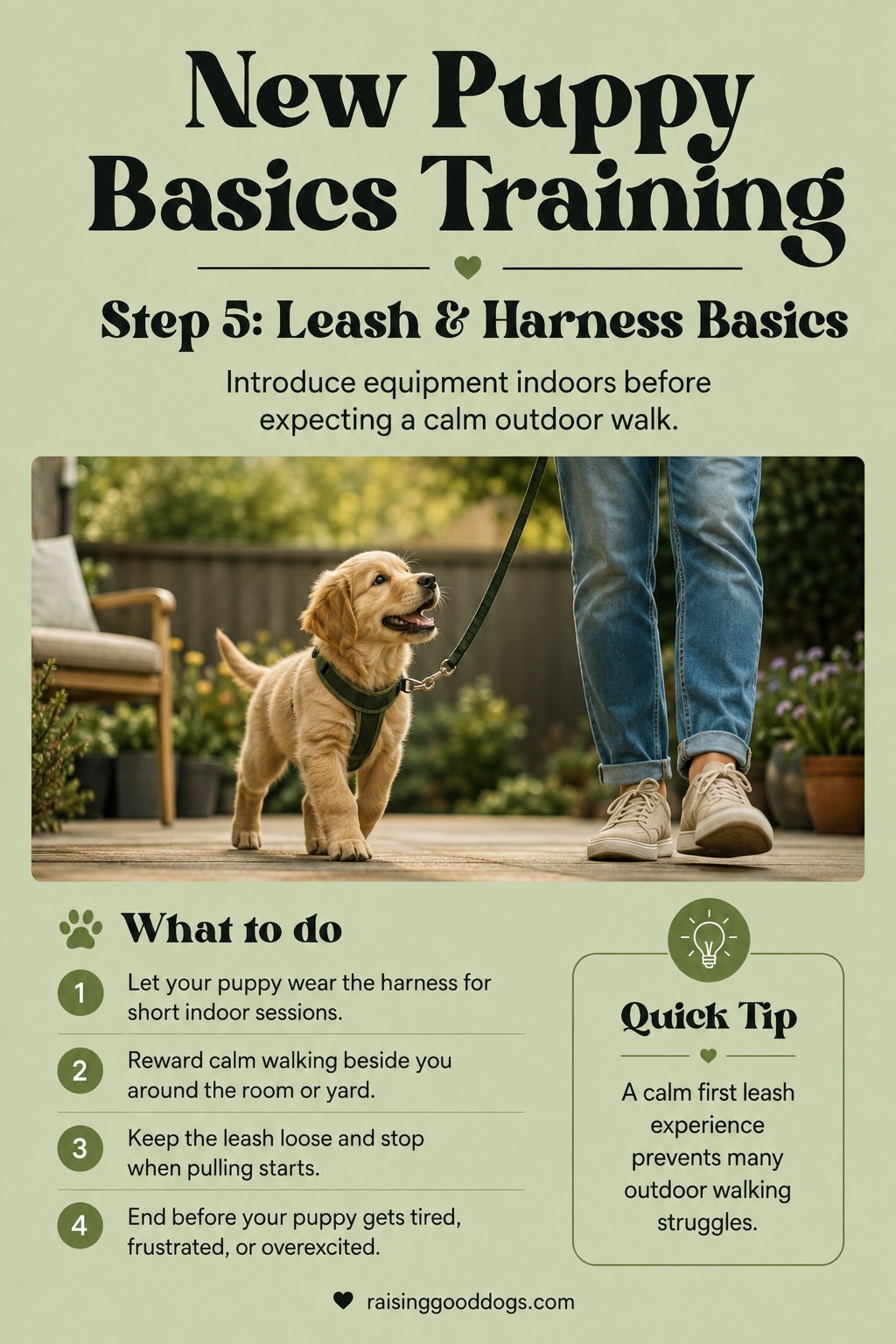
Most of the leash problems I see in adult dogs were built in the first two weeks of ownership, indoors, by accident — a puppy learns that pulling gets it where it wants to go, and that reinforcement history is brutal to undo later.
Start the equipment relationship somewhere boring:
- Let your puppy wear the harness for short sessions indoors, with treats, before it means anything.
- Reward calm walking beside you around the room or yard — no destination, no pressure.
- Stop moving the instant the leash tightens; only continue once it's slack again.
- End before your puppy is tired, frustrated, or wound up.
A well-fitted front-clip harness reduces pulling mechanics without any discomfort involved — I don't use or recommend anything that works by pinch or startle, on a puppy or otherwise. The first real outdoor walks will be slow. That's correct, not a sign you're doing it wrong.
Bite Inhibition & Structured Play
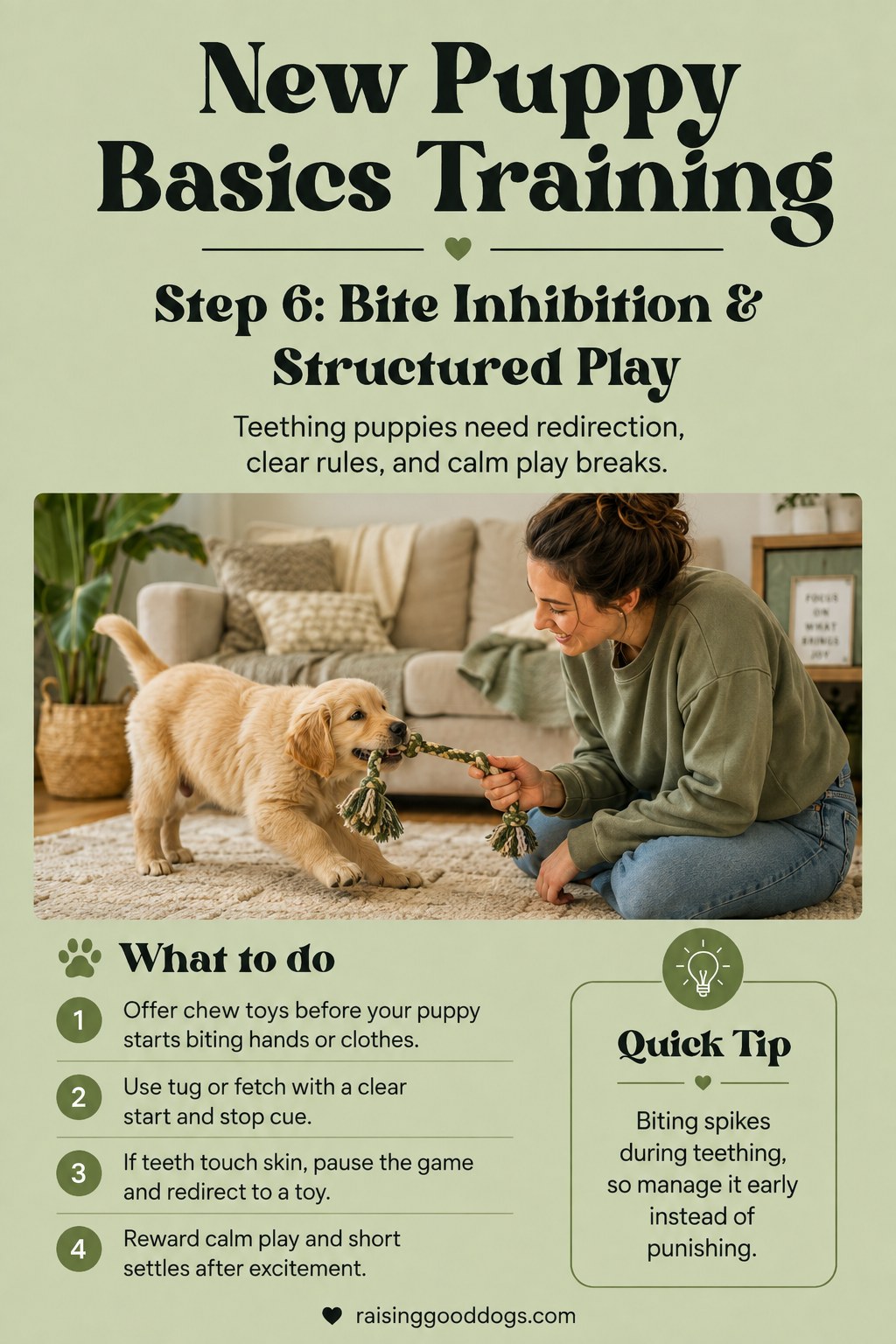
Puppy biting is developmentally normal, not aggression, and it is never something to punish — teething, overstimulation, and a mouth that's still figuring out pressure are the whole story, almost every time.
- Offer the toy first — before hands or sleeves become the default target.
- Give tug and fetch a clear start and stop cue so your puppy learns games have edges.
- Pause the instant teeth touch skin, redirect to a toy, and resume once calm — no yelling, no scruffing.
- Reward the settle after excitement, not just the play itself.
Biting spikes hardest during teething, usually between four and six months, and it passes faster when it's managed calmly and consistently rather than punished — punishment tends to teach a puppy to bite faster and with less warning, which is the opposite of what anyone wants.
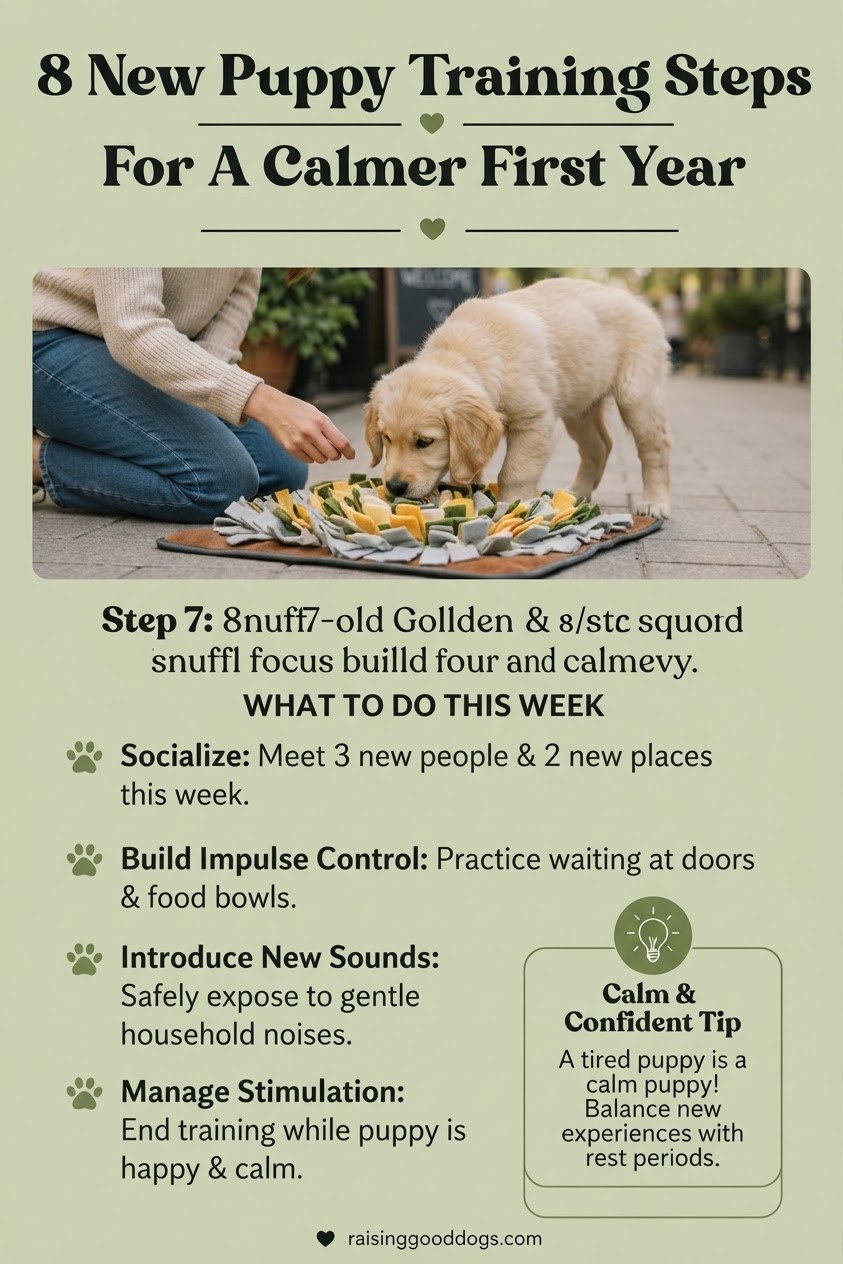
Socialization & Impulse Control
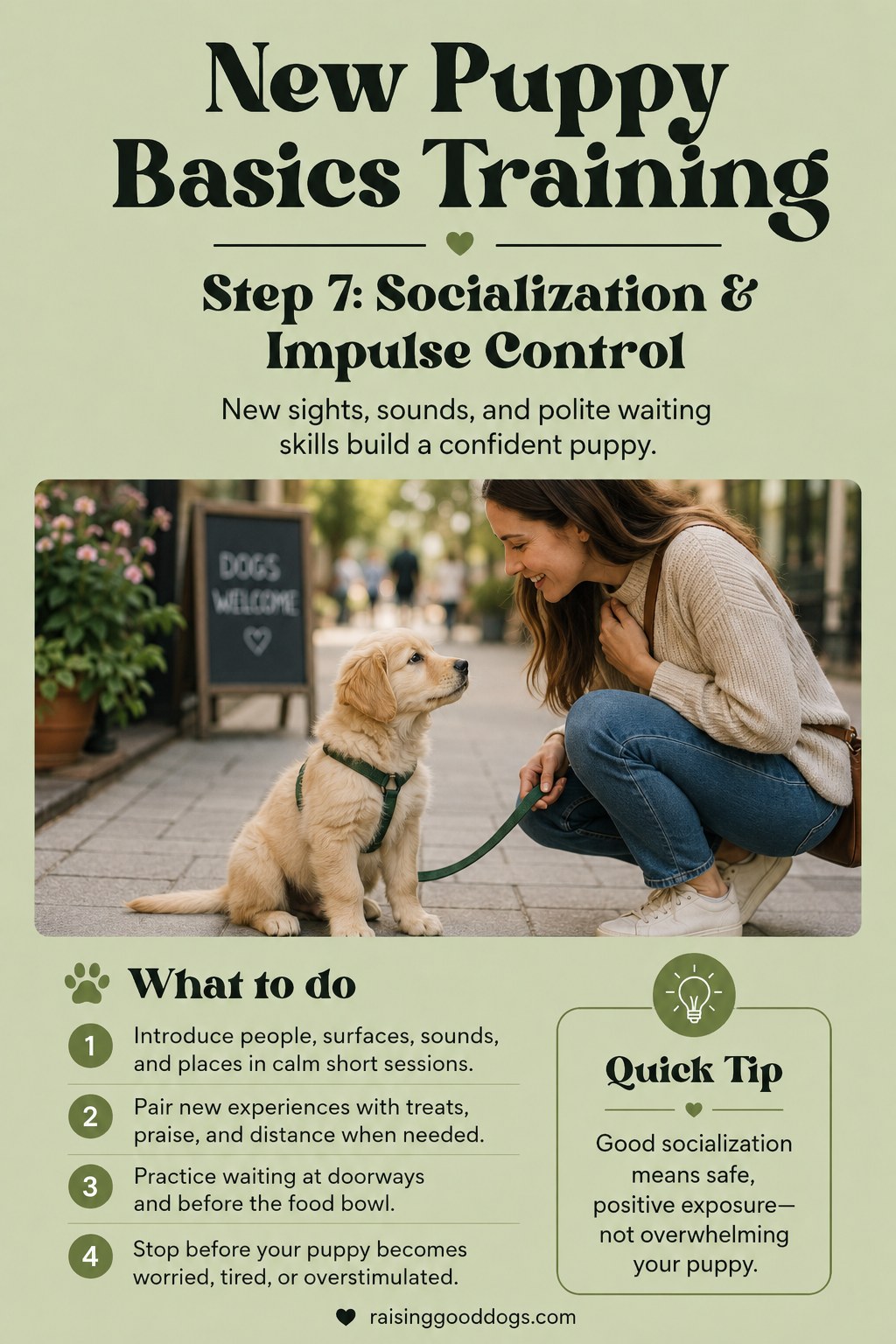
The sensitive period — roughly three to fourteen weeks — is a genuine window, but I want to correct the most common misunderstanding I hear from new owners: good socialisation is quality over quantity, not a checklist of forced encounters. I spent six years in a vet clinic watching what happens on the other end of this — dogs surrendered as adults for fear and reactivity that traced straight back to being overwhelmed as puppies, not under-exposed.
- Short, calm introductions to new people, surfaces, sounds, and places.
- Treats, praise, and distance paired with anything new or uncertain.
- Practice waiting politely at doorways and before the food bowl.
- Stop the moment your puppy looks worried, tired, or overstimulated.
Check vaccination timing with your own vet before public spaces with unknown dogs — that guidance is theirs to give, not mine.
Recall & Leave It
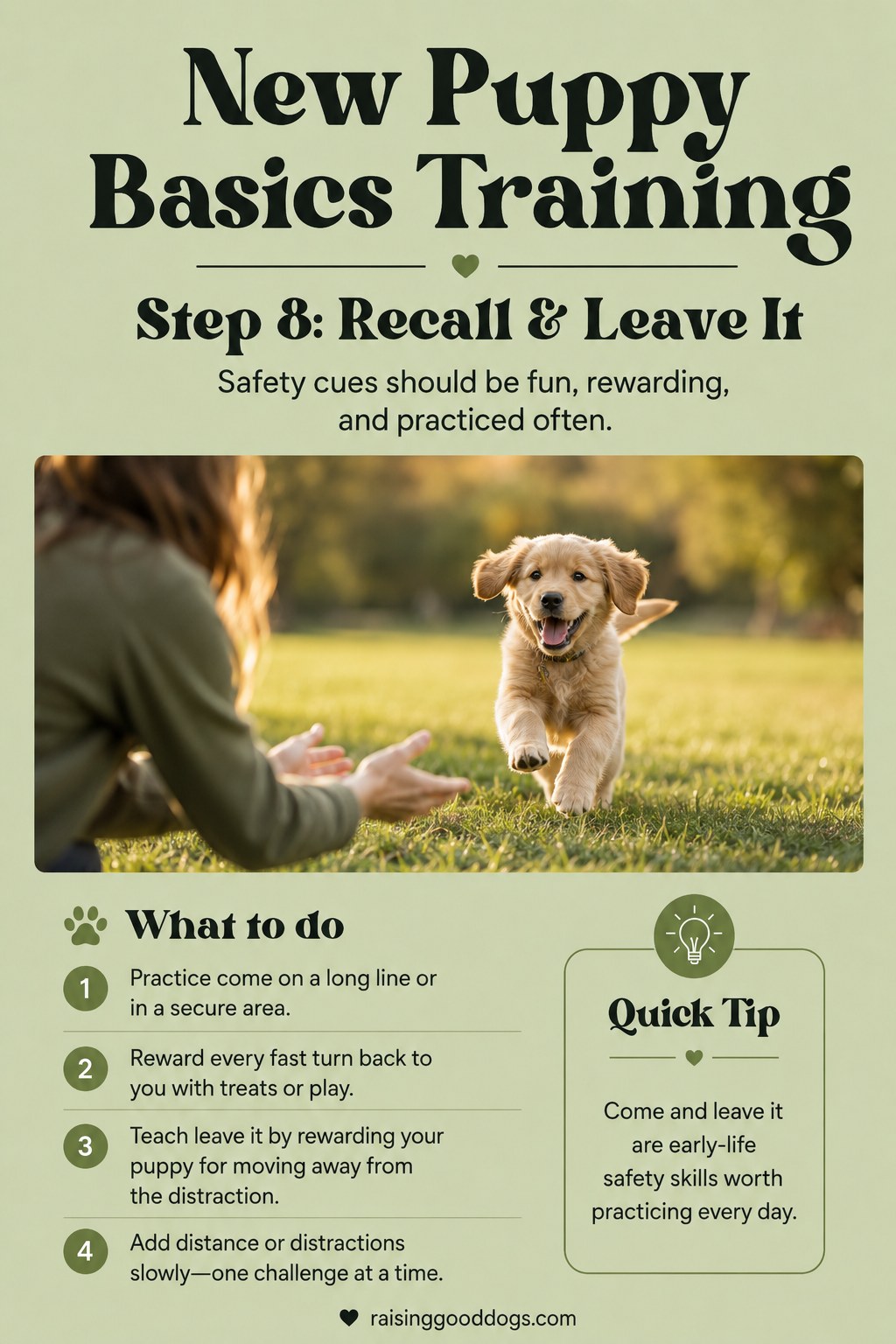
These two cues are safety skills, and I teach them the same way I'd teach anything else I want a dog to do reliably under pressure — heavily rewarded, low-drama, practiced constantly in easy conditions.
- Practice 'come' on a long line or in a securely fenced area, never off-leash before it's earned.
- Reward every single fast turn back to you — treats, play, genuine enthusiasm.
- Teach 'leave it' by rewarding the moment your puppy moves away from the tempting thing, not by snatching it away.
- Increase distance or distraction slowly, one variable at a time.
Never call your puppy to you for anything unpleasant — a bath, a nail trim, the end of the park — that's how a recall gets poisoned before it's even finished forming, and it's one of the hardest things to rebuild later.
None of this needs to happen in a week, and it won't happen in a straight line — there will be a good Tuesday followed by a rough Wednesday, and that's just what a developing brain looks like from the outside. Build the routine, protect the wins, and the rest tends to follow at its own pace.





Common Questions
How long should puppy training sessions actually be?
Three to five minutes at a time is realistic for most puppies. Several short sessions across the day beat one long one every time, and always end while your puppy is still succeeding.
Is my puppy's biting a sign of aggression?
Almost never. Teething and overstimulation drive the vast majority of puppy biting. Redirect to a toy and manage overtiredness rather than punishing it — punishment tends to make bite pressure less predictable, not more.
When can I start socialising my puppy?
The sensitive period runs roughly from three to fourteen weeks, but talk to your own vet about vaccination timing before public spaces with unfamiliar dogs. Calm, controlled exposure matters far more than volume of outings.
What if my puppy panics in the crate instead of settling?
Treat that as information, not stubbornness. Shorten sessions, build the positive association more slowly, and consider an exercise pen if the crate genuinely isn't working for this particular puppy.